



In our previous blogs we covered how AI works in promotional claims processing and why Opia takes a purpose-led approach to deploying it. This blog goes one level deeper.
It covers how AI is actually embedded across our operations today: where it runs, who works with it, and what guardrails govern it. For brands evaluating a promotional partner, this is the part that matters most.
Key Takeaways
- The Rapid Rewards platform uses AI-assisted pre-configuration to deploy campaigns across multiple markets and languages significantly faster than manual builds
- Every function at Opia works with AI day to day, from operations and product to QA and commercial teams
- Governance guardrails, including structured decision frameworks, model-agnostic architecture, and human oversight, are built into deployment from the start, not added afterwards
- Some widely discussed AI applications, including AI-powered fraud detection, are still being evaluated against cost and performance benchmarks before Opia commits to full deployment
The Three Layers of AI Deployment at Opia
AI at Opia is not a single system. It is deployed across three complementary layers, each with a clear role in how promotions are delivered.
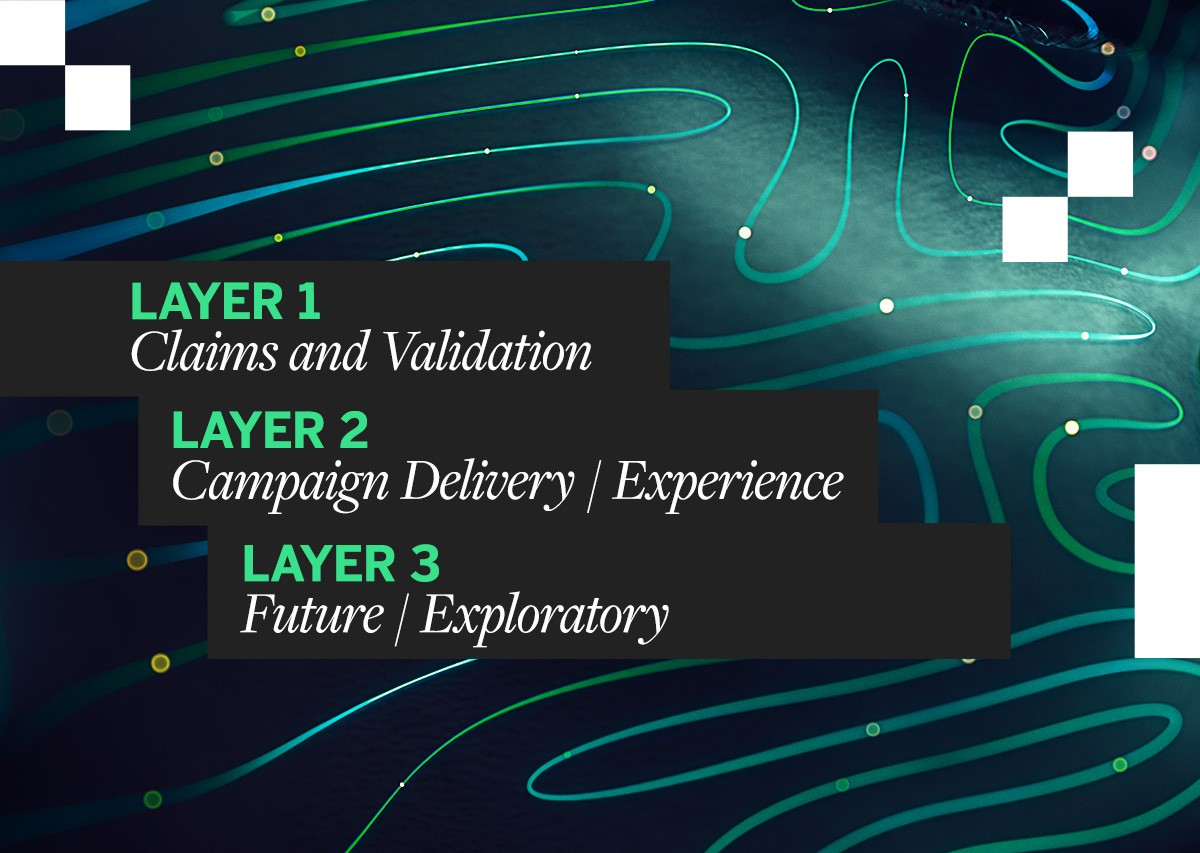
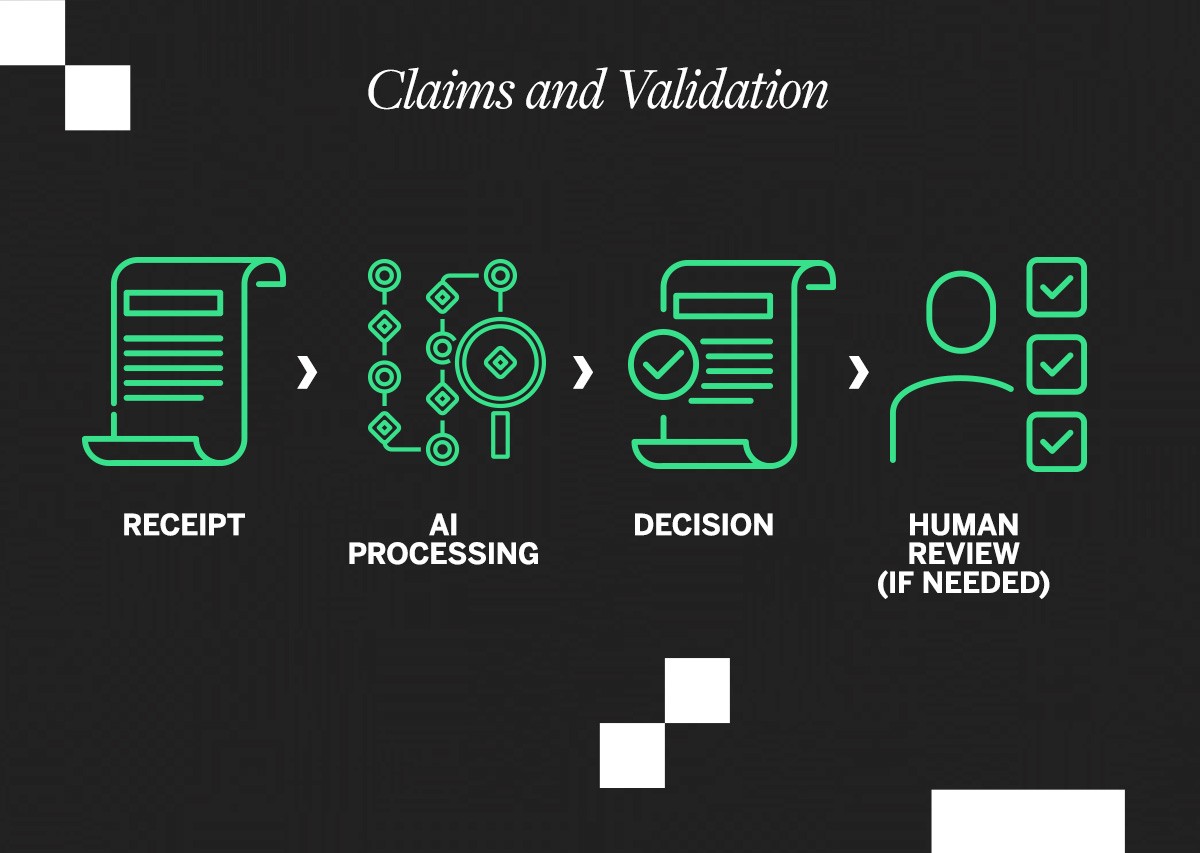
Layer 1: AI for Claims and Validation
This is where our AI deployment is most established. The technical detail of how our engine processes receipts, validates eligibility, and handles image-based proofs is covered in depth in our guide to promotional claims process automation.
For the purposes of this blog: our in-house AI engine processes claims at scale using large language models and image recognition, achieving automation rates above 80% on average across campaigns, with some exceeding 90% depending on claim complexity and volume.
Claims that fall outside clear thresholds, whether due to ambiguity, missing data, or fraud signals, are automatically escalated to human review. The ratio of automated to human-reviewed claims shifts based on campaign type, risk profile, and client requirements.
Layer 2: AI for Multi-Market Campaign Delivery
AI is playing an increasingly central role in how we localise and prepare promotional campaigns for launch across global markets.
Our Rapid Rewards platform now comes pre-configured with the core mechanics behind some of the most popular promotion types, including but not limited to cashback, gift with purchase, trade-in, buy and try, prize draw, and reliability guaranteed programmes. This means campaigns are now largely built and translated before launch, with localised content then refined by our team for tone, messaging, and market-specific requirements.
By leveraging AI-powered translation alongside professional linguistic review, we have been able to reduce translation timelines from a seven-week lead time to just one, helping brands launch faster across multiple markets while maintaining a consistent client tone and customer experience worldwide.

Layer 3: Emerging Capabilities
AI is evolving rapidly. So is our understanding of where it adds genuine value versus where it sounds better in theory than it performs in practice.
Customer Service and Communications
Our customer service team has moved this from pilot into live deployment, currently running across a handful of campaigns, with a wider rollout planned before the end of the year.
The application goes far beyond simple claim summaries. It uses AI to:
- Capture customer sentiment
- Measure satisfaction
- Identify pain points in the customer journey
- Support translated customer communications
It can even rewrite messaging to align with a client’s tone of voice or Opia’s best-practice customer language for specific situations, delivering not only time saving but also a more positive customer experience every time.
Alongside this, we’ve worked with our contact centre software provider to deploy AI-powered email handling in two ways: an AI translator that automatically translates incoming emails into English for our agents and translates responses back into the customer’s original language, and an AI rewriter that drafts responses from a prompt, with tone adjustable to detailed, succinct, professional, or friendly depending on the situation.
Fraud Detection
This is an example where honest assessment matters more than a confident claim. A couple of years ago, we evaluated AI-powered fraud detection tools, benchmarking them against our existing expert human team. The AI tool identified a marginally higher volume of forged documents, but the gains were too marginal to justify the cost of bringing in a third-party service on top of the high-performing fraud capability we already have in-house, backed by a small, experienced team.
We continue to monitor this space as models and pricing evolve, and will revisit the decision if the value case changes.
Reporting
We’re also in the early stages of using AI to automate elements of campaign reporting, surfacing insights automatically rather than purely through manual analysis. This is an area we expect to say more about as it matures.

How Teams Actually Use AI Internally
One of the clearest signals of genuine AI integration is not what the technology does but who works with it. At Opia, AI is part of daily operations across functions, not confined to a single team.
- Operations teams have evolved into prompt engineers, refining validation instructions and handling the edge cases that fall outside automated thresholds
- Technology teams manage model selection, integrations, and performance monitoring
- Product teams define the decision logic and eligibility rules the AI applies
- QA and compliance teams run accuracy audits and spot checks to ensure consistency and fairness across claim types
- Commercial teams use AI-supported campaign data to identify performance patterns and inform future campaign design, including AI plug-ins within Excel used both to build economic models and to analyse complex data sets, augmented with third-party data through prompting
This cross-functional use is what distinguishes embedded AI from a bolt-on tool. The system improves continuously because every team that works with it contributes to its refinement.
Our Deployment Guardrails
Operating AI at scale in a commercial and regulated environment requires explicit controls. Ours are built into the deployment model from the start, not added in response to problems.
Structured Decision Frameworks
AI outputs in claim validation are designed to return clear, consistent, binary decisions: approve, reject, or escalate. This structure reduces ambiguity, makes every decision auditable, and prevents the kind of open-ended AI outputs that create compliance risk.
Model-Agnostic Architecture
As covered in our blog on AI innovation at Opia, we are not tied to any single AI provider. This protects clients from disruption when models are deprecated or significantly updated, and allows us to adopt better-performing models as they become available without rebuilding the platform.
Data Protection, Privacy, and Regulatory Compliance
All AI processes align with UK GDPR, the California Privacy Act, ISO standards, and enterprise-grade governance frameworks, with lawful use, transparency, and safeguards built into how AI-informed decisions are made. We monitor evolving guidance from regulators including the ICO and CNIL, and track the broader regulatory landscape as it develops, including the EU AI Act, UK governance approach, and FTC consumer protection rules in the US.
In public-sector work, deployment is governed collaboratively with clients and aligned to sector-specific frameworks, including public tender requirements and NHS standards where relevant. As regulation in this space continues to evolve, our approach is adaptive rather than fixed to a single compliance snapshot.
Security, IP, and Third-Party Risk
Operating AI at scale introduces risks beyond data protection alone. We manage cyber risk, including data leakage and model-targeted attacks, and take IP and copyright considerations seriously when working with generative AI outputs. Vendor and supply chain compliance, covering data handling, hosting, and cyber security, is assessed against ISO frameworks and recognised security standards before any third-party AI tool is adopted.
Governance and Accountability
AI governance policies and guardrails are documented and maintained on an ongoing basis, with human oversight and periodic audits built into how the system is monitored. Every deployment also respects client-specific contractual obligations, confidentiality requirements, and competitive sensitivities, since what is appropriate to disclose or automate can vary significantly from one client relationship to another.
Human Oversight as a Design Principle
Human review is not a fallback for when automation fails. It is built into the process design for ambiguous, sensitive, or high-stakes cases. The threshold between automated and human review is configurable based on campaign type, risk profile, and client requirements.
What This Means for Clients
The practical benefit of this model is that clients do not need to manage AI risk themselves. Governance, validation, and oversight are built into the service.
In practice this means faster campaign launches across markets, consistent claim handling regardless of volume or promotion type, and richer campaign data captured through every validated claim. It also means the promotional mechanics available to clients can be more ambitious, because the operational infrastructure to support them reliably already exists.
Conclusion
AI at Opia is operational, not aspirational. It runs across claims validation, multi-market campaign deployment, and internal team workflows today, with further capabilities in active development and honest evaluation.
What makes the model work is not the technology itself but the discipline around it: deploying where there is measurable value, maintaining human oversight where it matters, and being willing to say clearly where AI does not yet justify its cost.
For brands running promotional campaigns at scale, that combination of capability and transparency is what responsible AI deployment looks like in practice.

How does Opia use AI in claim validation?
Our AI engine processes receipts, validates eligibility, and handles image-based evidence, achieving automation rates above 80% on average while routing unclear or high-risk cases to human review. Full detail is in our claims automation guide.
How does AI support multi-market campaign delivery?
Our Rapid Rewards platform is pre-configured with core promotional mechanics. AI-assisted translation then pre-configures campaign content across languages, reducing the manual build work per market to campaign-specific customisation only.
Does AI replace human teams at Opia?
No. Human oversight is built into every deployment. Automation handles volume and consistency. People handle complexity, exceptions, edge cases, and the continuous refinement that makes the system more accurate over time.
Does Opia use AI for fraud detection?
We evaluated AI-powered fraud detection tools and found that our expert human team performed comparably at significantly lower cost. We are actively reassessing this as models and pricing evolve, and will deploy AI in this area when it demonstrably justifies the investment.
How does Opia manage AI risk?
Through structured decision frameworks that produce auditable binary outputs, a model-agnostic architecture that prevents dependency on any single provider, GDPR and CCPA-aligned data practices, security and vendor risk assessment against ISO standards, and human review built into the process for all ambiguous or sensitive cases.