



A promotion team watches Black Friday claims taper off through early December and assumes peak is over. Then, weeks later, on Christmas Day itself, claims spike again, gifted devices get unwrapped and recipients scan the QR code on the packaging right then. That second surge catches most teams by surprise, because most planning stops at the weekend Black Friday is named after.
That’s one symptom of a bigger problem: brand teams discount because everyone else does, and run the same offer in every market regardless of how different Black Friday actually is from one to the next. This guide, written for brands that sell through retailers and run their own funded promotions, cashback, gift with purchase, trade-in, not retailers running site-wide discounts, is about closing that gap: choosing the right mechanic is only half the decision, sizing it for the real shape of peak is the other half.
Key Takeaways
- Peak isn’t a weekend anymore, it’s a season running from September/October launches through December, with a second claims spike on Christmas Day itself
- Black Friday’s importance varies sharply by market, major in the US, smaller in the UK, secondary to France’s January and June sales seasons
- A straight discount is the most expensive lever available, it cuts margin on every unit sold, not just the incremental ones a promotion is meant to win
- Judge success on incremental margin, not total revenue, which seasonal demand drives regardless of the mechanic running
Why Black Friday Pulls Brands Toward Discounting
At peak, the pull toward discounting is real and specific. Competitors are visibly cutting prices, retailers push for sharper deals to stay competitive on comparison sites, and a brand that holds its price can look expensive by comparison, even when nothing about the product has actually changed.
But a straight discount is the most expensive lever available, precisely because it’s blunt. It cuts margin on every unit sold, including the ones a brand would have sold anyway, not just the incremental sales a promotion is actually meant to win.
Which Mechanics Fit Peak, and Why
Cashback and gift with purchase both protect headline price in a way a straight discount can’t, the shelf price never moves, so there’s no new low for customers to anchor against once the promotion ends. That matters more at peak, not less, since this is exactly when competitors are discounting hardest and price integrity is most under pressure.
Trade-in promotions work differently, and particularly well when it’s timed to a flagship launch rather than run as a generic, year-round offer. The customer’s incentive to upgrade already exists, a trade-in simply converts it into a sale with the brand instead of a private resale site, which matters at peak specifically because so many flagship launches land in the September and October window right before it.
The Real Shape of Peak
Once a mechanic is chosen, most promotions are still sized for a Black Friday that doesn’t actually exist, one weekend, one set of rules, everywhere. The real shape of peak is different on two separate axes.
It’s a season, not a day, with two separate spikes
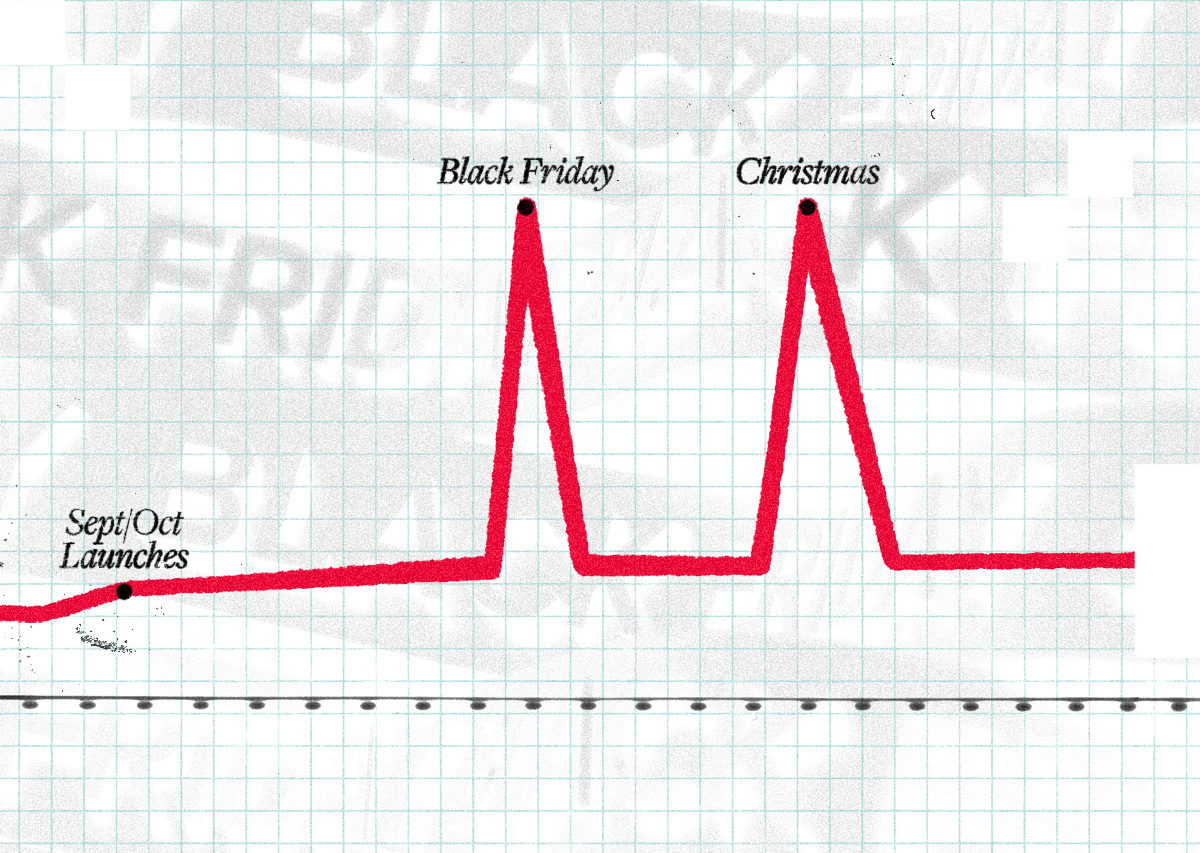
The old pattern, a sharp concentration narrowly on Black Friday and Cyber Monday, has shifted. Peak now behaves more like an extended season: offers running continuously from flagship launches in September and October straight through December, rather than one concentrated weekend.
A second, distinct peak follows weeks later: claims spike again on Christmas Day itself, when a device bought as a gift is unwrapped and the recipient scans the promotional QR code on the packaging right then. Teams that plan capacity for one surge are routinely caught by the second.
It’s wildly uneven by market, not global
Black Friday is a major retail event in the US and a meaningfully smaller one in the UK. In France, it’s often secondary to two distinct official sales seasons in January and June, which carry more commercial weight than Black Friday itself. A single global mechanic and timeline, run identically everywhere, is the wrong default.
Both of these are the same underlying mistake: planning for the assumed version of peak instead of the real one. Everything below, capacity, exposure caps, and the readiness checklist, is about closing that gap.
Our guide on launching a sales promotion across multiple markets covers how to structure one region to region instead of copy-pasting a single playbook everywhere.
Capping Over-Redemption Exposure at Peak
The same discipline that applies to any claim-based promotion matters more at peak volume, where the gap between a conservative forecast and an optimistic one is largest in absolute terms. Working with a partner who can model risk through Conditional Rebate Insurance, cover that applies once costs exceed an agreed level, removes the risk of an unexpectedly popular promotion overshooting budget.
A Peak-Readiness Checklist
The table below is a reasonable starting structure, not OPIA’s own standard checklist. Timing assumes a December-only campaign, trade-in, free trial, and markets with longer claim windows (commonly 90 days in the US) push reconciliation well past January.
| Timing | What to lock down |
|---|---|
| 8 weeks out | Mechanic finalised, budget and exposure cap agreed, legal review started in every market running the promotion |
| 6 weeks out | Claim journey tested end to end, fraud screening rules confirmed, support team briefed on expected volume and timing |
| 4 weeks out | Stock and fulfilment capacity confirmed against the claims forecast, including the gifting-driven spike around Christmas Day |
| 2 weeks out | Final QA on the claim site and any packaging QR codes, support scripts finalised |
| Launch through December | Daily monitoring of claim volume against forecast, fraud flags reviewed, support queue tracked |
| January | Final reconciliation and incremental margin reported, redemption rate calculated and included in post-campaign analysis where sales data is shared, learnings fed into next year’s planning |
Judging It Afterwards on Margin, Not Revenue
Revenue at peak is driven by many things beyond a promotion, seasonal demand alone moves volume regardless of what mechanic is running. The honest measure is incremental margin, what the promotion specifically added, not what the season would have delivered anyway. We cover the full method in How to Measure Sales Promotion ROI.
FAQs
Less than it used to be. Peak now behaves more like a season running from flagship launches in September and October through December, with a secondary claims spike on Christmas Day itself as gifted devices get unwrapped.
No. It’s a major event in the US, smaller in the UK, and in markets like France it often sits behind two official sales seasons in January and June.
Sizing the promotion for the Black Friday they assume exists, one weekend, one global rule set, rather than the one that actually happens, a multi-week season with two separate claims spikes and sharply different importance by market.
On incremental margin, the profit is specifically attributable to the promotion, not on total revenue, which seasonal demand drives regardless of the mechanic running.