



Most brands reach for a discount when they need to drive sales. It is the fastest lever to pull and the easiest to measure. The problem is that discounting is also one of the most expensive habits a brand can develop, not just in terms of margin, but in terms of how customers come to see your product and what they are willing to pay for it over time.
The good news is that discounting is not the only way to run an effective sales promotion. There is a whole category of promotional mechanics that drive conversion, build loyalty, and generate first-party customer data without reducing the price your customers pay at the shelf.
This guide covers how those mechanics work, when to use each one, and how to build a commercial case for them internally.
Key Takeaways
- Discounting protects short-term volume but erodes long-term brand value and trains customers to wait for the next sale
- Non-discount promotions deliver value to the customer without reducing the shelf price, protecting both margin and brand positioning
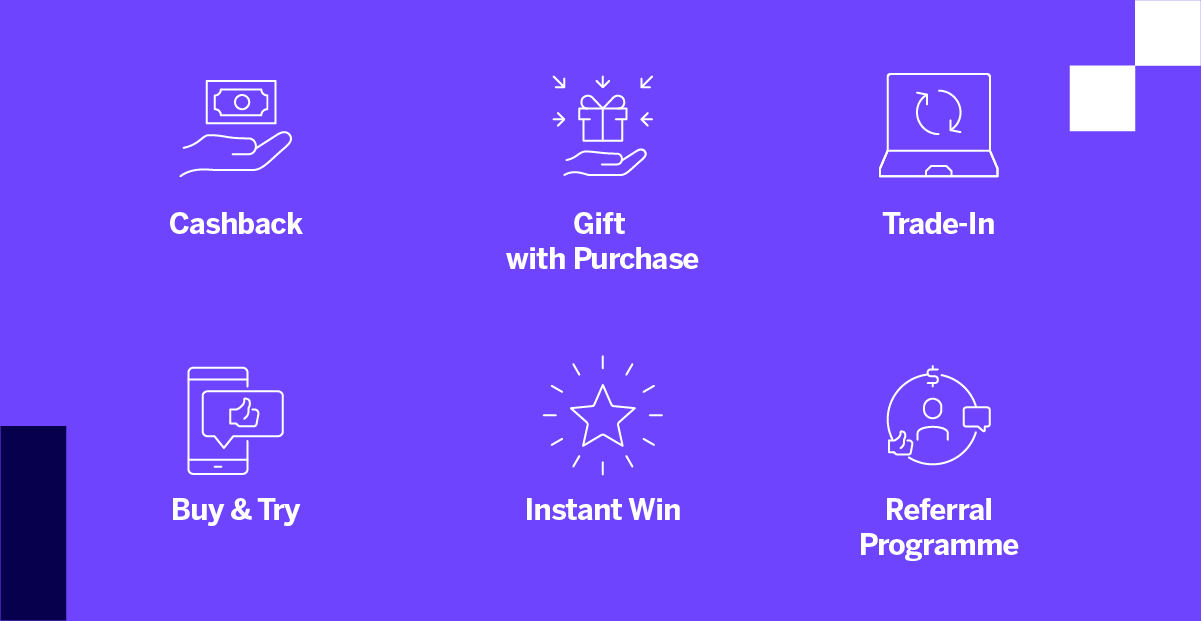
- The main mechanics are cashback, gift with purchase, trade-in, buy and try, instant win, and referral programmes
- Each mechanic suits a different commercial objective. The right choice depends on your goal, your product price point, and your risk appetite
- Fixed-fee promotional models remove open-ended financial exposure, making non-discount promotions easier to budget and easier to approve
- Post-purchase mechanics generate first-party customer data through the claim process, something a point-of-sale discount never produces
Why Discounting Is a Short-Term Fix With Long-Term Costs
Discounting works. That is the problem. Because it produces an immediate, measurable sales lift, it becomes the default response every time volume is soft or a campaign needs momentum. Over time this creates a set of commercial problems that are hard to reverse.
Price erosion
Every time you discount, you set a new reference price in the customer’s mind. Research consistently shows that customers anchor to the lowest price they have seen for a product. Once they have bought at £200, paying £250 feels like overpaying, even if £250 is the fair market price. Frequent discounting gradually undermines the perceived value of your product.
Training buyers to wait
Brands that discount on a predictable cycle, quarterly peaks, Black Friday, end of range, create a customer base that learns to wait. Sales data from brands with established discount patterns shows a consistent drop in purchase activity between promotional periods and a spike when discounts arrive. This makes revenue unpredictable and cash flow difficult to manage, particularly when you need to fund stock or invest in growth ahead of a campaign.
Margin compression
A 20% discount on a product with a 25% gross margin, roughly the higher end of what’s typical in consumer electronics today, takes an 80% bite out of your profit, not the 20% the headline discount suggests.
At the lower end of that range, around 15% margin, the same discount pushes you into a loss on every unit sold. At scale, the cumulative margin impact of promotional discounting is one of the least visible but most significant drains on a P&L. For a detailed look at how to calculate the true cost of a promotional campaign, see our guide to sales promotion ROI.
Channel conflict
For brands selling through multiple retail partners, discounting in one channel creates pressure on every other channel. If a product is available at 20% off through one retailer, other partners either demand the same terms or lose sales. This is one of the reasons MAP (Minimum Advertised Price) policies exist, and it is also why non-discount mechanics are particularly valuable for brands with complex distribution.
What a Non-Discount Promotion Actually Looks Like
A non-discount promotion delivers value to the customer without reducing the price they pay at point of sale. The core principle is simple: instead of making the product cheaper, you make the purchase more valuable.
This distinction matters commercially. When a customer buys at full price and receives a reward, you retain the shelf price, you protect your positioning with retail partners, and you generate a claim record that tells you exactly who bought, when, and on what product. A point-of-sale discount produces none of this.
Non-discount promotions also give you more control over who receives the benefit. A price reduction at the shelf goes to every buyer equally, including customers who would have paid full price without any incentive. A post-purchase mechanic can be targeted, time-limited, and structured so that the cost per redemption is predictable before the campaign launches.
For a broader comparison of how these approaches differ commercially, see our guide on discounts vs sales promotions vs offers.
Six Proven Mechanics for Promoting Without Discounting
1. Cashback Promotions
The customer pays the full shelf price and receives a cash reward after submitting a valid claim. The reward is delivered via digital prepaid card, bank transfer, or check, typically within a few days of claim validation.
Cashback is the most commercially versatile non-discount mechanic. It works across most product categories, is easy for customers to understand, and delivers a clear, tangible value that influences purchase decisions. Because the reward is paid post-purchase through a managed claim process, you only pay for customers who actually bought and claimed, and you capture their data in the process.
Opia built a tiered cashback campaign for Dell, offering up to €200 on its XPS and Alienware ranges during back-to-school and Black Friday. Sales grew 25% without a single price cut. Read the case study.
Learn more: Cashback Promotions: What They Are and How They Work
2. Gift with Purchase
The customer buys a qualifying product and receives an additional item or service at no extra cost. The gift can be a physical product, a digital reward such as streaming credit or a gift card, a service such as extended warranty or installation, or a lifestyle reward such as a fuel card. Gift with purchase is particularly effective when the gift is desirable relative to the purchase.
The choice of gift matters. It should be relevant to the customer’s context, complementary to the product they are buying, and perceived as high value relative to its actual cost to you. A gift that feels cheap or unrelated reduces the effectiveness of the promotion even if the headline value is significant.
Opia created a joint promotion for LG and Sky, bundling a discounted Sky Q subscription with LG TV purchases. The campaign exceeded every target and led to a three-year partnership. Read the case study.
Learn more: Gift with Purchase Promotions Guide
3. Trade-In Promotions
The customer exchanges an old or used product in return for a reward, typically credit toward a new purchase or a cash reward. The customer pays full price for the new product and receives the trade-in value through a separate post-purchase process.
Trade-in promotions are particularly powerful for consumer electronics, automotive accessories, and any category where upgrade cycles matter. They create a clear commercial reason to upgrade now rather than later, they support sustainability goals by managing end-of-life product responsibly, and they give you detailed data on the existing product landscape in your customer base.
Opia designed a £150 trade-in rebate for Intel and Dixons Retail to launch Ultrabooks. Sales grew more than tenfold within six weeks. Read the case study.
Learn more: Trade-In Promotions Guide
4. Buy and Try (Satisfaction Guarantee)
The customer buys the product at full price and has a defined window to return it for a full refund if they are not satisfied. Unlike a standard returns policy, a buy and try promotion is actively marketed as the central value proposition of the campaign.
Buy and try is most effective for premium or new-to-market products where purchase hesitation is driven by uncertainty rather than price sensitivity. Removing the financial risk of a bad purchase decision unlocks buyers who would otherwise wait for reviews, try a competitor’s product first, or simply defer the purchase indefinitely. The promotional risk here is redemption rate: if a high proportion of customers return the product, the effective cost is significant.
Opia ran a 60-day Buy and Try trial for Samsung to remove hesitation around its first foldable phones. 95% of participants said it encouraged them to switch brands, try something new, or buy sooner. Read the case study.
A fixed-fee promotional risk model can cap this exposure before launch.
5. Instant Win
Customers who make a qualifying purchase receive a chance to win a prize. The prize can be revealed immediately at point of sale or through a post-purchase digital entry. Only a subset of participants win, which means the total cost of the promotion is a fraction of what a universal discount would cost while still creating engagement and excitement around the campaign.
Instant win is effective when your primary goal is campaign awareness and engagement rather than pure conversion volume. It is particularly well suited to product launches, seasonal campaigns, and situations where you want to generate buzz and dwell time around a product without committing to a universal reward.
The key design consideration is the prize: it needs to be desirable relative to the purchase to drive engagement, but the probability of winning should be communicated clearly to maintain trust.
6. Referral and Reward Programs
Existing customers are rewarded for introducing new customers to your brand. The referrer receives a reward when their referee makes a qualifying purchase. Both parties can be rewarded, which increases the likelihood of the referral being shared.
Referral programmes are one of the most cost-efficient customer acquisition mechanics available. The cost per acquired customer is typically a fraction of paid media acquisition costs, and referred customers tend to have higher lifetime value and lower churn than customers acquired through advertising.
For brands with an established customer base, a well-structured referral programme is often the highest-ROI promotional investment available. The challenge is making the reward compelling enough to motivate the referral without it feeling transactional.
Learn more: Guide to Customer Referral Programmes
Comparison: Which Mechanic Is Right for You?
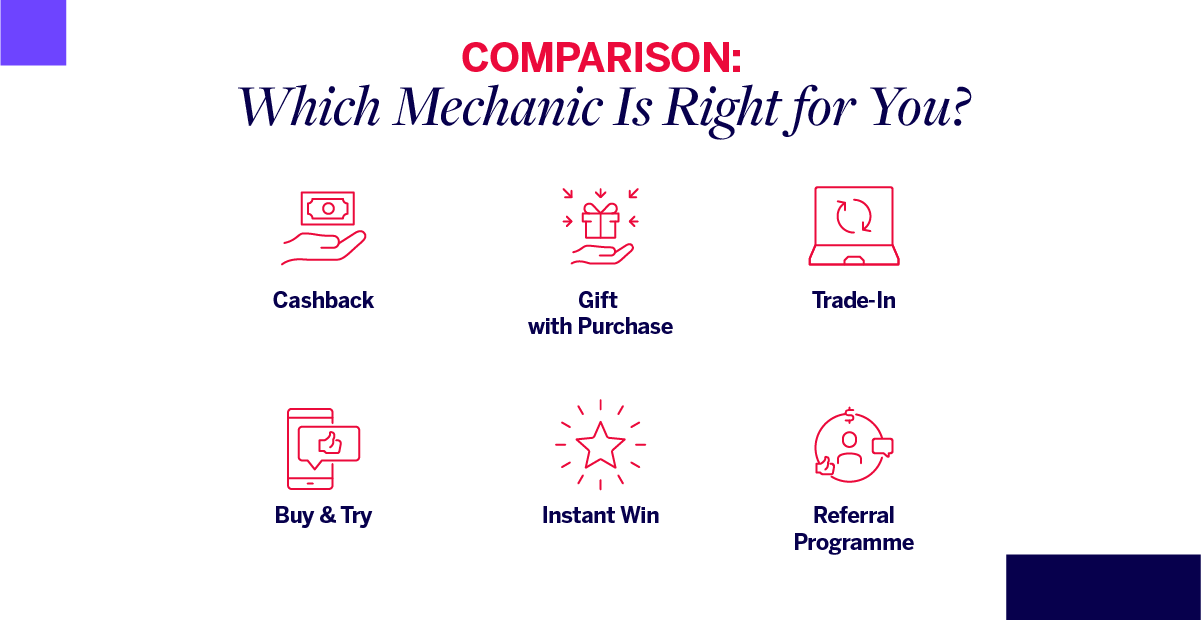
The right non-discount mechanic depends on what you are trying to achieve, not just what sounds appealing. Here is how the main options compare across the dimensions that matter most commercially.
| Mechanic | Best For | Price Impact | Data Capture | Complexity |
| Cashback | Driving conversion on higher-priced items | None. Full shelf price maintained | High. First-party data via claim | Low |
| Gift with Purchase | Increasing perceived value, launching new products | None. Shelf price intact | High. Claim process captures data | Medium |
| Trade-In | Driving upgrades, sustainability goals | None. Full price paid upfront | High. Trade-in data very valuable | High |
| Buy and Try | Removing hesitation on premium or new products | None. Risk is on the brand not price | Medium | Medium / High |
| Instant Win | Driving engagement and campaign buzz | None. Only winners receive reward | Medium | Low |
| Referral Programme | Lower-cost customer acquisition | None. Reward is for referring, not buying | High. Referral data very actionable | Medium |
A few practical decision rules:
- If your goal is immediate conversion on a high-value product, start with cashback. It is the most direct non-discount equivalent to a price reduction
- If your goal is to increase average order value or launch a new product, gift with purchase is typically the strongest mechanic
- If your goal is to drive upgrades in a category with established ownership, trade-in gives you the strongest commercial argument
- If your goal is acquisition at lower cost than paid media, referral is usually the most efficient option
- If your goal is engagement and campaign buzz alongside sales, instant win adds a layer of excitement that the other mechanics do not
For a structured approach to choosing and planning a promotional campaign, see our sales promotion planning guide.
How to Make the Case Internally
One of the practical challenges of moving away from discounting is the internal conversation. Finance teams understand discounts because the cost is visible and immediate. Non-discount promotions have a less obvious cost structure, which can make them harder to approve even when the commercial case is stronger.
Here is how to frame the argument.
Lead with margin protection
A cashback promotion on a product with a 20% gross margin costs a fraction of what a price reduction of the same apparent value costs. A £50 cashback on a £400 product costs £50 only if the customer claims. A £50 discount costs £50 on every unit sold, including to customers who would have paid full price without any incentive. The incremental cost of a non-discount promotion is almost always lower than the equivalent discount, even before accounting for the value of the data captured.
Show the redemption rate math
Not every customer who qualifies for a post-purchase reward will claim it. In well-run cashback and gift with purchase campaigns, redemption rates typically sit between 30% and 70% depending on the reward value, the claim process, and the product category. This means your effective cost per unit is significantly lower than the face value of the reward. A discount, by contrast, has a 100% redemption rate by definition.
Highlight the data advantage
Every validated claim in a post-purchase promotion produces a verified customer record: name, address, purchase date, retailer, product, and reward claimed. This data has commercial value well beyond the campaign itself. It feeds CRM, informs future campaigns, and builds a first-party data asset that a point-of-sale discount never produces.
Remove the financial risk with a fixed-fee model
One of the main objections to non-discount promotions is uncertainty around redemption cost. If you do not know how many customers will claim, you cannot predict the total campaign cost. A fixed-fee promotional model resolves this by capping the maximum liability before the campaign launches, regardless of redemption rate. This makes non-discount promotions as predictable as discounts in terms of budget, while retaining all their commercial advantages.
How Opia Can Help
Opia designs and manages non-discount promotional campaigns for some of the world’s leading consumer brands. From cashback and trade-in programmes to gift with purchase and referral mechanics, we handle the full campaign end-to-end: strategy, redemption website, claim validation, fraud prevention, fulfilment, and reporting.
Our fixed-fee pricing model means your maximum promotional liability is known before the campaign launches. Our AI-assisted claim validation means fraud is managed at scale. And our post-campaign reporting gives you the data you need to measure ROI accurately and plan the next campaign better.
If you are looking to move away from discounting and want to explore which mechanics fit your product, market, and commercial goals, get in touch with our team.
FAQs
What is a sales promotion without discounting?
A promotion that delivers value without lowering the shelf price. Instead of charging less, the brand adds something extra, cashback, a free gift, trade-in credit, or a prize, after purchase.
Is cashback the same as a discount?
No. A discount reduces the price at checkout. Cashback is paid after purchase, so the shelf price stays intact and only claiming customers receive the reward.
Why do brands avoid discounting?
It erodes the reference price customers expect to pay, trains them to wait for the next sale, and often costs more margin than it appears to.
What is the most effective alternative to discounting?
Cashback is the closest substitute for a price cut. Gift with purchase suits launches, trade-in drives upgrades, and referral programmes deliver the lowest cost per acquisition.
How do I know which non-discount mechanic to use?
Start with your objective, acquisition, retention, inventory clearance, or launch, then factor in price point and how much operational complexity you can manage.
How do I manage the financial risk of a non-discount promotion?
A fixed-fee model caps your cost per unit before launch, regardless of how many customers claim, making the total cost predictable.
Can I run a non-discount promotion across multiple retailers?
Yes. Since the shelf price stays the same everywhere, there’s no channel conflict, every retailer sells at one consistent price.