



Discounts vs Sales Promotions vs Offers: What Is the Difference?
Discounts, sales promotions, and offers are three of the most commonly used terms in marketing, and three of the most commonly confused. They are not interchangeable. Each one works differently, costs differently, and produces different commercial outcomes.
This guide explains the difference between all three, when to use each one, and which approach protects your margin while still driving the results you need.
Key Takeaways
- A discount is a direct price reduction at the point of sale. It is simple, immediate, and has a direct margin cost
- A sales promotion is a broader incentive mechanic such as cashback, trade-in, or gift with purchase, designed to drive a specific outcome without reducing shelf price
- An offer is a value proposition that packages one or more incentives into a single customer-facing message
- Discounts erode margin and can devalue your brand if used frequently. Sales promotions protect price positioning while delivering real customer value
- The right choice depends on your commercial objective, your audience, and the financial risk you are willing to carry
Discounts vs Sales Promotions vs Offers: Side-by-Side
| Discount | Sales Promotion | Offer | |
| What it is | A direct price reduction at point of sale | A broader incentive mechanic designed to drive a specific commercial outcome without reducing shelf price | A value proposition packaging one or more incentives into a single customer-facing message |
| When to use | Clearing inventory, responding to competitor pricing, quick volume boost | Driving conversion without discounting, building loyalty, encouraging upgrades | Creating urgency, increasing perceived value, standing out from competitors |
| Margin impact | High. Directly reduces revenue per unit | Controllable. Fixed-fee models cap financial exposure before launch | Variable. Depends on what the offer includes |
| Brand impact | Risk of price erosion if used frequently | Protects shelf price and brand positioning | Neutral to positive when structured well |
| Examples | 20% off, BOGO, clearance sale | Cashback, trade-in, gift with purchase, buy and try, referral reward | Buy this product and get a £50 gift card plus free delivery |
What Is the Difference Between a Discount and a Promotion?
A discount lowers the price. A promotion delivers value in a different way.
When you discount, you reduce what the customer pays at the register. That reduction comes directly out of your margin on every unit sold in that period. If you sell a product at £100 and offer 20% off, every sale in that window generates £80 of revenue, not £100.
When you run a sales promotion, the customer pays the full shelf price. The value they receive, whether that is cashback after purchase, a gift alongside their order, or a reward for trading in an old product, is delivered separately. This keeps your advertised price intact, protects your brand positioning, and gives you more control over cost because you can cap your financial exposure upfront using a fixed-fee model.
The commercial case for promotions over discounts is clear: they drive similar purchase behaviour without the permanent margin impact. They also generate first-party customer data through the claims process, which a point-of-sale discount never produces.
Discounts
What Is a Discount?
A discount is a price reduction applied at point of sale. The customer pays less than the standard price, either as a percentage off, a fixed amount off, or a conditional deal such as buy one get one free.
Discounts are simple to communicate and quick to execute. They work well in specific circumstances, particularly for clearing inventory or responding to short-term competitive pressure. The risk is that frequent discounting trains customers to wait for the next deal and can permanently lower the perceived value of your product.
Types of Discounts
- Percentage-based: a percentage off the original price, such as 20% off
- Fixed-amount: a specific dollar amount off, such as £10 off your next order
- Early bird: reward customers for buying early, often used for events or pre-orders
- Bundle: a lower price when multiple products are purchased together
- Loyalty: exclusive price reductions for repeat customers
- Conditional: applied based on spend level, membership, or time of purchase
When to Use Discounts
- Clearing excess or seasonal inventory quickly
- Responding to short-term competitive pricing pressure
- Driving volume in a specific window where margin impact is already budgeted
Drawbacks of Discounts
- Directly reduces revenue per unit and margin per sale
- Frequent use erodes the perceived value of your product over time
- Attracts price-driven buyers rather than loyal customers
- Difficult to reverse once customers expect regular price reductions

Sales Promotions
What Is a Sales Promotion?
A sales promotion is a time-bound incentive designed to drive a specific commercial outcome without reducing the shelf price. Instead of lowering what the customer pays, it delivers additional value through a reward, a guarantee, or an incentive delivered after purchase.
A well-structured sales promotion drives the same purchase behaviour as a discount but protects your price positioning, preserves brand equity, and gives you more control over campaign cost through fixed-fee pricing models.
Types of Sales Promotions
- Cashback promotions: customers receive a portion of their purchase price back after submitting a claim. Effective for driving conversion on higher-priced items while maintaining shelf price
- Trade-in promotions: customers exchange an old product for a reward or discount on a new one. Drives upgrades, supports sustainability goals, and moves newer inventory
- Buy and try: customers can return the product within a defined period if not satisfied. Removes purchase hesitation on premium or new-to-market products
- Instant win: customers have a chance to win a prize on purchase. Drives engagement and campaign buzz without rewarding every transaction
- Referral and rewards programs: existing customers are rewarded for bringing in new ones. Drives lower-cost acquisition and builds advocacy
- Gift with purchase: customers receive a free product or service alongside their purchase. Increases perceived value without reducing the core product price
Benefits of Sales Promotions
- Drives conversion without reducing advertised shelf price
- Protects brand positioning and price integrity across retail channels
- Generates first-party customer data through the claims process
- Fixed-fee pricing models cap financial exposure before launch
- Adaptable to a wide range of commercial objectives from volume to loyalty to acquisition
Risks and How to Manage Them
- More complex to plan and execute than a simple discount
- Require robust claim validation and fraud prevention to protect budget
- Redemption rate miscalculation can affect campaign P&L. A fixed-fee promotional model removes this uncertainty by capping liability before launch
Opia manages these risks end-to-end with AI-assisted claim validation, fraud detection, and fixed-fee pricing structures.
Offers
What Is a Promotional Offer?
An offer is the customer-facing presentation of value. It is how a promotion is packaged and communicated as a single, compelling proposition.
An offer can include a discount, a sales promotion mechanic, or both. The distinction is useful: the offer is what the customer sees and evaluates, while the promotion is the underlying mechanic that delivers the value.
For example: “Buy this laptop and get £100 cashback plus free accessories worth £50” is an offer. The cashback is the promotion mechanic. The combined value package is the offer the customer responds to.
What Makes an Effective Offer?
- Easy to understand in one sentence
- The value is tangible and meaningful relative to the purchase price
- It creates a clear reason to act now rather than later
- It is relevant to the customer’s situation and needs
- The terms and conditions are clear and do not create friction at redemption
Choosing the Right Strategy
The right approach depends on what you are trying to achieve, who you are targeting, and what financial risk you are prepared to carry.
- Use a discount when you need to move inventory quickly, respond to a short-term competitive threat, or drive volume in a window where margin reduction is already budgeted.
- Use a sales promotion when you want to drive purchase behaviour without lowering your shelf price, protect your brand positioning across retail channels, or build customer loyalty and data over time.
- Use an offer framing when you want to present maximum value in a single, compelling message, combining mechanics where needed to create a proposition that stands out.
Need help structuring your next promotion? See our step-by-step sales promotion planning guide.

Ready to Elevate Your Sales Promotion Strategy?
At Opia, we design and manage sales promotions that drive commercial results without discounting. From cashback and trade-in campaigns to gift with purchase and referral programs, we handle strategy, execution, claim validation, and fulfilment end-to-end.
Contact us today to discuss how we can help you build a promotion that protects your margin and delivers real customer value.
FAQs
What is the difference between a discount and a sales promotion?
A discount reduces the price the customer pays at point of sale, directly reducing your revenue per unit. A sales promotion delivers value through a different mechanic after the purchase has been made at full price. Promotions protect your shelf price and give you more control over campaign cost.
What is a promotional offer?
A promotional offer is the customer-facing presentation of value. It packages one or more incentives into a single proposition the customer evaluates and responds to. The offer is what the customer sees; the promotion mechanic is what delivers the underlying value.
When should I use a discount rather than a sales promotion?
Use a discount when you need to move inventory quickly, respond to short-term competitive pricing, or drive volume in a window where the margin impact is already planned. Use a sales promotion when protecting your shelf price and brand positioning matters, or when you want to drive similar purchase behaviour at a more controllable cost.
What are the main types of discounts?
The most common types are percentage-based, fixed-amount, early bird, bundle, loyalty, and conditional discounts based on spend level or membership.
What are the main types of sales promotions?
Core mechanics include cashback, trade-in, gift with purchase, buy and try, instant win, and referral and rewards programs. See our sales promotions guide for a full breakdown.


Rebate Marketing: A Complete Guide
Want to boost sales, increase customer loyalty, and gain a competitive edge? Rebate marketing offers a unique approach to promotions that can deliver impressive results. Unlike traditional discounts, rebate marketing provides a delayed incentive, rewarding customers for their purchases and fostering long-term engagement.
This comprehensive guide will delve into the world of rebate marketing, exploring its benefits, strategies, and best practices. Whether you’re new to rebate marketing or looking to refine your existing strategies, this guide will equip you with the knowledge and insights you need to succeed.
Table of Contents
- What is Rebate Marketing?
- How Does Rebate Marketing Work?
- Benefits of Rebate Marketing
- Key Considerations for a Successful Rebate Marketing Strategy
- Expert Tips for Rebate Marketing from Opia
- Common Types of Rebate Marketing
- How to Manage a Rebate Programme Effectively
- Partner with Opia for Rebate Marketing Success
- FAQs
What is Rebate Marketing?
Rebate marketing is a sales promotion technique where customers receive a refund or a portion of their purchase price back after completing a purchase.
Unlike discounts, which reduce the price at the point of sale, rebates offer a delayed incentive, rewarding customers for their purchase behaviour. This delayed gratification can be a powerful motivator, encouraging customers to choose your product or service over a competitor’s.
At Opia, we recognize the power of rebate marketing in driving customer engagement and boosting sales. Our expertise lies in crafting custom rebate programmes that align with your business objectives and resonate with your target audience. Our modular Sales Promotion platform gives access to over 38 different flavours of Sales Promotion, with customer experience, validation, payments, reporting and fraud prevention all baked into our simple and easy to use service
How Does Rebate Marketing Work?
The typical rebate process involves three main steps:
- Purchase: Customers make a qualifying purchase from a participating retailer or manufacturer.
- Submission: Customers submit a rebate claim form, usually online or by mail, along with proof of purchase (receipt, invoice, etc.).
- Receipt: Once the claim is verified, customers receive the rebate amount in their preferred form (cash, gift card, etc.).

Benefits of Rebate Marketing
Rebate marketing offers a compelling blend of strategic advantages and direct benefits that can significantly impact your business’s bottom line. Here’s how it can help:
Drive Business Growth
- Increase Market Share: Attract customers from competitors and expand your market reach by offering enticing rebates that differentiate you from competitors. This can be particularly effective when launching new products or entering new markets.
- Boost Sales: Drive both immediate and long-term sales with strategic rebate offers. Motivate customers to make purchases they might have otherwise delayed, leading to increased revenue and market share growth. Consider offering rebates on bundled products or high-value items to further incentivize purchases.
Enhance Customer Relationships
- Offer Valuable Incentives: Provide compelling reasons for customers to choose your brand and foster a sense of appreciation that encourages repeat business. This can be achieved through various rebate types, such as percentage-based rebates, fixed-amount rebates, or tiered rebate structures.
- Boost Customer Loyalty: Build stronger customer relationships by rewarding their purchases and making them feel valued. This can be particularly effective when combined with a well-designed customer loyalty program. Consider offering exclusive rebates to loyal customers to further strengthen their bond with your brand.
Optimize Marketing Efforts
- Affordable Marketing Strategy: Execute cost-effective campaigns compared to other marketing initiatives, as you only incur costs when customers redeem the rebate. This allows you to allocate your marketing budget more efficiently and maximize your return on investment. Rebates typically save at least 40% compared to discounting, and work on both b2b and b2c product categories.
- Effective Digital Tools: Seamlessly integrate rebate programs with online shopping experiences, making it easier for customers to claim rebates and for businesses to manage their promotions efficiently. Leverage digital platforms and automation to streamline the rebate process, from claim submission to reward delivery.
- Better Customer Data Collection: Gather valuable customer information through the rebate process, which can be used to personalize marketing efforts, improve product development, and gain a deeper understanding of your customer base. This data can help you tailor your marketing messages, refine your product offerings, and improve the overall customer experience.
- Customisation and Targeting: Tailor rebate offers to specific customer segments, demographics, or product categories, maximising the impact of your promotions. By understanding your audience and their preferences, you can create targeted rebate campaigns that resonate with specific customer groups.
Key Considerations for a Successful Rebate Marketing Strategy
Creating a rebate programme that truly resonates with your customers and drives results requires careful planning and execution. Here are some key considerations to keep in mind:
Define Clear Objectives and KPIs
Before launching any rebate programme, it’s essential to establish clear objectives and Key Performance Indicators (KPIs). What do you hope to achieve with your rebates? Are you aiming to increase sales of a specific product, attract new customers, or reward loyal customers?
Defining your objectives will help you design a targeted rebate programme and select the appropriate metrics to track its success. For example, if your goal is to boost sales, you might track the number of redeemed rebates and the overall sales uplift during the promotion period.
Understand Your Target Audience
Not all rebates appeal to everyone. It’s crucial to understand your target audience’s preferences and motivations. What kind of rebates would they find most valuable? Are they more likely to respond to a percentage-based rebate, a fixed-amount rebate, or a tiered rebate structure?
Conducting market research and analysing customer data can provide valuable insights into your target audience’s needs and preferences. This information will help you design a rebate programme that resonates with your customers and encourages participation.
Craft a Compelling Offer
Your rebate offer should be clear, concise, and enticing. Highlight the value proposition of the rebate and make it easy for customers to understand the benefits. Use persuasive language and visuals to capture their attention and encourage them to take advantage of the offer.
Consider offering different types of rebates to appeal to different customer segments. For example, you could offer a percentage-based rebate for high-value purchases and a fixed-amount rebate for lower-priced items.
Ensure a Seamless Redemption Process
A complicated or time-consuming redemption process can deter customers from claiming their rebates. Make the process as simple and user-friendly as possible. Offer online claim submission options, provide clear instructions, and ensure timely processing of rebates.
Consider using technology to streamline the redemption process. Automated verification and digital reward delivery can significantly enhance the customer experience and encourage participation.
Maintain Transparency and Build Trust
Transparency is crucial for building trust with your customers. Clearly communicate the terms and conditions of your rebate programme, including eligibility criteria, redemption deadlines, and any limitations or exclusions.
Provide easy access to customer support channels to address any questions or concerns. By being upfront and responsive, you can foster a sense of trust and encourage customers to participate in your rebate programmes.
Setting Realistic Expectations
It’s important to set realistic expectations for rebate redemption rates and overall campaign performance. Don’t assume that every customer will redeem a rebate; factor in typical redemption rates for your industry and adjust your budget accordingly.
Promote Your Rebate Programme Effectively
Develop a comprehensive marketing strategy to promote your rebate programme. Utilize various channels, such as your website, social media platforms, email marketing, and in-store displays, to reach your target audience.
Craft compelling marketing messages that highlight the value of your rebate offer and encourage customers to take action. Consider running targeted advertising campaigns to reach specific customer segments.
Analyse and Optimize
After your rebate programme has ended, analyse its performance to identify areas for improvement. Track key metrics such as redemption rates, sales uplift, and customer acquisition cost. Use this data to optimize future campaigns and maximize your ROI.
Consider conducting customer surveys or focus groups to gather feedback on their experience with the rebate programme. This qualitative data can provide valuable insights into customer perceptions and preferences.
Monitoring Customer Satisfaction
Track customer feedback and address any issues promptly to maintain a positive brand image. Make it easy for customers to provide feedback through surveys, online forms, or social media channels. Respond to complaints and resolve issues quickly and efficiently.
Adapting to Changing Trends
Stay informed about the latest trends in rebate marketing and adjust your strategies accordingly. Keep an eye on emerging technologies, changing consumer behaviours, and new promotional approaches to ensure your rebate programmes remain effective and relevant.
Expert Tips for Rebate Marketing from Opia
At Opia, we’ve helped numerous businesses achieve success with rebate marketing. Here are some expert tips based on our experience:
- Post-Promotion Tracking: Track the performance of your rebate programme to measure its effectiveness. Learn how to track promo codes and the best software to do it.
- Analysis and Learnings: Analyse the data to identify areas for improvement and optimize future campaigns.
- Customer Segmentation: Segment your customers to tailor rebate offers to specific groups.
- Technology Integration: Leverage technology to streamline the rebate process and enhance customer experience. Explore the best customer loyalty software.
Common Types of Rebate Marketing
Rebate marketing isn’t a one-size-fits-all strategy. Businesses can tailor their rebate programmes to achieve specific goals and cater to different customer preferences. Here’s a look at some of the most common types of rebate marketing:
Mail-in Rebates
This traditional approach requires customers to mail in their proof of purchase, such as a receipt or barcode, to claim their rebate. While this method allows for thorough verification, it can be less convenient for customers and involve longer processing times.
Digital Rebates
Digital rebates leverage the convenience of online platforms. Customers can submit their claims online, often leading to faster processing and a more streamlined experience. This approach also allows businesses to collect valuable customer data.
Instant Rebates
Instant rebates provide immediate gratification by offering a discount at the point of sale. This can be a powerful tool for driving impulse purchases and creating a sense of urgency. At Opia, we can help you integrate instant rebates into your promotional campaigns, creating a sense of urgency and maximising their impact.
Conditional Rebates
Conditional rebates add a layer of engagement by offering rewards based on specific customer actions or criteria, such as purchasing a certain quantity or bundling products. This allows businesses to strategically influence customer behaviour.
Product Launch Rebates
Product launch rebates can generate excitement and drive early adoption of new products. By offering incentives for early purchases, businesses can create buzz and encourage customers to try their latest offerings.
How to Manage a Rebate Programme Effectively
Managing a rebate programme can be complex, but Opia has streamlined solutions and best practices to help businesses like yours navigate the process with ease. Here’s how to effectively manage your rebate programme:
Leverage Technology
Embrace technology to streamline your rebate process. A robust rebate management system can automate tasks like claim submission, reward delivery, and reporting. Opia offers comprehensive solutions to help you automate these tasks and gain valuable insights into your programme’s performance.
Communicate Clearly
Maintain open communication with everyone involved in your rebate programme. Provide clear information to customers and suppliers, and ensure your internal teams are aligned on the programme’s objectives.
Track and Verify Claims
Implement a system for tracking and verifying customer claims against purchase records to prevent fraud and maintain programme integrity.
Stay Compliant
Keep up-to-date with legal requirements for rebate offers in your region to ensure compliance and maintain customer trust.
Streamline and Optimize
Continuously review and refine your rebate programme. Analyse customer feedback, track key metrics, and conduct regular audits to ensure efficiency and effectiveness.
Segment Your Customers
Segment your customers to tailor your rebate offerings to specific groups, maximising engagement and the impact of your promotions.
Drive Continuous Improvement
Regularly evaluate your rebate programme and make adjustments based on feedback and data analysis. Stay informed about industry best practices to ensure your programme remains competitive.
Looking for the best rebate management system? Check out our comprehensive guide to the top-rated platforms.
Partner with Opia for Rebate Marketing Success
Ready to unlock the power of rebate marketing? At Opia, we design custom rebate programmes, with end-to-end management built into our service, tailored to your unique business goals and target audience. Get in touch today to discuss your requirements and discover how we can help you achieve success with rebate marketing.
FAQs
What is an example of a rebate?
A customer buys a printer for £100 with a £20 rebate offer. They pay £100 upfront, then submit a claim to get £20 back.
What is a rebate campaign?
A rebate campaign is a marketing initiative where a business offers rebates to customers to incentivize purchases and achieve specific goals.
How much does rebate marketing cost?
The cost of rebate marketing varies depending on factors like the rebate amount, redemption rate, and programme complexity.
Are marketing rebates only for B2C?
No, rebates can be used in both B2C and B2B marketing to incentivize various actions.
How do I track rebate marketing?
Use tracking tools and analyse data to monitor key metrics like redemption rates, sales uplift, and customer acquisition cost.
What are the best practices for designing a rebate claim form?
Keep your rebate claim form clear, concise, and easy to understand. Request only essential information, provide clear instructions, and offer online submission options for convenience.
How can I integrate rebate marketing with my other marketing efforts?
Promote your rebate programme through various channels, such as your website, social media, email marketing, and in-store displays. Align your rebate offers with your overall marketing strategy and brand messaging.
What are some common mistakes to avoid in rebate marketing?
Avoid common pitfalls such as complex claim processes, unclear terms and conditions, inadequate fraud prevention, and poor customer support.

Instant Win Promotions Guide
Instant win promotions are powerful tools that drive immediate customer engagement, excitement, and increased sales. Offering instant rewards motivates customers to act quickly, boosting brand visibility and loyalty.
In this guide, we’ll walk you through everything you need to know about instant win promotions, from how they work to the benefits they offer, expert tips, and why Opia is the perfect partner for your next campaign.
Table of Contents
- Key Takeaways
- What Are Instant Win Promotions?
- How Do Instant Win Promotions Work?
- Benefits of Instant Win Promotions
- Key Considerations for a Successful Instant Win Campaign
- Expert Tips for Running a Successful Instant Win Promotion
- How Opia Can Help Your Instant Win Promotions
- FAQs About Instant Win Promotions
Key Takeaways
- Instant Gratification Drives Engagement: Instant win promotions leverage the power of immediate rewards to engage and motivate customers.
- Boost Customer Loyalty & Retention: Rewarding customers instantly enhances their experience, fostering loyalty and encouraging repeat business.
- Increase Brand Awareness: These promotions create buzz, driving conversations about your brand both online and offline.
- Streamline Execution with Opia: With Opia, setting up, running, and tracking instant win promotions becomes simple and seamless, so you can focus on growth.
What Are Instant Win Promotions?
Instant win promotions allow customers to win a prize instantly upon entry, making them more engaging and exciting than traditional contests.
Unlike traditional sweepstakes that require a waiting period, instant win promotions deliver instant results, fueling excitement and engagement. These campaigns can be used for various marketing purposes, including driving sales, collecting customer data, and promoting new products.
At Opia, we specialise in creating thrilling instant win campaigns that are also easy to execute and manage. With our platform, you can easily set up, track, and fulfil instant win promotions.
For more on sales promotions, check out our comprehensive guide on sales promotion.
How Do Instant Win Promotions Work?
Instant win promotions are straightforward but effective. Here’s how they typically work:
1. Eligibility Criteria
Customers must meet certain criteria to enter, such as a minimum purchase or the completion of a specific action (e.g., signing up for an email list). This ensures that your promotions attract the right audience.
For more on defining eligibility and rewarding customer loyalty, check out our guide to customer loyalty programs.
2. Offer
Participants are given the chance to win an instant prize. The prizes can range from discounts and store credit to free products, gift cards, or exclusive experiences.
3. Entry Process
Customers can enter by purchasing, completing a survey, engaging on social media, or another action, creating seamless interactions that boost brand connection.
4. Instant Reward
Once the customer enters, they receive immediate feedback—either a prize or an alternative message if they did not win. This instant gratification creates excitement and encourages further participation.
Check out Cashback Promotions for more details on another way to reward your customers instantly.
5. Fulfilment
After winning, participants redeem their prizes either online or in-store. Opia ensures the redemption process is smooth, allowing customers to easily claim their rewards.
At Opia, we simplify the entire process, from setting up the eligibility criteria to fulfilment, ensuring that you can focus on driving engagement while we handle the technicalities.
Benefits of Instant Win Promotions
Instant win promotions come with a range of benefits that help businesses connect with customers, boost engagement, and increase sales. Here’s why they’re so effective:
1. Instant Gratification Boosts Engagement
The thrill of winning immediately encourages repeat interactions and keeps customers excited.
2. Stronger Customer Loyalty
Winning something on the spot creates a memorable experience, leading to higher retention rates.
3. Brand Awareness & Virality
Instant wins generate buzz that can spread rapidly, increasing brand recognition.
4. Customer Insights
Instant win campaigns provide valuable data to tailor your future marketing efforts and refine your customer base.
5. Customisable Campaigns
Whether for product launches, holidays, or special events, instant win promotions are adaptable to any marketing goal.
Key Considerations for a Successful Instant Win Campaign
To maximise the success of your instant win promotion, you’ll need to consider several factors:
1. Define Clear Eligibility Criteria
Set clear and concise eligibility requirements, such as purchase minimums or age restrictions, to avoid confusion and ensure fairness.
2. Choose Prizes That Appeal to Your Audience
Select prizes that resonate with your target audience. These can be physical items, discounts, gift cards, or exclusive experiences that excite your participants.
3. Create a Seamless User Experience
The entry and prize redemption process should be simple and easy. Complicated steps can deter participants from engaging with your promotion.
4. Set Clear Communication Guidelines
Make sure your promotion’s terms and conditions are communicated, including how winners will be notified and when they can expect to receive their rewards.
5. Promote Your Campaign
Leverage your marketing channels to promote the campaign effectively. Use email marketing, social media, and your website to drive awareness and participation.
Need help setting up your promotion? Check out our Sales Promotion Step-by-Step Guide.
Expert Tips for Running a Successful Instant Win Promotion
At Opia, we’ve helped brands run highly successful instant win campaigns. Here are some expert tips to help you optimise your promotion:
1. Use Urgency to Drive Participation
Create a sense of urgency by adding deadlines or limited-time offers to your instant win promotion. The fear of missing out (FOMO) can encourage more people to participate.
2. Make it Mobile-Friendly
Since most users access promotions via smartphones, ensure your instant win campaigns are optimised for mobile devices. This ensures a seamless experience across all platforms.
3. Incorporate Social Media Sharing
Encourage participants to share their instant wins on social media. This not only drives engagement but also increases brand visibility.
4. Track and Analyse Results
Use analytics to track the performance of your campaign. This will help you understand customer behaviour, optimise future campaigns, and measure ROI effectively.

How Opia Can Help Your Instant Win Promotions
At Opia, we make running instant win promotions simple and effective.
Our platform streamlines the setup, management, and tracking of your campaigns, allowing you to focus on what matters most: engaging your customers and driving business growth. From eligibility verification to prize fulfilment, we take care of all the technical details, ensuring a seamless and enjoyable experience for both you and your participants.
Ready to see results? Contact Opia today to create an instant win promotion that’s hassle-free and designed for success. Let us handle the complexities while you focus on growing your business.
FAQs About Instant Win Promotions
How do instant win promotions work?
Participants get immediate feedback, either winning a prize or learning they didn’t win. Rewards can include discounts, products, or exclusive experiences.
What types of prizes can I offer?
Offer discounts, store credits, gift cards, free products, or exclusive experiences to excite your audience.
How can I set up an instant win promotion?
Define eligibility, choose prizes, and select a platform. Opia simplifies setup, management, and tracking for you.
How do instant win promotions benefit my business?
Instant win promotions boost engagement, loyalty, sales, and visibility while providing data to optimize future campaigns.
Why should I choose Opia for my instant win campaigns?
Opia handles everything—from setup to fulfilment—ensuring a seamless and rewarding experience for both you and your customers.
* These examples are used for illustrative purposes only, and Opia Limited does not claim ownership of the work referenced in them.

Trade-In Promotions Guide
Trade-in promotions have become a vital marketing tool for businesses seeking to drive customer loyalty, increase sales, and build sustainability. By offering customers the chance to trade in their old products for discounts, credit, or rewards, businesses can encourage upgrades, generate excitement, and expand their customer base.
This blog will guide you through what trade-in promotions are, how they work, and why they are a win-win for both customers and brands.
Key Takeaways
- Boost Sales and Customer Retention: Trade-in promotions are a great way to boost sales by encouraging customers to upgrade their existing products. They not only increase customer loyalty but also provide valuable data on consumer preferences.
- Improve Customer Experience: Customers love receiving trade-in rewards, which enhance their overall buying experience. These promotions allow them to feel that they’re getting extra value in exchange for their old items.
- Sustainable Marketing Option: Trade-in promotions align with eco-friendly practices, encouraging customers to recycle old products while upgrading to newer models, which promotes sustainability.
- Cost-Effective Way to Clear Inventory: If you’re looking to clear out old stock or launch a new product, trade-in promotions provide an effective solution to move products and encourage repeat business.
What Are Trade-In Promotions?
Trade-in promotions offer customers the chance to exchange their old products for rewards like discounts or credits toward new purchases. This mutually beneficial strategy not only increases customer engagement but also boosts sales and enhances brand loyalty.
In essence, trade-in promotions create a win-win scenario: customers benefit from discounts or rewards, and businesses gain new customers, clear inventory, and foster brand loyalty.
At Opia, we specialise in creating seamless Trade-In Promotions that enhance customer experience and drive sales.
How Do Trade-In Promotions Work?
Trade-in promotions are straightforward processes that provide clear benefits to both businesses and customers. Let’s break down the step-by-step process of how they work and how you can make the most of them.

1. Eligibility Criteria
Customers are informed of the requirements for trade-ins, such as the product condition and model specifications. Often, trade-ins are applicable for certain categories of products, such as smartphones, electronics, or home appliances.
For more on defining eligibility and rewarding customer loyalty, check out our guide to customer loyalty programs.
2. Offer
Customers receive an offer, typically in the form of a discount, store credit, or cash rebate, in exchange for their old product. This offer could vary based on the model and condition of the trade-in product.
3. Exchange Process
Customers return their old product to the retailer or brand, either online or in-store. Depending on the terms of the promotion, they might need to provide proof of purchase, registration, or product condition.
4. Redemption
Upon receiving the old product, the retailer or brand verifies its condition and the trade-in offer. Once confirmed, customers receive their discount, credit, or reward towards the purchase of a new product. The value of the trade-in might be deducted from the final purchase price.
Make your redemption process easier with our promo code tracking guide.
5. Fulfilment
After completing the trade-in, customers are able to complete their purchase of the new product, either online or in-store, taking advantage of the trade-in credit or reward.
At Opia, we help businesses manage the trade-in journey, ensuring a seamless
Benefits of Trade-In Promotions
Trade-in promotions are highly effective because they offer multiple benefits for both customers and businesses. Here’s how they can make a significant impact:
1. Boost Sales and Encourage Upgrades
By offering customers discounts or rewards for trading in their old products, businesses create a strong incentive for customers to purchase new items. This not only drives sales but also encourages customers to upgrade to the latest models.
2. Increase Customer Loyalty
Trade-in rewards make customers more likely to return for future purchases. Knowing they can benefit from future promotions builds trust and loyalty, helping brands retain their customer base long-term.
3. Sustainability and Eco-Friendly Practices
Trade-in promotions support sustainability by encouraging the recycling of old products, reducing waste, and fostering eco-conscious behaviour. This aligns with the growing demand for environmentally responsible practices among today’s consumers.
4. Clear Out Inventory and Launch New Products
Trade-in promotions are an effective way to clear old stock and create excitement around new product launches. They help businesses move inventory quickly while introducing customers to the latest offerings.
5. Attract New Customers
Trade-in offers not only engage loyal customers but can also attract new ones. The added value of a trade-in incentive might entice potential buyers who were initially hesitant to make a purchase.
Key Considerations for a Successful Trade-In Campaign
To ensure your trade-in campaign is successful, you must consider several key factors that can impact the customer experience and your campaign’s overall effectiveness.
1. Set Clear Eligibility Criteria
Define clear rules for customers to be eligible for a trade-in. This includes product condition, type, and age. This helps ensure the success of your promotion and avoids confusion.
2. Determine the Value of Trade-Ins
Assess the value of the trade-in items based on factors such as model, condition, and market demand. Offering fair and competitive trade-in values ensures customers feel they’re getting a good deal.
3. Consider Logistics and Fulfilment
Make the trade-in process as easy as possible for customers, whether they’re exchanging their old product in-store or online. Ensure your fulfilment systems can handle the volume and scale of the promotion efficiently.
4. Target the Right Audience
Tailor your trade-in promotions to customers who are most likely to upgrade or benefit from the offer. For example, target customers who are nearing the end of their product lifecycle, or focus on specific product categories, such as smartphones or laptops.
Targeting specific customers? Our sales promotion guide offers useful insights on building campaigns for different demographics.
5. Promote the Offer Effectively
Use a mix of online and offline marketing channels to promote your trade-in offer. Leverage social media, email marketing, and in-store displays to ensure maximum visibility and participation.
Expert Tips for Running a Successful Trade-In Promotion
At Opia, we’ve helped brands run successful trade-in promotions that deliver real results. Here are our expert tips to help you optimise your campaign and ensure it’s smooth, customer-friendly, and effective.
1. Clear Communication
Make sure customers understand the full value of the trade-in offer. Provide clear instructions, including how to qualify, what they can expect, and any deadlines for the offer.
2. Use Technology to Streamline the Process
Invest in technology that allows for easy trade-in claim submissions, product condition verification, and reward fulfilment. This ensures a smooth customer experience and reduces the administrative burden.
3. Incorporate Timely Incentives
Offer limited-time promotions or extra benefits, such as bonus credits or early bird rewards, to create a sense of urgency and encourage quick participation.
4. Monitor Customer Satisfaction
Regularly check customer feedback and satisfaction levels. This allows you to adjust your approach and optimise future trade-in campaigns.

How Opia Can Help Your Campaigns
Opia specialises in making trade-in promotions seamless, managing everything from eligibility verification to reward fulfilment. Our platform ensures smooth execution, so you can focus on driving results. Whether you’re launching a new product, clearing stock, or building customer loyalty, Opia’s tailored sales promotion solutions are designed to deliver.
Ready to optimise your trade-in promotion? Contact Opia today to get started and see how we can help you drive sales, loyalty, and success.
FAQs About Trade-In Promotions
How do trade-in promotions work?
Customers exchange their old products for rewards (discounts, credits, or new products). The trade-in offer varies depending on product condition and demand.
What products can be included in trade-in promotions?
Typically, electronics, appliances, vehicles, and mobile phones. Trade-ins can be tailored to fit any industry, depending on product lifecycle and market demand. Link to guide on seasonal promotions.
How can I set up a trade-in promotion for my business?
To set up a trade-in, define eligibility, assess product value, and ensure your logistics are ready. Partnering with Opia can simplify the process.
Can Opia help manage my trade-in promotion?
Yes, Opia provides end-to-end management, including customer verification, claims, and reward fulfilment, ensuring a seamless promotion.
How can trade-in promotions benefit my business?
Trade-ins drive sales, clear inventory, build customer loyalty, and promote sustainability by encouraging product recycling.
* These examples are used for illustrative purposes only, and Opia Limited does not claim ownership of the work referenced in them.

Referral & Rewards Programs Guide
Did you know that 92% of consumers trust recommendations from people they know?
In today’s interconnected world, where consumers readily share their experiences and opinions online, referral and rewards programs have become an indispensable tool for businesses seeking to expand their customer base and cultivate lasting loyalty.
This comprehensive guide will delve deep into the world of referral and rewards programs, exploring their benefits, key considerations for success, and expert tips for maximising their impact.
Table of Contents
- Key Takeaways
- Referral & Rewards Programs: A Definition
- When to Use Referral & Rewards Programs
- How Referral & Rewards Programs Work
- Types of Referral & Rewards Programs
- Benefits of Referral & Rewards Programs
- Key Considerations for a Successful Referral Program
- Expert Tips for Successful Referral Programs
- How Opia Can Help
- Ready to Elevate Your Referral & Rewards Program?
- FAQs About Referral & Rewards Programs
Key Takeaways
- Referral programs incentivise existing customers to refer new customers.
- They leverage the power of word-of-mouth marketing.
- They can significantly increase customer acquisition and retention rates.
- They can help build brand advocacy and enhance brand reputation.
- They are a cost-effective way to acquire new customers.
Referral & Rewards Programs: A Definition
A referral and rewards program is a structured sales promotion strategy that encourages existing customers to refer new customers to your business. In return for successful referrals, customers receive rewards, such as discounts, free products, or exclusive benefits.
This creates a win-win situation where both the referrer and the referred friend benefit from the program.
When to Use Referral & Rewards Programs
Referral and rewards programs are particularly effective in the following scenarios:
- New Customer Acquisition: When you’re looking to expand your customer base and reach new markets, perhaps by targeting a specific demographic or expanding into a new region.
- Increasing Customer Lifetime Value: When you want to encourage repeat purchases and build stronger relationships with your customers, ultimately increasing their lifetime value and profitability.
- Boosting Brand Advocacy: When you want to turn your satisfied customers into brand advocates who actively promote your products or services, generating organic buzz and positive word-of-mouth.
How Referral & Rewards Programs Work
Referral programs typically operate through a simple and user-friendly process:
- A customer refers a friend to your business. This can be done through various channels, such as email, social media, or a unique referral link.
- The referred friend makes a purchase or completes a desired action (e.g., signs up for a newsletter, creates an account).
- The referrer receives a reward for the successful referral.
- The referred friend may also receive a reward or incentive, such as a discount on their first purchase.
Types of Referral & Rewards Programs
- Tiered Programs: Offer increasing rewards based on the number of referrals made. For example, a customer might receive a £10 voucher for their first referral, a £20 voucher for their second referral, and so on. This incentivises continued participation and rewards your most loyal advocates.
- Points-Based Programs: Award points for referrals that can be redeemed for rewards. These programs often allow customers to accumulate points for various actions, such as making purchases, referring friends, or engaging with the brand on social media. This creates a versatile rewards system that encourages ongoing engagement.
- Referral Bonuses: Provide a one-time bonus for each successful referral. This could be a fixed amount of cash, a discount on a future purchase, or a free product or service. This provides a clear and immediate incentive for making referrals.
Benefits of Referral & Rewards Programs
Referral and rewards programs offer a multitude of benefits that can significantly impact your business’s growth and success. Here are some of the key advantages:
1. Increased Sales and Customer Engagement
Referral and rewards programs are a powerful tool for driving sales and engaging customers. By offering attractive incentives, these programmes encourage existing customers to actively promote your brand and products, leading to increased awareness, engagement, and ultimately, higher sales volumes and improved conversion rates. Referred customers also tend to have a higher customer lifetime value.
2. Enhancing Perceived Value
Referral programs enhance the perceived value of your brand and products by leveraging the power of social proof. When customers see that their friends and family are recommending your business, it builds trust and credibility, making them more likely to consider your offerings.
3. Fostering Brand Advocacy and Loyalty
Referral programs not only attract new customers but also foster loyalty among existing ones. By rewarding customers for their referrals, you create a sense of community and encourage them to become brand advocates, strengthening their relationship with your business and increasing the likelihood of repeat purchases.
4. Building Valuable Customer Insights
Referral programs provide a unique opportunity to gather valuable customer data and insights. By tracking referral patterns and customer behaviour, you can gain a deeper understanding of your target audience, their preferences, and their social networks. These insights can inform your future marketing strategies and help you tailor your promotions more effectively.
5. Strategic Flexibility
Referral and rewards programs offer flexibility in design and implementation. They can be customised to fit various marketing goals, seasons, or events, providing brands with the flexibility to design campaigns that align with their specific objectives and market conditions.
Key Considerations for a Successful Referral Program
1. Set Clear Goals and KPIs
Establish specific, measurable objectives for your referral program, such as increasing customer acquisition, boosting sales of a particular product line, or expanding into new customer segments.
For more guidance on setting clear goals and KPIs for your sales promotion campaigns, check out our comprehensive guide: Sales Promotion Planning: Step-by-Step Guide.
2. Understand Your Target Audience
Tailor your referral program to meet the needs and preferences of your target market. Use customer data and insights to design a program that resonates with your audience and motivates them to participate actively.
3. Leverage Technology for Seamless Execution
Utilise digital platforms to manage your referral program efficiently. Ensure that the referral process is straightforward, tracking is accurate, and customer interactions are seamless. Platforms like Opia’s CLOUD can facilitate a smooth process from referral to reward.
For more information on referral management software, check out our blog post: Best Referral Management Software.
4. Create a Sense of Urgency
Incorporate time-limited offers or special bonuses to encourage quick decision-making and referrals. Urgency can drive immediate action, increasing the effectiveness of your program and boosting customer engagement.
5. Offer Value Without Eroding Prices
Design your referral program to maintain your product’s price integrity and avoid excessive discounting. Focus on providing value through rewards and benefits that enhance the overall customer experience without compromising your profit margins. Consider incorporating Gift with Purchase promotions to further incentivise referrals without directly reducing prices.
You can learn more about Gift with Purchase promotions in our detailed guide: Gift with Purchase Promotions: What are they and how do they work?.
6. Choose the Right Rewards
The rewards you offer should be valuable and relevant to your target audience. Consider offering a variety of rewards to appeal to different preferences, such as discounts, free products, exclusive access, or charitable donations.
7. Simplify the Sharing Process
Make it as easy as possible for customers to share their referral links. Provide clear instructions and offer various sharing options, such as email, social media, and messaging apps.
Expert Tips for Successful Referral Programs
Clear and Simple Referral Process
Ensuring that the referral process is clear and straightforward is essential for customer satisfaction. Provide step-by-step instructions and make it easy for customers to refer their friends through various channels, such as email, social media, or unique referral links.
Importance of Tracking
Accurate tracking is crucial for the success of a referral program. Utilise technology to track referrals, customer interactions, and reward redemptions. This ensures transparency, efficiency, and valuable data insights for future program optimisation.
Building Excitement and Engagement
Create excitement around your referral program by keeping customers informed about their progress, rewards earned, and the impact of their referrals. Gamification elements, such as leaderboards or badges, can further boost engagement and motivation.
Offer a Variety of Rewards
Appeal to different customer preferences by providing a choice of rewards, such as discounts, free products, exclusive experiences, or charitable donations.
How Opia Can Help
At Opia, we understand that every brand has unique commercial goals. Our bespoke approach ensures that each promotional idea is tailored to your specific needs, driving action from your target market. By working closely with our clients, we design innovative referral and rewards programs that offer the best value for you and your customers.
Discover more about how we can increase your sales revenue with our different types of disruptive sales promotion solutions. Visit our Referral & Rewards programs page for more information.
Ready to Elevate Your Referral & Rewards Program?
Opia’s team of experts can help you design and implement a high-impact referral programme tailored to your unique business goals and target audience. Contact us today to discuss how we can start building your customised referral program.
FAQs About Referral & Rewards Programs
What are the key benefits of a referral and rewards program?
Referral programs can significantly increase customer acquisition, boost brand advocacy, improve customer loyalty, and enhance brand reputation.
How can I ensure my referral program is successful?
Set clear goals, choose the right incentives, make it easy to participate, actively promote your program, and track your results.
What are some common mistakes to avoid when implementing a referral program?
Common pitfalls include complex referral processes, unclear terms and conditions, inadequate fraud prevention, and poor customer support.
What should be included in a referral program?
Include a clear call to action, attractive incentives, a user-friendly referral process, and a system for tracking and rewarding referrals.
How to run a good referral program?
Promote it actively, make it easy to understand, offer valuable rewards, and continuously monitor and optimise its performance.
How can Opia help me design a referral program that aligns with my business goals?
Opia’s experts don’t just hand you a generic referral program template. We take the time to deeply understand your specific business goals, whether it’s increasing brand awareness, driving sales of a new product, or boosting customer loyalty.
We’ll analyse your target audience, industry landscape, and competitive environment to craft a bespoke referral program that resonates with your customers and motivates them to participate. This includes:
- Defining clear objectives and KPIs.
- Determining the ideal referral incentives.
- Creating a user-friendly referral process.
- Developing engaging promotional materials.
- Integrating the program with your existing marketing channels.
Our collaborative approach ensures that your referral program is strategically aligned with your overall business objectives and drives measurable results.
What types of rewards and incentives can Opia help me source for my referral program?
Opia can help you source a wide range of rewards, from gift cards and discounts to exclusive experiences, that appeal to your target audience.
* These examples are used for illustrative purposes only, and Opia Limited does not claim ownership of the work referenced in them.

Types of Rebates
Rebates come in many forms. The right type depends on whether you are selling directly to consumers or through a channel, whether your goal is short-term volume or long-term loyalty, and how much operational complexity you are prepared to manage.
This guide covers all the main types of rebates used in sales promotions today, how each one works, when to use it, and how they compare. If you are new to rebates and want to understand the basics first, our complete guide to rebates covers the fundamentals.
Key Takeaways
- There are two broad categories: consumer-facing rebates (paid to the end customer) and B2B or channel rebates (paid to retailers, distributors, or sales partners)
- Cash rebates, instant rebates, loyalty rebates, and percent rebates are the most commonly used consumer mechanics
- Volume rebates and manufacturer rebates are the dominant B2B and channel mechanics
- The right rebate type depends on your commercial goal, your audience, and your appetite for financial risk
- Fixed-fee models are available for most rebate types and remove open-ended financial exposure from your campaign budget
- Opia designs and manages rebate programmes end-to-end, from mechanics and claim validation to fulfilment and reporting
What is a Rebate?
A rebate is a post-purchase incentive where a customer or business partner receives money back after making a qualifying purchase. Unlike a discount, which reduces the price at the point of sale, a rebate is paid after the transaction. The customer pays full price, submits a claim with proof of purchase, and receives the reward once validated.
This timing difference is commercially significant. Rebates protect shelf price, give brands more control over who receives the reward, and generate first-party data through the claims process
Types of Rebates
Rebates fall into two broad categories.
Consumer-facing rebates are paid directly to the end customer, either at the point of sale or after a claim is submitted following purchase.
B2B and channel rebates are paid to business partners such as retailers, distributors, or resellers as an incentive to stock, promote, or sell specific products.
Within those two categories, the main types are:
- Cash rebates
- Instant rebates
- Loyalty rebates
- Percent rebates
- Flat-rate rebates
- Delivery rebates
- Sales rebates
- Coupon and rebate combinations
- Volume rebates
- Manufacturer rebates
The sections below explain how each one works, when to use it, and what to watch out for.
Consumer-Facing Rebate Types
These rebates are paid directly to the end customer, either immediately at point of sale or after a claim is submitted following purchase.
Cash Rebates
Cash rebates are the most versatile consumer rebate type. The customer makes a qualifying purchase, submits a claim with proof of purchase such as a receipt, and receives a cash refund. The refund can be delivered via check, bank transfer, or digital prepaid card.
Cash rebates are particularly effective for higher-priced items where the rebate amount is meaningful relative to the purchase price. They drive conversion without reducing the advertised shelf price, protecting your brand positioning across all retail channels.
Example: A consumer electronics retailer offers a £100 cash rebate on the purchase of a new laptop. Customers submit their receipt online and receive a digital Visa prepaid card within five business days.
Opia designs and manages cashback promotions end-to-end, including the branded redemption website, claim validation, and fulfilment. See our cashback solutions page for more detail.
Instant Rebates
Instant rebates provide an immediate discount at the point of sale rather than after a claim. The customer sees and receives the saving upfront, which makes them highly effective for driving impulse purchases and creating urgency.
The trade-off is that instant rebates function more like a discount in their margin impact. Unlike post-purchase rebates, there is no claim process, which means no data capture and no ability to filter eligibility after the fact.
Example: A home improvement retailer offers an instant £20 rebate on a specific brand of power tool. The discount is applied automatically at checkout, encouraging customers to choose that product over competitors.
Loyalty Rebates
Loyalty rebates reward customers for repeat purchases over time. Rather than paying out after a single transaction, the customer accumulates credits or points and redeems them once they reach a defined threshold.
These are a core mechanic within customer loyalty programs and are particularly effective at increasing customer lifetime value. They encourage ongoing engagement with the brand rather than a one-off purchase.
Example: A coffee subscription service offers customers a £10 rebate after every fifth order. Customers receive automatic notification when they qualify, keeping engagement high between purchases.

Percent Rebates
Percent rebates are calculated as a percentage of the purchase price. The higher the spend, the larger the rebate. This makes them particularly well suited to premium product promotions where you want to reward customers who trade up to higher-value items.
Example: An appliance brand offers a 5% rebate on all purchases over £500. A customer who spends £800 receives a £40 rebate, creating a meaningful reward that scales with spend.
Flat-Rate Rebates
Flat-rate rebates offer a fixed dollar amount regardless of the purchase price. They are the simplest rebate type to communicate and administer, which makes them a good choice when clarity and low friction are priorities.
Example: A software company offers a £25 flat-rate rebate on any subscription purchase over £75. The fixed amount is easy to promote and straightforward for customers to claim.

Delivery Rebates
Delivery rebates offset or eliminate shipping costs after purchase. They are particularly effective for online retailers where shipping cost is a common barrier to conversion, especially on mid-range purchases where free shipping is not the standard offer.
Example: A furniture retailer offers a delivery rebate of up to £50 on orders over £300. Customers who pay for delivery at checkout can submit their receipt to reclaim the cost, reducing cart abandonment and incentivising larger orders.
Sales Rebates
Sales rebates are applied retroactively to past purchases. Rather than being offered at the time of sale, they are awarded to customers who made a qualifying purchase within a defined previous period.
This mechanic is particularly useful for rewarding existing customers, driving engagement during slow trading periods, or clearing inventory of products that have already been purchased but not yet fully adopted.
Example: A software company offers a rebate to customers who purchased a specific product in the previous six months and have now renewed their subscription, rewarding loyalty and encouraging continued use.
Coupon and Rebate Combinations
Combining an immediate coupon discount with a post-purchase rebate creates a dual-reward mechanic that maximises customer appeal. The coupon delivers instant gratification at the point of sale, while the rebate provides a delayed reward that keeps the brand front of mind after purchase.
This combination is particularly effective for new product launches or slow trading periods where you need to create both immediate sales momentum and post-purchase engagement.
Example: A brand offers a 10% off coupon usable immediately at checkout, combined with a £20 mail-in rebate available after purchase. The customer benefits from both an instant saving and a delayed reward.

B2B and Channel Rebate Types
These rebate types are paid to business partners such as retailers, distributors, or resellers rather than directly to end consumers. They are a standard part of channel incentive programmes across consumer electronics, automotive, and technology industries.
Volume Rebates
Volume rebates are tiered rebates based on the quantity of products purchased within a defined period. The more a partner buys, the higher the rebate percentage they earn. This mechanic is common in B2B settings and is highly effective at encouraging larger orders and building committed channel relationships.
Volume rebates typically operate on a quarterly or annual basis, with tiers reset at the start of each period to keep partners motivated throughout the year.
Example: A technology distributor offers a 2% rebate for orders over 100 units, 4% over 250 units, and 6% over 500 units in a quarter. Partners have a clear incentive to consolidate orders and push volume before the quarter closes.
Manufacturer Rebates
Manufacturer rebates are offered by brands directly to retailers or distributors as an incentive to stock, promote, or sell specific products. Unlike consumer rebates, the financial benefit goes to the trade partner rather than the end customer, though the intent is ultimately to drive consumer sell-through.
Manufacturer rebates are common in consumer electronics, automotive, and fast-moving consumer goods where manufacturers compete for shelf space and promotional support from retail partners.
Example: A TV manufacturer offers retailers a £15 per unit rebate on a new product line for the first 90 days of availability. This incentivises retailers to display the product prominently and recommend it to customers.
Which Type of Rebate Should You Use?
Choosing the right rebate type depends on four questions:
- Are you selling to consumers or to business partners? Consumer-facing mechanics such as cash, instant, loyalty, and percent rebates are designed for direct customer engagement. B2B mechanics such as volume and manufacturer rebates are designed for channel relationships
- Is your goal short-term volume or long-term loyalty? Instant rebates and flat-rate mechanics drive immediate conversion. Loyalty rebates and volume tiers build relationships over time
- How much financial risk are you prepared to carry? Post-purchase rebates with a claim process give you more control over cost than instant discounts. Fixed-fee models, where a partner like Opia carries the redemption risk, remove financial uncertainty entirely. See our guide to promotional risk management for more on how this works
- What is the price point of your product? Higher-value products benefit from cash or percent rebates where the reward amount is meaningful. Lower-value products are better suited to flat-rate or delivery rebates
For a structured approach to planning any promotional campaign including rebates, our sales promotion planning guide walks through the full process from goal-setting to evaluation.
Types of Rebates: Comparison Table
Here is a summary of all rebate types across the metrics that matter most when choosing the right mechanic.
| Type | What It Is | Best For | Margin Impact | Customer Appeal |
| Cash Rebate | Cash refund after qualifying purchase, delivered via check, bank transfer, or digital prepaid card | Higher-priced items, driving immediate sales | Moderate. Paid post-purchase | High |
| Instant Rebate | Immediate discount applied at point of sale | Impulse purchases, limited-time promotions, clearance | Direct. Reduces revenue per unit | Very high |
| Loyalty Rebate | Reward accumulated over repeat purchases, redeemable once threshold is met | Retention, increasing customer lifetime value | Low per transaction. Higher over time | High for repeat customers |
| Percent Rebate | Rebate calculated as percentage of purchase price | Premium products, encouraging trade-up | Scales with purchase value | High for high-value purchases |
| Flat-Rate Rebate | Fixed rebate amount regardless of purchase price | Promoting specific products, clearing slow-moving inventory | Predictable and fixed | Moderate |
| Delivery Rebate | Offsets or eliminates shipping cost post-purchase | Online retailers, reducing cart abandonment | Low to moderate | Moderate for online shoppers |
| Sales Rebate | Retroactive rebate applied to past purchases | Rewarding loyal customers, clearing inventory | Varies by campaign design | High for existing customers |
| Coupon and Rebate Combo | Immediate coupon discount combined with a post-purchase rebate | New product launches, slow trading periods | Higher than single mechanic | Very high. Dual reward |
| Volume Rebate | Tiered rebate based on quantity purchased. More you buy, more you earn | B2B, bulk orders, channel partners | Controlled via tier structure | High for bulk buyers |
| Manufacturer Rebate | Offered by manufacturer to retailer or distributor for selling specific products | Driving sell-through of specific SKUs, channel incentives | Absorbed by manufacturer | Indirect consumer benefit |
How Opia Can Help With Your Rebate Program
Opia designs and manages rebate programmes end-to-end for some of the world’s leading brands. From campaign design and mechanics to claim validation, fraud prevention, fulfilment, and reporting, we handle the full operational model under a fixed-fee structure so your budget does not carry open-ended financial risk.
We work across all the rebate types covered in this guide, including:
- Cashback and cash rebate promotions
- Trade-in programs with digital or physical reward fulfilment
- Gift with purchase promotions
- Referral and rewards programs
- Volume and manufacturer rebate programs for B2B and channel incentives
Whether you are planning your first rebate campaign or looking to scale an existing programme across markets, get in touch with our team to discuss how we can help.
FAQs
What is the most common type of rebate?
Cash rebates are the most widely used consumer type, particularly in consumer electronics, automotive, and home appliances. Volume rebates dominate in B2B and channel settings.
What is the difference between a cash rebate and an instant rebate?
A cash rebate is paid after purchase following a claim. The customer pays full price and receives the refund later. An instant rebate is applied at point of sale, functioning more like a discount in its margin impact.
What is the difference between a rebate and a discount?
A discount reduces the price at point of sale. A rebate is paid after purchase, protects shelf price, and generates customer data through the claims process.
What is a volume rebate?
A tiered incentive paid to a retailer or distributor based on quantity purchased within a defined period. The more they buy, the higher the rebate percentage. Common in B2B and channel incentive programmes.
What is a manufacturer rebate?
A rebate paid by a brand to a retailer or distributor to incentivise stocking or selling specific products. The benefit goes to the trade partner, not the end consumer, though the goal is to drive consumer sell-through.
How do I prevent fraud in a rebate programme?
Through AI-assisted claim validation, unique claim codes, receipt verification, address checking, and redemption limits. A managed partner like Opia has fraud detection built into every campaign.
What is a fixed-fee rebate model?
A pricing structure where the partner charges a set fee per unit sold rather than a percentage of redemptions. This caps your financial exposure before launch. See our promotional risk management guide for more detail.
How can I measure the ROI of a rebate programme?
Track sales uplift against a baseline, redemption rate, cost per claim, average order value, and new versus existing customer ratio.
Ultimate Guide to Coupon Management Systems
Running coupon campaigns at scale requires more than a spreadsheet and a promo code. A coupon management system handles the full lifecycle of a promotion: creation, distribution, validation, redemption, and reporting. Without the right infrastructure, campaigns become operationally messy, fraud-prone, and difficult to measure.
This guide covers what a coupon management system is, the must-have features to look for, how leading platforms compare, and when a managed promotional partner like Opia is a better fit than a standalone software solution.
Table of Contents
- Key Takeaways
- What Is a Coupon Management System?
- Why Businesses Use Coupon Programs
- How a Coupon Management System Works
- Must-Have Features of a Coupon Management System
- Build In-House or Use a Provider?
- Top Coupon Management Systems and Software
- How to Optimise Your Coupon Marketing Campaign
- How Opia Complements Traditional Coupon Management Systems
- FAQs
- Related Posts
Key Takeaways
- A coupon management system handles the full lifecycle of a promotion from code creation through to redemption, tracking, and reporting
- The must-have features are advanced customisation, automated distribution, real-time tracking, integration capabilities, and fraud prevention
- Building in-house gives you control but comes with significant maintenance burden. Most businesses are better served by a proven provider
- For standard coupon campaigns, dedicated software platforms such as Talon.One, Voucherify, and Open Loyalty are strong choices
- For complex promotional campaigns involving high-value rewards such as cashback, gift cards, or trade-in mechanics, a managed partner like Opia provides end-to-end delivery with built-in fraud protection and fixed-fee pricing
What Is a Coupon Management System?
A coupon management system is a digital platform that allows businesses to create, manage, distribute, and track coupon campaigns across multiple channels. It automates the process of offering discounts by handling code generation, validation, redemption tracking, and performance reporting.
From digital promo codes to printed vouchers, these systems are designed to meet the diverse needs of marketing and commercial teams, enabling them to personalise offers, monitor customer engagement, and prevent fraud.
It is worth noting that not all coupon management needs are the same. Standard systems manage discount codes and redemptions well. But when your promotional campaign involves post-purchase rewards, high-value incentives, or multi-market fulfilment, you may need a managed promotional partner rather than a self-serve software platform. More on that distinction later.

Why Businesses Use Coupon Programs
Understanding why coupon programmes work commercially helps frame which system you actually need.
1. Competitive Edge
In crowded markets, exclusive coupon offers can differentiate your brand and give consumers an additional reason to choose you over a competitor at a comparable price point.
2. Customer Acquisition and Retention
Coupons are a proven mechanic for attracting new customers and incentivising first-time purchases. Once a customer experiences your product, well-timed follow-up offers keep them engaged. Studies suggest that over three quarters of brand-loyal consumers have been influenced to try a product they would not normally buy because of a coupon. For more on acquisition mechanics, see our guide to customer referral programmes.
3. Brand Loyalty
Exclusive offers for loyal customers strengthen brand connection and increase customer lifetime value. Loyalty-integrated coupon programmes reward repeat purchase behaviour and foster advocacy.
4. Cost-Effective Marketing
Compared to broad advertising, coupon campaigns are highly measurable and targetable. They allow you to reach specific customer segments with relevant offers, reducing wasted spend. See our coupon marketing strategies guide for practical tactics.
5. Valuable Data Insights
A good coupon management system captures redemption data, customer behaviour, and campaign performance in real time. This data informs future promotional strategy and helps justify spend to stakeholders.
How a Coupon Management System Works
A coupon management system automates the process of issuing, tracking, and redeeming coupons. Here is how it typically functions:
- Campaign creation: businesses set up campaigns, defining parameters such as discount value, validity, eligible products, and distribution channels
- Distribution: coupons are distributed via digital channels such as email, SMS, and social media, or printed for in-store use
- Redemption and validation: customers redeem the coupon, which is validated by the system to confirm it meets all campaign conditions
- Tracking and reporting: the system captures redemption data and provides insights into customer behaviour and overall campaign performance
Must-Have Features of a Coupon Management System
The effectiveness of your coupon campaigns depends significantly on the features your system supports. Here are the capabilities that matter most.
1. Advanced Customisation
The system should support flexible coupon creation including personalised codes, time-sensitive discounts, segment-based offers, and granular redemption rules such as minimum spend, eligible products, channel restrictions, and per-customer usage limits. White-label flexibility so codes look and feel on-brand is also essential.
2. Automated Distribution
Effective systems automate coupon distribution based on triggers such as abandoned carts, new customer sign-ups, loyalty milestones, or post-purchase events. Automation ensures offers reach the right person at the right moment without manual intervention, and scales across large customer bases without adding operational overhead.
3. Real-Time Tracking and Coupon Tracking Software
Real-time data allows marketing teams to monitor campaign performance as it happens and make adjustments mid-flight. Strong coupon tracking software gives you visibility into redemption rates, channel performance, customer segmentation, AOV impact, and fraud attempts. If your system cannot feed your reporting or BI layer, you are making decisions without evidence.
4. Integration Capabilities
Seamless integration with your existing CRM, e-commerce platform, POS systems, and marketing automation tools ensures a unified approach to customer engagement. API-first systems allow you to connect coupon logic directly to checkout, loyalty programmes, and messaging platforms without building custom workarounds.
5. Fraud Prevention Tools
Security features including single-use codes, IP tracking, redemption limits, and real-time validation help prevent fraudulent activity. This is particularly critical for high-value promotions where the reward per claim is significant. For more on this topic, see our guide to how to prevent coupon fraud and abuse.
6. Mobile Coupon Delivery
Modern customers expect to access and redeem coupons from their phone. A strong system supports QR codes and barcodes for in-store scanning, mobile wallet integration with Apple Wallet and Google Pay, app-embedded coupons, and location-triggered offers for proximity-based campaigns.
7. Coupon Stacking and Combination Rules
Some customers will attempt to combine multiple coupon offers. A good system lets you define clear stacking rules: which offers can be combined, in what order, and with what conditions. This protects your margin while giving you the flexibility to run multi-mechanic campaigns where appropriate.

Build In-House or Use a Provider?
One of the key decisions when implementing a coupon management system is whether to develop one in-house or use an external provider.
In-House Development
Building in-house gives you full control over features, customisation, and integration with existing systems. It is worth considering for organisations with very specific requirements not met by existing solutions and the technical resource to build and maintain the system long term.
The drawbacks are significant: high development costs, long implementation timelines, ongoing maintenance burden, and the security and compliance challenges of managing coupon fraud prevention yourself.
Using a Provider
A third-party provider offers faster setup, lower upfront cost, ready-to-use features, regular updates, and technical support. For the vast majority of businesses, this is the more practical and cost-effective route.
The main trade-off is customisation: most self-serve platforms have limits on how far you can adapt their system to your specific campaign mechanics. This is where the distinction between a coupon platform and a managed promotional partner becomes important.
Opia is not a standard coupon management platform. Where a platform gives you the tools to manage your own campaigns, Opia manages the entire campaign for you, including the redemption website, claim validation, fraud prevention, fulfilment, and reporting. This is particularly relevant for complex promotions involving high-value rewards where the operational and financial stakes are higher.
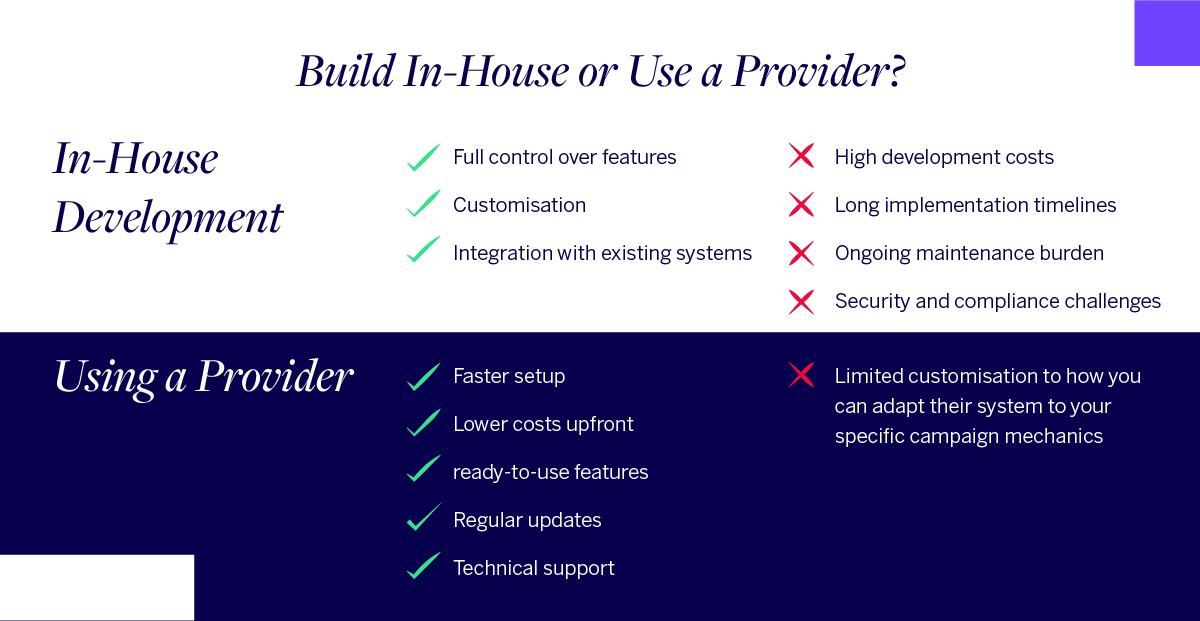
Top Coupon Management Systems and Software
The right system depends on your campaign type, technical capability, and budget. The table below covers the leading options, followed by a brief overview of each.
| Software | Starting Price | Key Features | Free Trial | Best For |
| Talon.One | Contact for pricing | Personalised coupon creation, real-time fraud prevention, omnichannel distribution, automated budgets and limits | No | Large enterprises |
| Open Loyalty | Contact for pricing | API-first, customisable campaigns, multi-channel distribution, loyalty integration, rule engine | No | Enterprise and mid-market retail |
| Voucherify | Contact for pricing | API customisation, omnichannel distribution, coupon stacking, fraud prevention, A/B testing | Yes | Digital-first brands and enterprises |
| Vouchery | Contact for pricing | AI-powered personalisation, mobile-ready QR codes, campaign automation, customer segmentation | Yes | E-commerce and mobile-focused businesses |
| Uniqodo | Contact for pricing | Single-use and dynamic codes, promotion rules, omnichannel delivery, managed service option | No | Retailers needing tailored promotion logic |
| Vouchermatic | Contact for pricing | Real-time distribution, analytics dashboard, secure system, barcode and QR code support | No | SMEs seeking simple digital coupon solution |
| Mezzofy | Contact for pricing | Paperless coupons, QR codes, API integration, fraud prevention, analytics | Yes | Businesses prioritising digital and sustainability |
| Snipp | Contact for pricing | Digital coupons, receipt validation, omnichannel distribution, AI fraud controls | No | Retail and CPG brands running large-scale programmes |
| Opia | Contact for pricing | Managed end-to-end promotional campaigns, high-value reward validation, AI-assisted fraud prevention, fixed-fee pricing | No | Brands running complex promotional campaigns with high-value rewards |
Talon.One
Talon.One is an enterprise-grade promotion engine used by large retailers and digital brands. It supports complex coupon logic through a rules engine that evaluates conditions in real time, including product eligibility, spend thresholds, customer segments, and channel constraints. Strong fraud detection and omnichannel support make it well suited to high-volume campaigns across web, mobile, and POS.
Best for: enterprises managing complex, multi-condition promotional campaigns at scale.
Open Loyalty
Open Loyalty is an API-first loyalty and promotion engine that connects coupon campaigns with loyalty tiers, points, and behavioural triggers. It is designed for organisations with complex tech stacks that need flexibility and control. Coupons can be tied to loyalty milestones, tier upgrades, or purchase history, making it a strong fit for businesses that want promotions to form part of a longer-term loyalty strategy.
Best for: enterprise and mid-market retailers running coupons as part of a broader loyalty programme.
Voucherify
Voucherify is a highly customisable API-based platform used by digital-first brands and enterprises. It supports rule-based coupon creation, coupon stacking, omnichannel distribution, referral mechanics, and robust fraud prevention. A/B testing and real-time analytics allow teams to optimise campaigns mid-flight. Developer-friendly with strong documentation.
Best for: digital-first and e-commerce businesses needing programmable coupon logic at scale.
Vouchery
Vouchery leverages AI to personalise coupon campaigns and increase customer engagement. The platform automates coupon distribution based on customer behaviour triggers such as abandoned carts or purchase history, and supports QR codes for mobile and in-store redemption.
Best for: e-commerce and mobile-focused businesses seeking AI-driven personalisation.
Uniqodo
Uniqodo is a UK-based promotion management platform combining a SaaS engine with optional managed services. It supports single-use, multi-use, and dynamically generated codes, with validation rules for eligibility, usage limits, and product restrictions. A managed service option is available for teams that need help designing or implementing more complex promotion structures.
Best for: UK retailers and e-commerce brands needing tailored promotion logic with optional hands-on support.
Vouchermatic
Vouchermatic offers a straightforward digital coupon platform designed for real-time distribution and tracking. It simplifies campaign management for businesses targeting digitally engaged customers, with barcode and QR code support for flexible redemption.
Best for: SMEs looking for a simple, secure digital coupon solution with quick implementation.
Mezzofy
Mezzofy is a digital-only coupon platform suited to businesses prioritising paperless and environmentally conscious promotions. It supports QR codes, API integration, and fraud prevention, with a no-code interface that allows marketing teams to create and launch campaigns without developer support.
Best for: businesses prioritising digital delivery and sustainability in their coupon campaigns.
Snipp
Snipp is a promotions and rewards platform used by retail and CPG brands running large coupon and rebate programmes. It supports digital coupons, receipt-based validation, and omnichannel distribution, with AI-driven fraud controls designed for high-volume campaigns across broad retail networks.
Best for: retail and CPG brands running large-scale, multi-retailer coupon and rebate programmes.
How to Optimise Your Coupon Marketing Campaign
Having the right system is only part of the equation. How you run the campaign determines whether the investment pays off.
Define Clear Goals and KPIs Before Launch
Every coupon campaign should start with a defined commercial objective: new customer acquisition, repeat purchase, average order value uplift, or inventory clearance. Without a clear goal, you cannot measure success. See our sales promotion planning guide for a full framework.
Segment Your Audience
Blanket coupon campaigns are inefficient. Use customer data to create targeted offers: higher-value discounts for VIP segments, first-purchase incentives for new subscribers, win-back offers for lapsed customers. The more relevant the offer, the higher the redemption rate and the lower your cost per acquisition.
A/B Test Offers and Messaging
Run parallel versions of campaigns with different discount values, messaging, or distribution channels to understand what drives conversion. Small differences in offer framing, for example £10 off versus 10% off, can produce materially different redemption rates.
Track and Measure ROI
Compare the revenue generated from coupon redemptions against the total campaign cost, including the discount value, fulfilment cost, and operational overhead. Look beyond redemption rate to sales uplift, average order value impact, and new versus existing customer ratio. See our guide to tracking promo codes for practical measurement approaches.
Plan for Fraud From the Start
High-value coupon offers attract misuse. Build fraud prevention into your campaign design rather than adding it afterwards. Unique single-use codes, redemption limits, address verification, and AI-assisted validation are the baseline. For brands offering rewards of £25 or more, more sophisticated validation is non-negotiable.
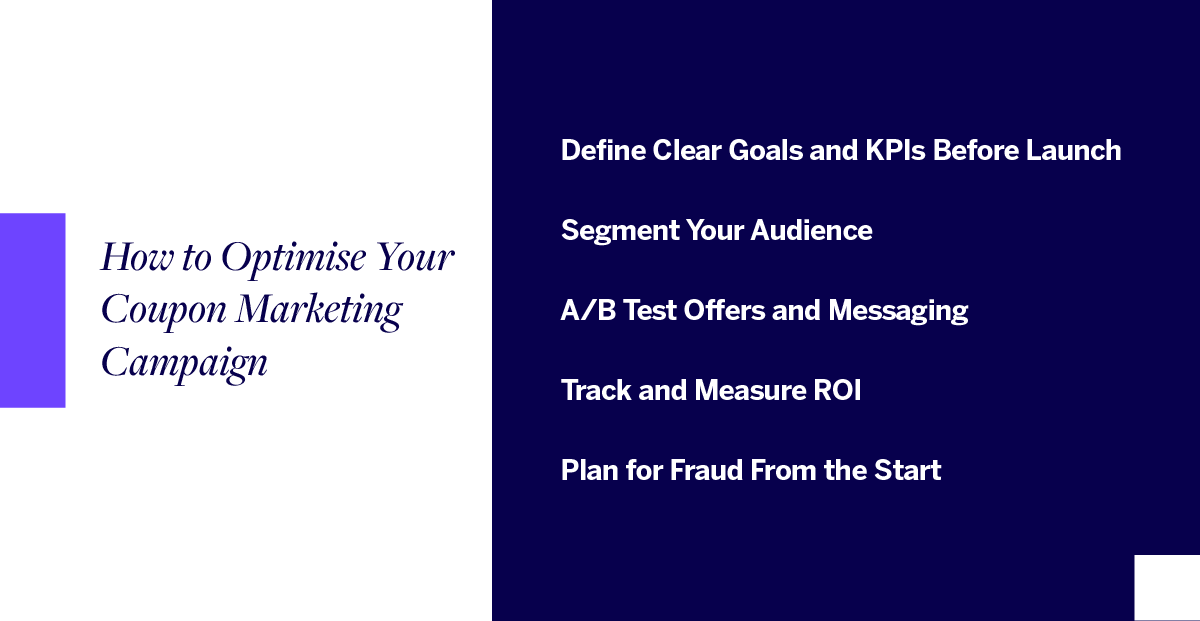
How Opia Complements Traditional Coupon Management Systems
Standard coupon management platforms are well suited to discount codes, vouchers, and straightforward redemption mechanics. Where they have limits is in more complex promotional campaigns, particularly those involving post-purchase rewards, high-value incentives, or multi-market fulfilment.
Opia’s sales promotion solutions are designed for exactly these scenarios. From cashback promotions and gift with purchase campaigns to trade-in programs and referral mechanics, Opia manages the entire campaign end-to-end.
This matters commercially for two reasons.
First, fraud prevention for high-value rewards requires a different level of sophistication than a standard code validation. Our AI-assisted claim verification and human QA review are designed for promotions where the reward per claim is £25 or more, a level of scrutiny that most self-serve platforms are not built for.
Second, fixed-fee pricing means your promotional budget does not carry open-ended financial risk. You know the maximum cost of the campaign before it launches, regardless of redemption rate.
If you are running a sales promotion that involves complex mechanics, high-value rewards, or multi-market delivery, get in touch with our team to discuss how Opia can help.
FAQs
What is a coupon management system?
A digital platform that creates, distributes, validates, and tracks coupon campaigns across multiple channels. It automates code generation, redemption checking, and performance reporting.
What is coupon tracking software?
The part of a coupon management system that monitors code usage in real time, capturing redemption rates, channel performance, and fraud attempts to help teams measure and optimise ROI.
What is the difference between a coupon management system and coupon management software?
They are interchangeable terms for the same category of tool. Both manage the full coupon lifecycle from creation through to reporting.
Should I build a coupon system in-house or use a provider?
Most businesses are better served by a provider. It is faster, cheaper, and lower risk. Building in-house gives more control but requires significant development resource and ongoing maintenance.
How does a coupon management system prevent fraud?
Through single-use codes, per-customer redemption limits, real-time validation, and AI-assisted pattern detection. The level of protection needed scales with the value of the reward.
How can a coupon management system increase sales?
By delivering targeted, timely offers that drive first-time purchase, repeat buys, or higher basket values. The more relevant the offer to the customer, the better the conversion rate.
How does Opia differ from standard coupon management software?
Opia is a managed promotional partner, not a self-serve platform. It designs, builds, and runs the entire campaign including redemption website, claim validation, fraud prevention, and fulfilment. Best suited to complex promotions with high-value rewards.

Guide to Customer Referral Programs: Best Practices & Strategies
Table of Contents
- Key Takeaways
- What Are Customer Referral Programs?
- How Do Referral Programs Work?
- Benefits of Customer Referral Programs
- Disadvantages of Referral Programs
- Key Considerations for a Successful Referral Program
- Expert Tips for Crafting the Perfect Referral Program
- How Opia Can Help Your Referral Campaigns
- Get in Touch
- FAQs
Key Takeaways
- Referral programs use word-of-mouth marketing to cost-effectively acquire new customers.
- They can boost brand awareness, increase loyalty, and improve customer lifetime value (CLV).
- Successful programs need clear objectives, appealing rewards, and seamless integration across digital platforms.
- Understanding your target audience and continuously optimising your strategy is crucial.
- Referred customers are significantly more likely to refer more customers to your brand, and can have higher Lifetime Value
- Opia provides custom solutions to design and manage effective referral campaigns that drive results.
Referral programs harness the power of word-of-mouth marketing, allowing businesses to reach new customers through trusted recommendations. From increasing brand awareness to fostering long-term loyalty, these programs are an effective, low-cost way to boost growth.
In this guide, we’ll explore everything you need to know about creating successful referral campaigns, plus how Opia’s tailored solutions can elevate your strategy.
What Are Customer Referral Programs?
Customer referral programs are marketing strategies where businesses encourage existing customers to refer friends and family to their products or services. By offering rewards for successful referrals, companies can tap into the power of word-of-mouth marketing, increasing brand awareness and acquiring new customers.
Typically, customers receive a unique referral link or code to share, and rewards are given when new customers make a purchase via these referrals.
Opia’s referral & rewards programs turn satisfied customers into advocates, driving consistent growth for your business.
How Do Referral Programs Work?
Referral programs work by encouraging current customers to act as ambassadors for the brand. Here’s a breakdown of a typical program:
- Joining the Program: Customers opt in to join the program, usually by registering online.
- Sharing the Referral: Participants receive a unique code or link to share with friends via social media, email, or messaging.
- Receiving Rewards: Both the referrer and the referee may receive benefits, like discounts, gift cards, or exclusive offers when a successful referral is made.
- Offer Even Rewards: It is best practice to offer the same value reward to the referrer and the referee, so the referee doesn’t think that the referrer is unevenly or unequally benefiting from the Referral Program.
- Data Tracking: Businesses can track referrals to gain insights into customer behaviour and optimise future campaigns.
Benefits of Customer Referral Programs
1. Increased Brand Awareness and Customer Acquisition
Referral programs can help businesses reach new audiences by encouraging existing customers to share their positive experiences. Studies show that consumers are four times more likely to buy when referred by a friend.
2. Improved Customer Loyalty and Retention
Incentivising referrals not only brings in new customers but also reinforces existing customer relationships. By rewarding customers for their recommendations, brands demonstrate appreciation, which fosters long-term loyalty and engagement. Learn more about customer loyalty programs.
3. Cost-Effective Marketing Strategy
Compared to traditional advertising, referral programs are a more cost-efficient way to attract new customers. They leverage word-of-mouth marketing, one of the most trusted forms, without requiring substantial advertising budgets. This is because the cost to acquire the customer has already been born when making the additional sale
4. Enhanced Trust and Credibility
Referrals from friends or family members carry a level of trust that traditional advertising often lacks. This added credibility leads to higher conversion rates, as consumers are more inclined to purchase when the recommendation comes from a trusted source.
5. Increased Customer Lifetime Value (CLV)
Customers acquired through referrals are more likely to stay loyal and make repeat purchases, which increases their lifetime value. Referred customers have been found to spend more and stay longer than those acquired through other means, boosting overall revenue.
6. Enhanced Community Engagement
Encouraging referrals helps build a community of loyal brand advocates who actively engage with your brand, both online and offline.

Disadvantages of Referral Programs
While referral programs have many benefits, there are some challenges to consider:
1. Balancing Incentives and Profit Margins
Offering rewards can sometimes eat into profit margins, especially if not planned carefully. Brands need to find a balance that incentivises without reducing profitability.
2. Potential for Misuse or Fraud
Referral programs can be susceptible to misuse, such as fake referrals or duplicate accounts. Safeguards must be in place to monitor and mitigate such risks.
3. Over-reliance on Referrals for Growth
Relying solely on referrals can limit growth if the brand does not diversify its marketing strategies. It’s crucial to use referrals as part of a broader marketing mix.
While referral programs come with certain risks, proper planning and monitoring can mitigate these issues. At Opia, we specialise in designing referral programs with robust fraud prevention and strategic cost management, ensuring that businesses can reap the benefits without worrying about pitfalls.
Key Considerations for a Successful Referral Program
1. Define Clear Objectives
Start by identifying what you want to achieve with your referral program. Whether it’s driving sales, boosting customer lifetime value (CLV), or enhancing brand visibility, setting clear and measurable goals will help shape your program’s design and success metrics.
Check out our comprehensive sales promotion step-by-step guide on planning effective promotional campaigns.
2. Choose the Right Rewards
Select incentives that genuinely resonate with your customers. The rewards should be compelling enough to motivate them to participate and share with others. Consider options like discounts, cashback, exclusive deals, or even special access to new products.
3. Simplify the Referral Process
Make it effortless for customers to refer friends. Provide them with easy-to-use referral tools, such as unique codes, shareable links, or social media integrations, so they can quickly spread the word without hassle.
4. Monitor and Optimise Continuously
Regularly track the performance of your referral program to identify what’s working and where improvements can be made. Use data to refine your strategies, ensuring that the program remains effective and continues to generate results over time.

Expert Tips for Crafting the Perfect Referral Program
1. Set Clear, Measurable Goals
Clarify what you want your referral program to accomplish, such as increasing sales volume, generating leads, or building stronger customer engagement. Make sure these goals are specific and measurable so you can track progress effectively.
2. Choose an Effective Reward Strategy
Think about what types of rewards will appeal most to your audience. Whether it’s discounts, gift cards, or exclusive offers, your incentives should be enticing enough to encourage both the referrer and the referred customer to engage with your brand.
3. Streamline the Referral Process
The success of a referral program often hinges on ease of use. Design a seamless referral experience by offering simple, shareable links, intuitive interfaces, and straightforward instructions, making it easy for customers to refer without any confusion.
4. Promote Your Program Across Multiple Channels
Leverage various platforms to raise awareness about your referral program. Include promotions in your email campaigns, social media posts, and in-store communications. The more touch points you use, the wider your reach.
5. Track and Analyse Performance Metrics
Utilise analytics tools to monitor how well your referral program is performing. By assessing key data points, you can identify strengths, uncover weaknesses, and adjust your approach to optimise results over time.
How Opia Can Help Your Referral Campaigns
Opia specialises in creating referral programs that are easy for customers to use and highly effective for brands. Our solutions ensure seamless integration across multiple digital channels, such as email, social media, and messaging apps, enabling maximum reach. We also provide robust promotion risk management, helping brands cap campaign costs and maintain profitability.
Our innovative approach includes:
- Strategic Cost Management: Ensuring rewards are impactful but not budget-breaking.
- Comprehensive Analytics: Our programs provide valuable insights for continuous improvement.
- Customised Flexibility: We adapt every aspect to fit your brand’s unique needs from tailored rewards to omnichannel integration.
Opia’s referral programs are proven to enhance customer retention, engagement, and brand equity. By leveraging our expertise, you can build a loyal customer base that continues to grow through peer recommendations.
Get in Touch
If you’re ready to implement a successful referral program, contact Opia to discover how our tailored sales promotion solutions can help you achieve your goals.
FAQs
Q: What is a referral program?
A: A referral program encourages existing customers to recommend your brand to friends and family, usually by offering rewards for successful referrals.
Q: How successful are referral programs?
A: Referral programs are highly effective, as they leverage trusted recommendations. Studies show that consumers are four times more likely to make a purchase when referred by a friend.
Q: What is the best referral program?
A: The best referral program is one that aligns with your brand’s goals and customer preferences, offering rewards that motivate both referrers and new customers to participate.
Q: How do you build a strong referral program?
A: Focus on clear goals, attractive rewards, easy referral processes, and continuous optimisation based on performance analytics.
Q: How does Opia support brands with referral programs?
A: Opia offers bespoke solutions that are cost-effective, easy to implement, and designed to boost engagement and conversions. We handle everything from setup to fraud monitoring.
Q: What kind of rewards work best for referrals?
A: It depends on your audience. Options range from discounts and gift cards to exclusive promotions. Opia helps brands choose the right incentives based on target demographics and goals.

Key Coupon, Voucher & Discount Code Stats & Trends (Updated 2026)
In today’s digital-first economy, vouchers and coupons have evolved beyond simple cost-saving tools to become pivotal drivers of consumer engagement, loyalty, and brand retention. As rising costs push consumers to make more selective choices, businesses are increasingly leveraging digital vouchers, mobile-friendly discounts, and targeted coupon codes to meet their customers’ demand for value.
Today, these promotional tools aren’t just popular; they’re indispensable, shaping consumer behaviour and creating new pathways for customer acquisition. Here, we dive into the latest statistics on digital coupons, vouchers, and discount codes, exploring how brands can effectively integrate these insights to refine their promotional strategies and stay competitive in a dynamic marketplace.
Table of Contents
- Key Statistics at a Glance:
- Digital Voucher Usage Trends
- Consumer Behaviour and Coupon Influence
- Digital vs. Paper Vouchers
- Future of Digital Vouchers: Looking Ahead to 2026 and Beyond
- AI-Driven Personalisation
- How Opia Can Help Brands Embrace These Trends
- Key Takeaways
- FAQs
- Enhance Your Sales Promotions with Opia
Key Statistics at a Glance:
- Over 90% of American digital coupon users accessed vouchers via smartphone in 2022 (Insider Intelligence).
- 57% of shoppers in the U.S. prefer digital over paper coupons as of 2023 (Statista).
- On average, digital coupon users save £1,200 per year (CouponFollow).
- 67% of shoppers report making a purchase solely because they found a discount (RetailMeNot).
Digital Voucher Usage Trends
- Smartphone Dominance: In 2023, 3% of UK digital voucher users accessed them via smartphone (RetailMeNot). Globally, by 2025, over 82% of consumers will use digital vouchers for purchases, a trend that shows mobile accessibility is critical (Statista).
- Time Spent Searching: The average online shopper spends 5-10 minutes searching for a digital voucher before making a purchase, with about 10-30% success in finding valid codes (Statista).
- Where Shoppers Find Vouchers: Email campaigns remain the top discovery method, with 47% of consumers finding vouchers in brand emails and 46% through online searches (CouponFollow).
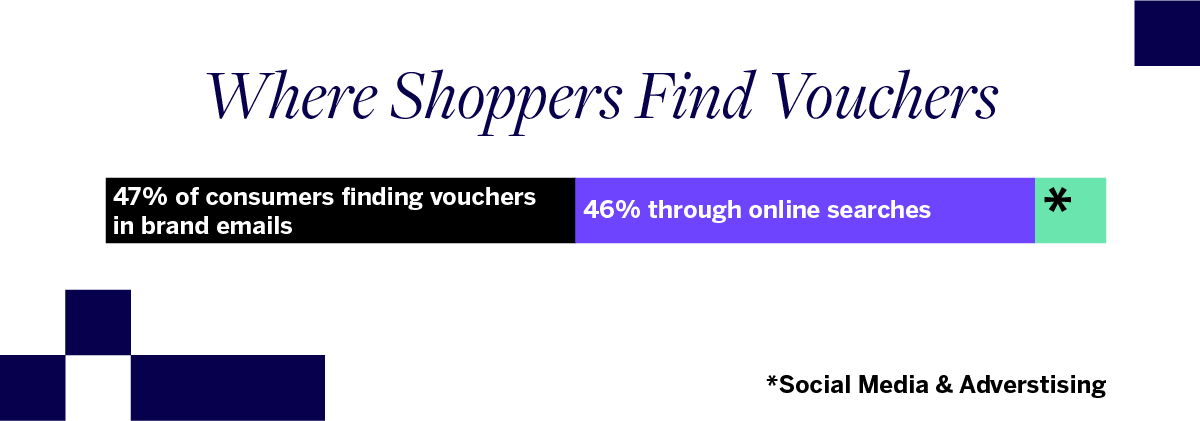
Consumer Behaviour and Coupon Influence
- Impact on Buying Decisions: A compelling 83% of consumers state that vouchers influence their buying behaviour, with 39% purchasing sooner than intended due to a voucher (Inmar Intelligence).
- Increasing Order Values: Consumers using vouchers spend 24% more than those who don’t (RetailMeNot).
- Cart Abandonment: In 2024, 46% of online shoppers abandoned their cart due to not finding a discount code (ConvertCart). Highlighting discounts or automating coupon applications at checkout could reduce abandonment rates, encouraging customers to complete purchases.

Future of Digital Vouchers: Looking Ahead to 2026 and Beyond
As technology advances, digital vouchers are set to grow in popularity, driven by innovations in AI and mobile integration. Brands are increasingly leveraging these technologies to enhance customer engagement and deliver personalised experiences that resonate on an individual level. Key trends shaping the future of digital vouchers include:
AI-Driven Personalisation
As technology advances, digital vouchers are set to grow in popularity, driven by innovations in AI and mobile integration. Brands are increasingly leveraging these technologies to enhance customer engagement and deliver personalised experiences that resonate on an individual level. Key trends shaping the future of digital vouchers include:
AI-Driven Personalisation
By 2026, over 90% of coupon platforms are expected to offer AI-driven, personalised voucher recommendations (Statista).
Through AI, brands can analyse consumer habits, purchase history, and even browsing behaviour to create vouchers that feel uniquely tailored to each user. These AI-powered vouchers not only increase redemption rates but also drive customer satisfaction and loyalty. For instance, location-based or event-triggered offers—such as birthday discounts—can appear at just the right moments to encourage engagement.
Mobile Redemptions Leading the Way
With mobile use becoming central to consumer behaviour, mobile-based voucher usage is predicted to reach 65% of all voucher redemptions by 2027 (Finance Yahoo). This shift shows that mobile accessibility will be critical for voucher campaigns moving forward, allowing consumers to redeem offers seamlessly through apps, social media, or QR codes in physical stores.
Integration into Omnichannel Experiences
As consumers expect a consistent experience across both online and offline shopping, digital vouchers are becoming increasingly integrated into omnichannel environments. This trend enables consumers to use vouchers across multiple touchpoints—whether shopping online, on mobile apps, or in-store—creating a smooth, interconnected journey.
For example, vouchers accessed via social media can be saved and redeemed later in-store or via a brand’s app, enhancing convenience and reach.
How Opia Can Help Brands Embrace These Trends
With expertise in AI-driven solutions and omnichannel integration, Opia helps brands design future-forward voucher and sales promotion strategies that align with these emerging trends. Here’s how we can assist across various areas:
Personalisation and Consumer Electronics
- Deliver exclusive discounts on accessories tailored for customers who recently purchased a smartphone, PC, or other electronics.
- Target promotions on gaming consoles for customers interested in gaming accessories.
- Provide personalised recommendations for smart home devices based on past purchases, enhancing customer engagement.
Coupons, Vouchers, Discount Codes, Cashback Promotions, and Loyalty
- Opia’s AI solutions identify inactive customers and offer personalised cashback promotions to re-engage them.
- Rewards can be tiered based on customer value, using AI to analyse purchase history and engagement.
- Targeted cashback offers can drive repeat purchases, tailored to products with the highest likelihood of success.
Digital Gift with Purchase and Omnichannel Integration
- Provide digital gift cards redeemable online and in-store, with offers personalised based on the customer’s location, purchase history, and preferred channels.
- Omnichannel integration allows customers to seamlessly use their digital gift cards across touchpoints, fostering a consistent, satisfying experience.
Slow-Moving Consumer Goods
- Identify likely buyers for specific slow-moving products based on behavioural and demographic insights.
- Personalised vouchers can create urgency, optimising sales on these items.
- Dynamic pricing adapts discount levels and voucher values to boost both revenue and profitability.
Opia’s solutions are designed to adapt to the evolving voucher and coupon landscape, supporting brands in creating impactful, data-driven promotions that engage today’s digital consumers effectively. For further insights, explore our resources on Sales Promotion Insights and Customer Loyalty Programs.
Key Takeaways
- Digital Dominance: Consumers are rapidly shifting towards digital vouchers, with mobile access being a primary driver.
- Impact on Spending: Vouchers significantly influence consumer purchasing decisions, encouraging additional spending and loyalty.
- Future Growth: AI and mobile integration are set to enhance voucher personalisation, making offers more appealing and relevant.
- Strategic Opportunities: For businesses, investing in mobile-optimised, personalised voucher strategies can drive both engagement and conversion rates.
FAQs
Q: How do consumers typically find digital vouchers?
A: Most consumers find digital vouchers through brand emails (47%) and online searches (46%) (CouponFollow).
Q: What impact do vouchers have on purchasing behaviour?
A: Around 83% of consumers report changing their purchasing behaviour due to vouchers, often buying products sooner or spending more than planned (Inmar Intelligence).
Q: Why should businesses use vouchers in 2024?
A: Vouchers boost consumer engagement, increase spending, and drive loyalty. They’re especially useful for reducing cart abandonment and attracting new customers.
Q: What is the future of voucher usage?
A: By 2025, 80% of online shoppers are expected to regularly use vouchers, with mobile redemptions and AI-driven personalisation becoming central.
Q: Do mobile vouchers have a higher redemption rate than paper vouchers?
A: Yes, mobile vouchers are redeemed 10 times more often than traditional paper vouchers, highlighting the shift to digital (Statista).
Q: What industries can benefit from voucher campaigns?
A: Retail, travel, electronics, and FMCG sectors all benefit from voucher campaigns by encouraging new product trials, repeat purchases, and reducing cart abandonment.
Q: How does Opia help businesses create effective voucher campaigns?
A: Opia provides tailored sales promotions like cashback promotions, and instant wins to increase engagement and conversions. Each campaign aligns with your goals to optimise success. For more information, check out Opia’s Sales Promotion Insights and Cashback Promotion Guide.
Q: Why is AI important for future voucher strategies?
A: AI can drive more effective, personalised voucher offers, providing targeted recommendations to users based on real-time shopping behaviour and location, which enhances both customer satisfaction and conversion rates.
With the rapid evolution of digital vouchers, businesses must stay informed and agile. By investing in personalised, mobile-first voucher strategies, brands can increase customer loyalty, improve conversion rates, and ensure a competitive edge in the marketplace.
For the latest in customer engagement and effective sales strategies, explore Opia’s insights on seasonal promotions and the psychology behind sales promotions.
Enhance Your Sales Promotions with Opia
At Opia, we specialise in providing bespoke sales promotion solutions to boost customer engagement and sales performance. We help brands drive results through smart, effective promotions.
Contact us today to learn more about how we can help your business harness the power of vouchers and sales promotions.

Vlog: The Science of Innovation
Adam Nicholson, Director of Technology and Product, describes how innovation is at the heart of Opia and the benefits it derives from creative problem solving.
Here are the key takeaways:
- Opia fosters innovation by promoting a culture of autonomy, encouraging teams to suggest new ideas and providing spaces for collaboration, including hack days and cross-department workshops.
- Regular hack days and collaborative sessions with internal and external SMEs have led to key innovations, such as AI-driven claim handling systems and consumer-friendly claim submission channels including WhatsApp and SMS.
- Opia balances a tech-first approach with a business-driven focus on solving real-world problems, ensuring that innovation aligns with clear business outcomes and priorities.
- Robust fraud prevention systems must constantly evolve, using AI, behavioural biometrics, and third-party technology. Staying one step ahead of fraudsters demands dedication and innovation, especially as generative AI presents new challenges in detecting fraudulent content.
- Opia collaborates with clients and partners, including global tech brands and retailers, to co-develop AI and machine learning solutions that address specific fraud risks, leveraging their clients’ technical expertise alongside their own.