



Memory Chip Shortage 2026: How Brands Can Protect Margins Without Discounting
Table of Contents
- The Defining Challenge of 2026
- The Scale of the Memory Crisis
- Numbers That Matter: 2026 Memory Outlook
- Why This Shortage Is Structurally Different
- Why Traditional Pricing Strategies Fail in a Supply Crisis
- Strategic Sales Promotions That Protect Margins
- The "Practical Playbook" for Brand Teams
- The Opia Advantage
- Conclusion: Don't Wait Out the Shortage
- FAQs
The Defining Challenge of 2026
For the consumer electronics industry, 2026 has become a year of reckoning. What began as a ripple in semiconductor supply chains has developed into a “RAMageddon” that threatens retail profitability. This isn’t just a logistics bottleneck; it is the defining commercial challenge for brands today.
As input costs surge, manufacturers face a brutal dilemma: pass the costs on to the consumer and risk demand destruction, or absorb the hit and see margins evaporate. At Opia, we believe there is a third path—one where strategic sales promotions act as a tool to navigate the crisis without devaluing your brand.
The Scale of the Memory Crisis
To understand the solution, we must first look at the sheer scale of the disruption. The current crisis is driven by a fundamental shift in global manufacturing.
- The Cause: High-Bandwidth Memory (HBM) for AI data centers has effectively “cannibalized” traditional capacity. By the end of 2026, data centers are projected to consume 70% of global memory production, leaving smartphones, PCs, and home appliances fighting for the scraps.
- The Impact: We are seeing a three-pronged threat:
- Margin Compression: Memory now accounts for up to 20% of the total bill of materials for mid-range hardware.
- Demand Destruction: With PC prices increasing by 15–20% and RAM costs rising by 172% over the last year, consumers are hesitating.
- Competitive Vulnerability: The big decision for manufacturers is how to manage the channel with varying price points of like-for-like products, potentially overstocked retailers and distributors and cash-strapped consumers.
Numbers That Matter: 2026 Memory Outlook
| Metric | Impact Level |
| PC/Laptop Price Increase | +15% to 20% |
| RAM Price Escalation | +172% (since 2025) |
| HBM Production Share | 70% of global output |
| Forecasted Duration | Continuing through 2027 |
Why This Shortage Is Structurally Different
Unlike previous semiconductor cycles, this disruption is not purely cyclical.
Industry analysts highlight that AI infrastructure demand is permanently reallocating silicon capacity toward high-bandwidth memory (HBM) and enterprise-grade components. As hyperscalers scale AI data centres, consumer device manufacturers are competing for increasingly constrained DRAM and NAND supply.
The impact is visible across:
- Smartphones facing potential average selling price increases
- PCs and AI-enabled laptops seeing 15–20% price adjustments
- Gaming consoles and consumer hardware under specification pressure
This is not a short-term imbalance. It represents a structural shift in how global memory production is prioritised.
For brands, that means pricing pressure may persist well into 2027.
Why Traditional Pricing Strategies Fail in a Supply Crisis
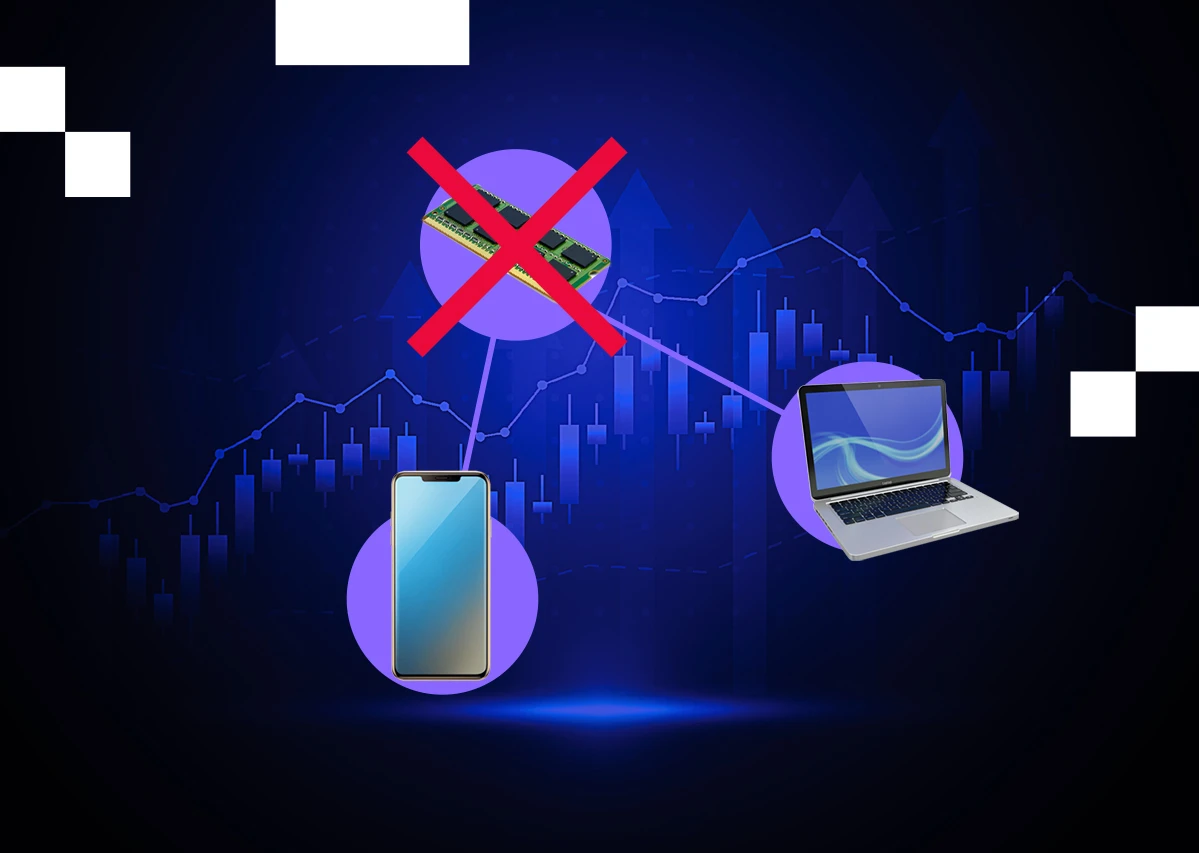
When costs rise by 15–20%, brands instinctively reach for discounts to protect volumes.
But discounting in a cost-inflation environment creates three long-term risks:
- Permanent margin erosion
- Channel conflict
- Brand devaluation
In a market where input costs are structurally higher, short-term price cuts compound long-term instability.
This is where strategic sales promotions outperform reactive discounting.
Strategic Sales Promotions That Protect Margins
When shelf prices rise, traditional “percentage-off” discounting is a race to the bottom. Instead, brands must use high-impact promotional mechanics to bridge the “affordability gap” and provide reassurance to customers entering the market.
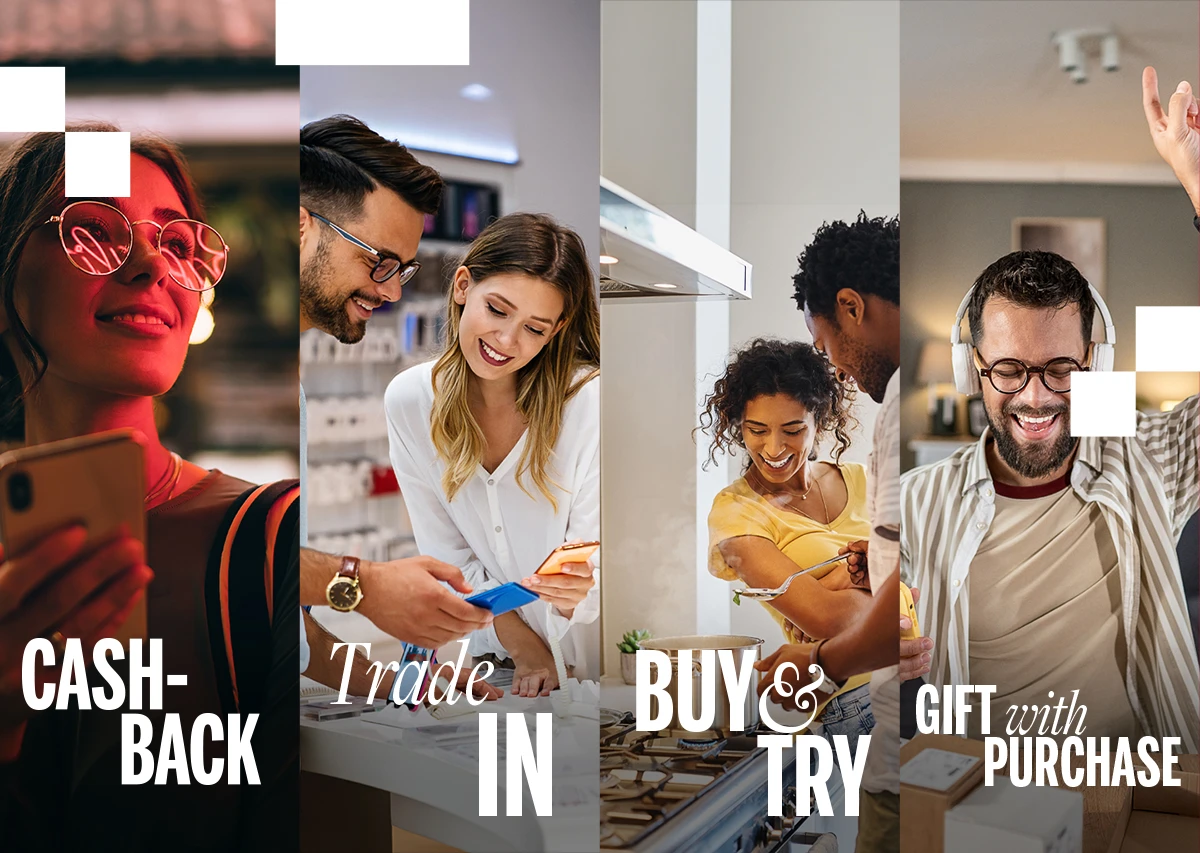
1. Cashback: Protecting RRP While Bridging the Affordability Gap
Cashback allows brands to maintain Recommended Retail Price while offering meaningful financial relief.
Because not every customer redeems, the effective cost is significantly lower than a blanket discount. That protects brand margins while still delivering a strong perceived reward.
2. Trade-In: Turning Scarcity Into Leverage
With used memory components and legacy devices increasing in resale value, trade-in programs create asymmetry in favour of the brand.
The result is a lower net cost without cutting prices and a circular economy narrative that strengthens positioning.
3. Buy & Try: Removing Risk in a High-Price Market
As hardware becomes more expensive, purchase decisions take longer.
Buy & Try mechanics reduce hesitation by removing perceived risk. Customers can experience premium devices with confidence, even in volatile pricing environments.
In inflationary cycles, reassurance drives conversion.
4. Gift with Purchase (GWP): Increasing Perceived Value Without Reducing Price
Bundled accessories, warranties, or services deliver higher perceived value at a lower real cost than direct price cuts.
During a consumer electronics price increase, gift with purchase promotions protect margins while reinforcing premium positioning.
The “Practical Playbook” for Brand Teams
Navigating the next 12–18 months requires a proactive stance. Here is your roadmap:
- Audit your approach: Shift away from margin-eroding blanket discounts toward conditional rewards.
- Launch Trade-In Programs: Capitalize on the current high value of used components to lower the barrier to entry for new models.
- Target Premium SKUs: Use “Buy & Try” to de-risk high-ticket items where price sensitivity is most acute.
- Accelerate Payouts: Use instant digital wallet delivery (Apple Pay/Google Pay) to ensure customer satisfaction is immediate, even if the price is high.
- Cap Your Risk: Utilize actuarial modeling and insured promotions to ensure that even if a campaign is wildly successful, your costs remain fixed.
The Opia Advantage
In a structurally inflationary tech market, promotional mechanics are no longer tactical marketing tools. They are financial instruments.
This is where Opia steps in. We design and manage promotions as controlled financial instruments, mitigating operational and commercial risk at scale.
- Proven Track Record: We’ve distributed over £800M in rewards across 1,800+ global campaigns.
- Technical Superiority: Our platform features 80%+ AI-powered automation, sub-1% fraud rates, and reward delivery in under two seconds.
- Government-Grade Reliability: From managing the UK Ministry of Justice Family Mediation Voucher Scheme to supporting world-leading tech OEMs, our infrastructure is built for scale and security.
Conclusion: Don’t Wait Out the Shortage
The memory crisis isn’t a temporary blip; experts project supply constraints to last well into 2027. Brands that wait for “prices to normalize” will lose market share and loyalty that may never return.
Ready to turn a market shortage into an opportunity to win?
Contact Opia today to discuss how we can build a custom promotional strategy that navigates the 2026 shortage without sacrificing your brand’s value.
FAQs
Is the memory chip shortage in 2026 temporary?
Current projections suggest supply constraints may persist through 2027 due to structural reallocation toward AI infrastructure and data centre demand.
Why are PC and smartphone prices increasing?
Memory can account for up to 20% of a device’s total bill of materials. Rising DRAM and NAND costs are driving 15–20% price increases across consumer electronics.
Why shouldn’t brands rely on discounting during a supply crisis?
Blanket discounting erodes margins and devalues pricing in a structurally inflationary market. Once reduced, prices are difficult to restore.
How can brands protect margins without reducing RRP?
By using conditional promotional mechanics such as cashback, trade-in, buy & try, or gift with purchase, brands can maintain price integrity while offering targeted value.
Are trade-in promotions effective during hardware shortages?
Yes. When component resale values rise, trade-in programs create asymmetric value, reducing net cost for consumers while protecting brand margins.
How can Opia support during supply chain disruptions?
Opia designs and manages promotional strategies that control financial exposure, automate validation, and protect margins – even in volatile market conditions.

Cashback Promotions: How They Work and Why Brands Use Them
Cashback promotions are one of the most effective ways for brands to drive sales without cutting shelf prices. Rather than offering an upfront discount, cashback gives customers money back after purchase, creating a strong incentive while protecting brand value.
For brands operating in competitive markets or selling considered purchases, cashback promotions offer a flexible, data-driven alternative to price reductions.
This guide explains what cashback promotions are, how they work, when to use them, and how brands can run successful cashback campaigns at scale.
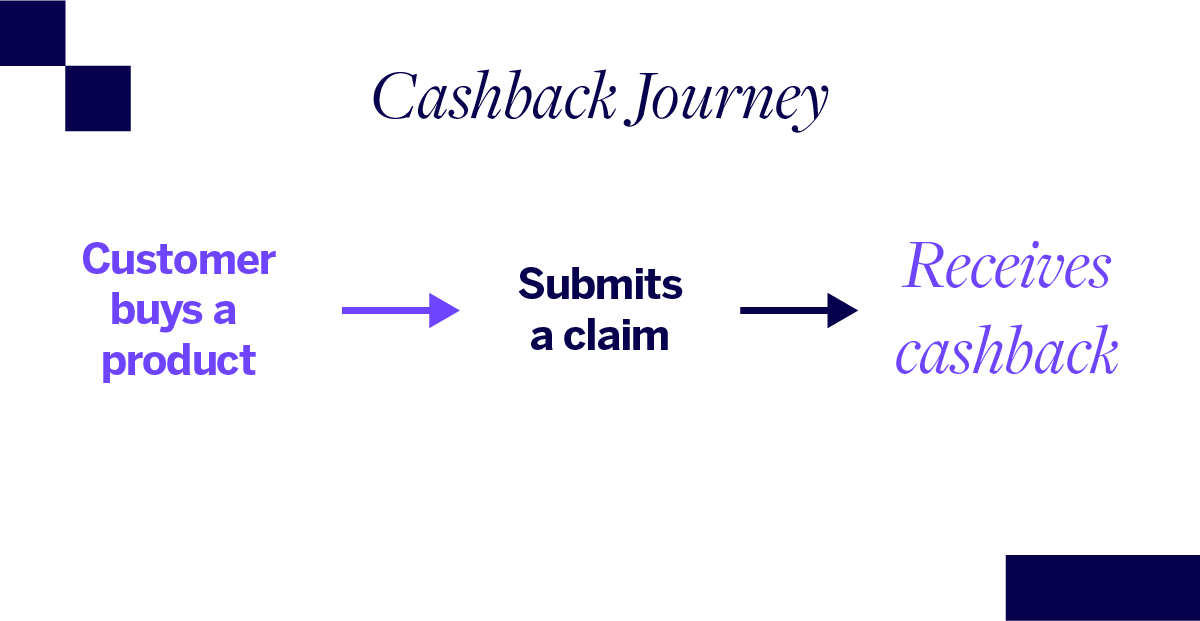
Table of Contents
- Key Takeaways
- What is a Cashback Promotion?
- How Do Cashback Promotions Work?
- Benefits of Cashback Promotions
- Cashback Promotions vs Discounts
- When to Use Cashback Promotions
- Common Cashback Promotion Mistakes (and How to Avoid Them)
- Example: Cashback Promotions in Practice
- Designing a Successful Cashback Campaign
- The Science of Sales Promotion
- How Opia Can Help Your Cashback Campaigns
- Want to Go Deeper into Cashback Promotions?
- Get in Touch
- FAQs
Key Takeaways
- Cashback promotions incentivise purchases without eroding price integrity.
- They are particularly effective for high-consideration and competitive categories.
- Cashback campaigns provide valuable first-party customer data.
- A simple claims journey is critical to success.
- When designed and managed correctly, cashback promotions drive both short-term sales and long-term loyalty.
- Well-structured cashback content with clear definitions, processes, and FAQs improves both search visibility and AI discoverability.
What is a Cashback Promotion?
A cashback promotion is a sales promotion strategy where customers receive a refund or partial rebate after purchasing a qualifying product.
Unlike discounts, which reduce the price at the point of sale, cashback rewards customers retrospectively. This allows brands to highlight savings while maintaining perceived product value and pricing consistency.
Cashback promotions are commonly used to:
- Drive short-term sales uplift
- Encourage trial without discounting
- Support premium positioning
- Collect first-party customer data
How Do Cashback Promotions Work?
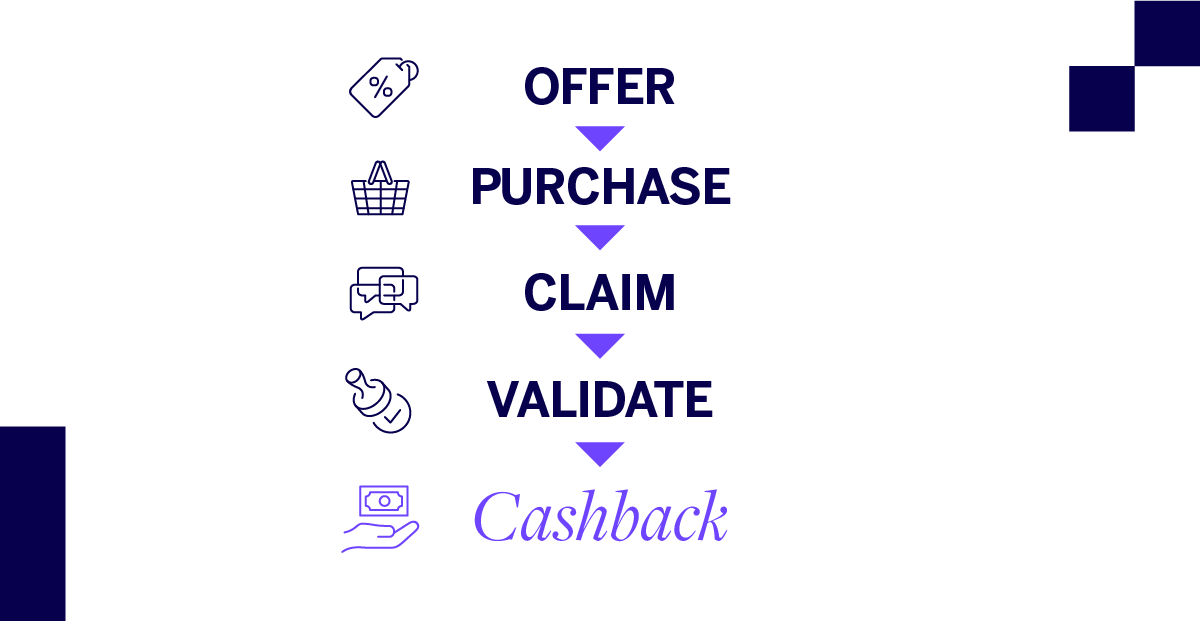
Cashback promotions follow a structured but customer-friendly process:
1. Offer
The brand defines a cashback incentive, either a fixed amount or a percentage, applied to specific products, retailers, or purchase conditions. The offer is promoted across digital, in-store, or retail channels.
2. Purchase
Customers buy a qualifying product within the promotional period, following the campaign rules outlined in the terms and conditions.
3. Claim
Customers submit a cashback claim through a branded digital platform. This typically includes:
- Completing a short form
- Uploading proof of purchase (receipt, invoice, confirmation email)
- Providing details for reward fulfilment
4. Verification
Claims are checked against campaign rules to confirm eligibility. This step helps prevent fraud and ensures accurate payouts.
5. Receive
Once approved, cashback is paid via bank transfer, prepaid card, or other digital payment methods.
Modern cashback campaigns increasingly use automation to validate claims quickly, improving customer experience and reducing operational overhead.
Benefits of Cashback Promotions
Drive Sales Without Price Erosion
Cashback promotions encourage purchases while keeping the headline price intact. This protects brand positioning and avoids long-term margin damage caused by frequent discounting.
Increase Engagement After Purchase
Unlike discounts, cashback keeps customers engaged beyond checkout. The claims journey creates additional brand touchpoints and reinforces trust.
Capture Valuable First-Party Data
The claim process provides insights into customer behaviour, preferences, purchase timing, and retailer performance.
Enable Campaign Flexibility
Cashback mechanics can be adapted to product launches, seasonal pushes, inventory clearance, or competitive responses.
Support Long-Term Brand Value
By rewarding customers without permanently lowering prices, cashback helps maintain perceived value while still offering tangible benefits.

Cashback Promotions vs Discounts
While both cashback and discounts aim to drive sales, they serve different strategic purposes.
| Cashback Promotions | Discounts |
| Reward after purchase | Immediate price reduction |
| Protects price integrity | Risks price erosion |
| Enables data capture | Limited customer insight |
| Perceived as added value | Often expected |
For brands selling higher-value or considered products, cashback is often the more sustainable option.
When to Use Cashback Promotions
Cashback promotions work best when brands want to:
- Encourage trial of higher-value products
- Drive volume without damaging brand perception
- Compete without entering price wars
- Support launches or seasonal spikes
- Gather customer data at scale
They are less suitable for low-margin products or purely impulse-driven categories where immediate discounts may be more effective.
Common Cashback Promotion Mistakes (and How to Avoid Them)
Overcomplicated Claims Journeys
Long or confusing claim processes lead to customer frustration and abandoned claims. Simplicity is key.
Unclear Eligibility Rules
Ambiguous terms and conditions increase customer support volume and disputes.
Underestimating Fraud Risk
Cashback campaigns require robust validation to prevent abuse, especially at scale.
Measuring the Wrong Metrics
Redemption rate alone does not define success. Brands should track incremental sales, engagement, and data capture.
Example: Cashback Promotions in Practice
Cashback promotions are particularly effective when brands want to influence purchasing behaviour without relying on discounts.
In a competitive market, Dell combined cashback incentives with a streamlined digital claims journey to promote its premium PC range. By removing friction from the validation process and confirming eligibility quickly, the campaign increased sales by 25% while maintaining a strong customer experience.
The success of the initial cashback activity led to repeat campaigns during key moments such as Black Friday, demonstrating how well-designed cashback promotions can scale and deliver consistent results.
Designing a Successful Cashback Campaign
Rather than focusing on tactics alone, successful cashback promotions are built around strong fundamentals.
- Clear objectives: define whether the goal is volume, trial, loyalty, or data.
- Simple claims journey: fewer steps lead to higher completion rates.
- Risk control: model redemption scenarios before launch.
- Fraud prevention: validation rules must be embedded from day one.
- Technology support: automation improves speed, accuracy, and scalability.
The Science of Sales Promotion
Promotions are no longer guesswork. At Opia, we use years of promotional data to understand how different mechanics perform across categories, markets, and objectives.
This scientific approach allows brands to plan promotions with confidence, predict outcomes more accurately, and optimise ROI across product lifecycles.
How Opia Can Help Your Cashback Campaigns
Every cashback campaign is different. Opia works closely with brands to design, manage, and optimise cashback promotions that align with commercial goals.
From campaign setup and claim validation to fulfilment and reporting, our end-to-end approach ensures a seamless experience for both brands and customers.
Want to Go Deeper into Cashback Promotions?
Download our Cashback Promotions Guide, where we break down how to plan, run, and optimise high-performing cashback campaigns – from mechanics and validation to payout methods and ROI tracking.
* These examples are used for illustrative purposes only, and Opia Limited does not claim ownership of the work referenced in them.
Get in Touch
Looking to drive sales without eroding your pricing strategy?
Get in touch to explore how a well-designed cashback promotion can support your commercial goals and deliver measurable results.
FAQs
What is a cashback promotion?
A cashback promotion offers customers money back after they purchase a qualifying product.
Is cashback the same as a discount?
No. Discounts reduce the price immediately, while cashback rewards customers after purchase.
How long does cashback take to receive?
This varies by campaign, but customers usually receive confirmation quickly, with payout following within days.
Are cashback promotions effective?
Yes. When designed

Promotional Claims Process Automation and AI: A Comprehensive Guide
Table of Contents
- What Is Promotional Claims Process Automation?
- The Promotional Claims Journey: Manual vs Automated
- How Claims Automation Works in Promotions
- Examples of Claims Automation in Promotions
- Who Benefits From Promotional Claims Automation?
- What to Look for in a Promotional Claims Automation Partner
- Benefits of Promotional Claims Automation
- Key Takeaways
- Partner With Opia
When customers take part in a promotional campaign, the claims process is the moment where promises turn into reality. It’s also where trust is won or lost. Customers can be sceptical about post-purchase redemptions, so a clear and quick validation of their entry often matters more than the fulfilment itself.
Automation now enables brands to provide that instant reassurance, but it’s not about replacing people entirely. Some entries will always require manual review, whether for spot-checking, exceptions, or customer complaints.
The goal is to keep these cases to a minimum while ensuring every purchase is validated accurately against the promotion’s terms and conditions.
What Is Promotional Claims Process Automation?
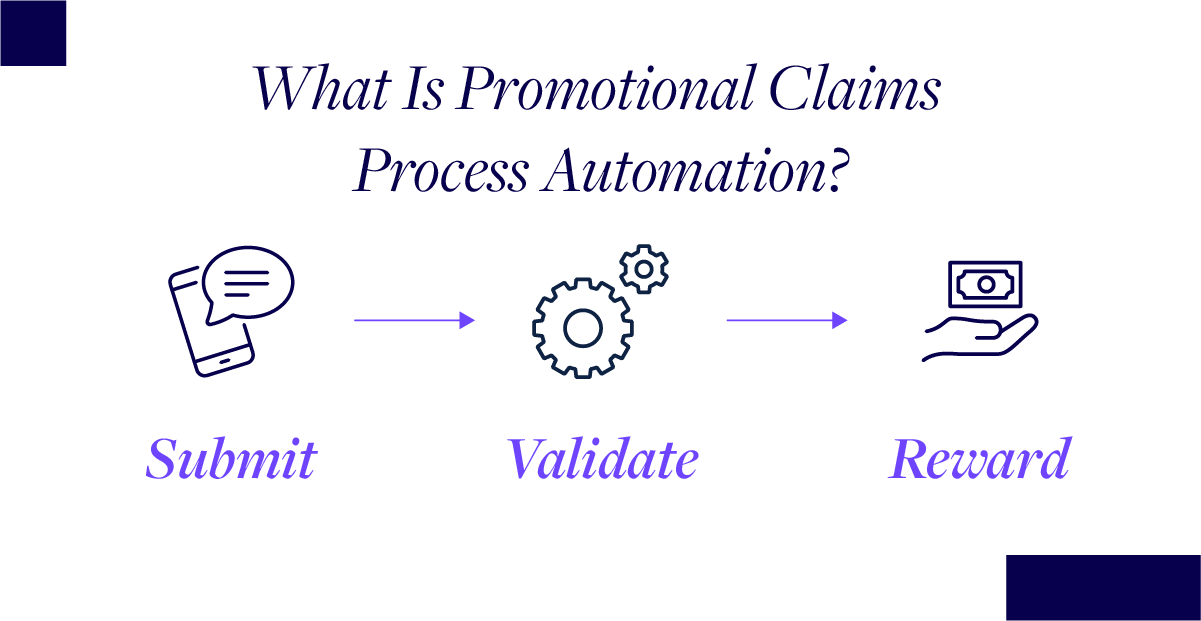
Promotional claims process automation is the use of technology to handle the key stages of claim submission, validation, and payout. Rather than relying on staff to manually review receipts, invoices, or product photos, automation uses advanced AI to validate entries quickly and accurately.
In the past, many providers leaned heavily on Optical Character Recognition (OCR) to scan and read receipts. While effective for clean, standardised formats, OCR is limited; it struggles with poor-quality images, complex promotion requirements, or non-receipt proofs. This is why it has become associated with basic “receipt clearing” services at the transactional end of the industry.
By contrast, Opia applies more versatile, AI-driven solutions, including GenAI models capable of interpreting messy smartphone photos, email confirmations, multi-product bundles, and a wide variety of proof types. This enables brands to run complex, creative, and digital-first promotions while delivering a seamless customer experience.
The Promotional Claims Journey: Manual vs Automated
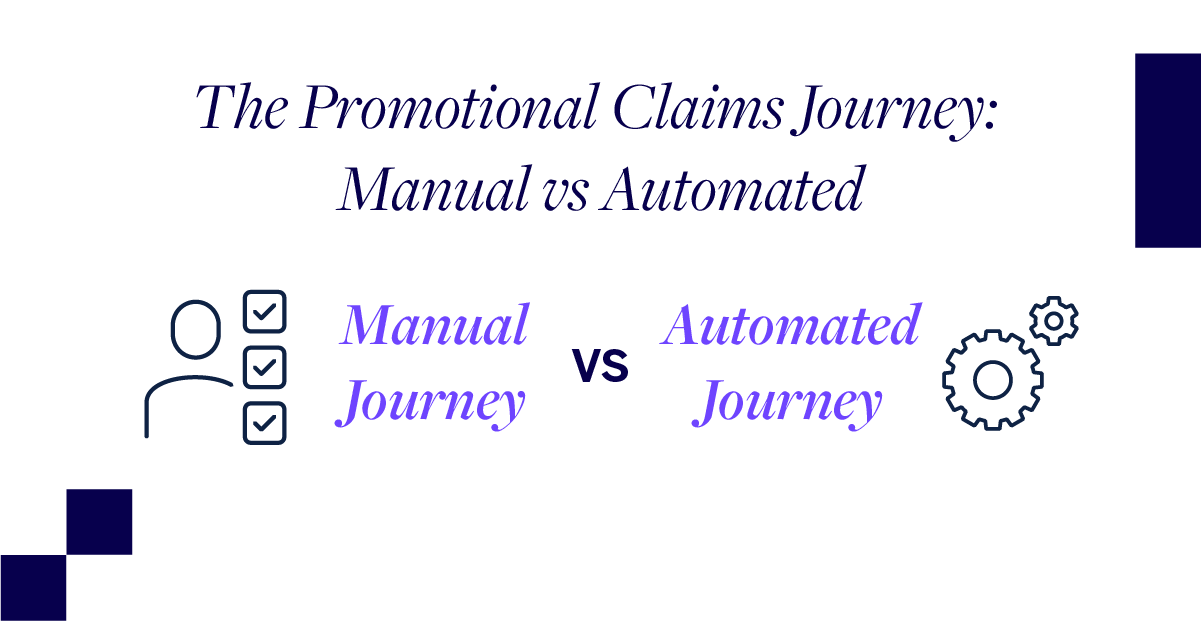
Every promotion follows a claims journey. This typically includes:
- Submission: Customers provide proof of purchase, receipts, or product details.
- Validation: Claims are checked against campaign rules.
- Reward/Payout: Eligible customers receive their cashback, voucher, or trade-in reward.
- Analysis: Data from claims is used for reporting and insights.
The Manual Process
Traditionally, each step required human intervention. In the past, this often meant paper claim forms sent by post, which some companies still rely on today. Even as the industry shifted to digital, many brands continued to review claims manually, with staff checking receipts or product details one by one.
The result is the same: long turnaround times, inconsistent results, and higher administrative costs. For customers, it can mean waiting up to three weeks without any clear indication of whether their claim is eligible.
The automated process
With automation, most of the validation work is handled instantly. Technologies can check receipts, confirm serial numbers, and cross-reference entries against all the rules of the promotion, from qualifying products and retailers to purchase dates, quantities, ticket values, discounts and other offers, or even geographic eligibility.
For customers, the experience should feel as quick and reassuring as receiving an order confirmation the moment you complete an online purchase. They know right away whether their claim is valid.
Reward fulfilment, however, follows a different rhythm. While validation can happen in real time, payments and reward distribution are typically completed within days rather than seconds.
This is both practical and expected. Customer feedback consistently shows that a matter of days (or even a couple of weeks) is perfectly acceptable. What matters most is the instant confirmation that their entry has been accepted and the reward is on its way.
How Claims Automation Works in Promotions
Across the industry, automation typically uses a mix of technologies:
- OCR to extract details from receipts or invoices.
- AI/ML models to detect fraud and validate eligibility.
- Automated workflows to route claims instantly across different regions or promotion types.
- Integrated fulfilment for fast and secure rewards, from cashback payments to digital vouchers or physical gifts.
At Opia, we take this further.
Our teams have developed advanced integrations with AI models, achieving high levels of automation (in some campaigns above 90%) while maintaining human oversight. This ensures accuracy, compliance, and operational independence. It also allows us to manage some of the most complex promotional mechanics in the industry, from multi-product bundles to global trade-in programs.
Examples of Claims Automation in Promotions
The following examples demonstrate how automation and AI converge across various promotional types, enabling brands to deliver faster, more consistent, and customer-friendly experiences.
At Opia, we’ve embedded automation and AI across a range of promotional mechanics, from fast, high-volume cashback campaigns to complex, multi-market trade-ins.
Cashback Campaigns
Cashback promotions remain one of the most powerful ways to drive sales without discounting shelf prices. With automation, customers receive instant validation of their claim after uploading a receipt, reassuring them that their reward is on its way. This transparency builds trust and strengthens brand perception.
How Opia Uses AI:
We use the power of AI large language models to scan and interpret millions of receipt types, reading elements like price paid, retailers or purchase dates, even from low-quality or non-standard images with great levels of accuracy.
This reduces manual checks, shortens turnaround times, and builds customer confidence through real-time confirmation.

Trade-In Programs
Trade-in promotions encourage upgrades while supporting sustainability goals. Automation validates device photos and product details instantly, ensuring eligibility without lengthy manual reviews.
How Opia Uses AI:
Our image-recognition AI assesses qualifying products, identifies serial numbers, and matches submissions to campaign rules within seconds.
This allows us to manage large-scale, complex trade-in campaigns efficiently while maintaining accuracy and fairness.
Multi-Market Campaigns
Running promotions across markets introduces complexity, different languages, currencies, and regulations.
Automation ensures consistency, validating claims in real time while adapting to local requirements.
How Opia Uses AI:
Our automation engine allows us to read and interpret multiple proofs of purchase or images in many languages and alphabets.

Creative or Complex Promotions
Some of the most engaging promotions involve unique proofs or bundle mechanics, like “buy X, register Y,” installation photos, or event participation.
AI-powered automation can interpret non-standard proofs, validate multiple conditions, and flag exceptions for review, keeping even the most creative campaigns scalable.
How Opia Uses AI:
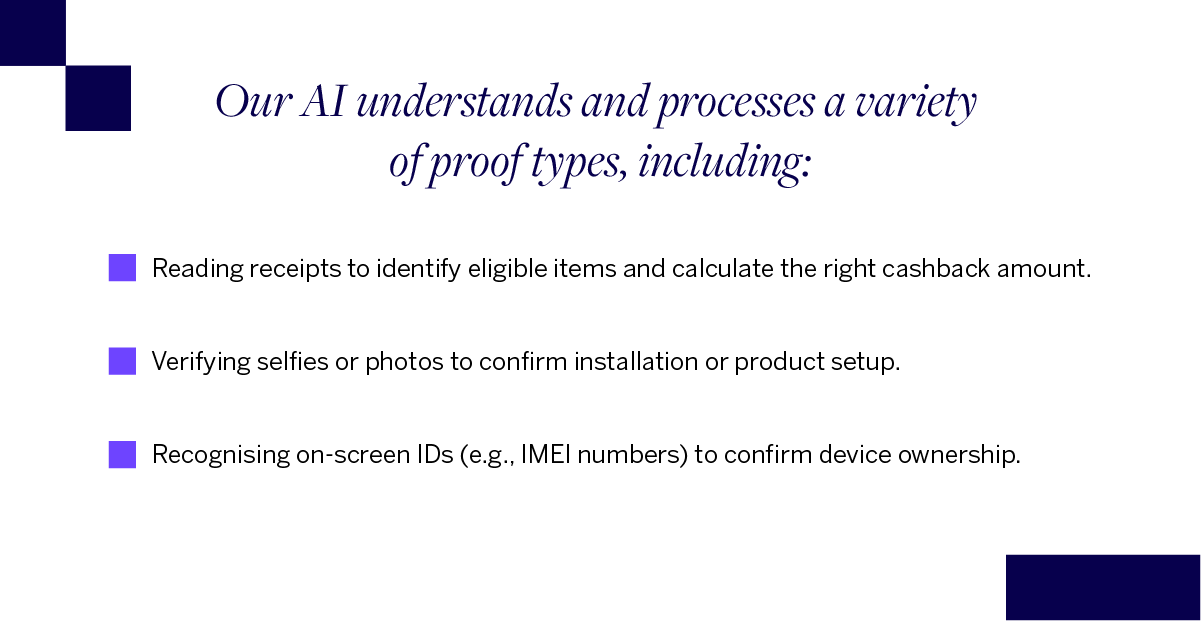
Our AI understands and processes a variety of proof types, including:
- Reading receipts to identify eligible items and calculate the right cashback amount.
- Verifying selfies or photos to confirm installation or product setup.
- Recognising on-screen IDs (e.g., IMEI numbers) to confirm device ownership.
This flexibility enables brands to run creative, multi-step campaigns with confidence without adding complexity to the customer journey.
Who Benefits From Promotional Claims Automation?
Claims automation delivers value across the board:
Brands
- Lower operational costs and reduced fraud.
- Faster, more reliable claims handling.
- Stronger customer loyalty and brand reputation.
- More creative freedom, as AI can validate all kinds of proof, from selfies at events to photos of installed products.
Customers
- Near-instant validation and faster payouts.
- Transparency and trust in the process.
- A better overall experience that matches the speed of e-commerce.
Retailers & Partners
- Reduced administrative burden.
- Smoother customer journeys that encourage repeat purchases.
What to Look for in a Promotional Claims Automation Partner
Not all automation is created equal. When selecting a partner, brands should look for:
- Scalability with Quality: handle hundreds of thousands of claims globally without sacrificing accuracy or customer experience.
- Compliance and Security: built-in adherence to GDPR, ISO standards, and global data protection requirements.
- Customer Experience First: intuitive journeys and instant confirmations, not just low-cost receipt checks.
- AI + Human Expertise: automation backed by experienced teams, delivering precision and brand protection.
- Actionable Insights: robust reporting to guide future strategy.
Benefits of Promotional Claims Automation
The impact of automation is both immediate and long-term:
- Real-Time Validation: Customers know instantly if their entry is approved, building trust and reducing uncertainty.
- Accuracy at Scale: AI reduces errors and disputes, delivering consistency across even the most complex campaigns.
- Fraud Prevention: Smart models detect unusual or suspicious patterns, protecting both brands and customers.
- Efficiency Gains: Automation reduces repetitive manual tasks, freeing resources for higher-value activities.
- Customer Loyalty: Fast, fair, and transparent validation creates positive brand experiences that drive repeat purchase.
- Global Reach: Scalable processes manage multiple markets, currencies, and regulations with ease.
- Actionable Insights: Rich data from validated entries fuels reporting, optimisation, and smarter future campaigns.
Key Takeaways
- Promotional claims automation is transforming the industry by improving speed, accuracy, and customer satisfaction.
- Manual processing is slow and error-prone; automation delivers a seamless experience.
- Opia combines AI-driven technology with expert human oversight to achieve market-leading automation rates.
- Customers, brands, and partners all gain value from automation.
- Choosing the right partner is crucial for ensuring compliance, scalability, and customer trust.
- Automation in promotions isn’t just about efficiency; it’s about building brand loyalty.
- Opia is at the forefront of this shift, helping global brands unlock the full potential of promotional claims.
Partner With Opia
At Opia, we’ve been embedding automation into promotions for over 19 years. From cashback campaigns to trade-in programs, our combination of AI-driven technology and promotional expertise helps global brands deliver seamless experiences at scale.
Ready to transform your promotional claims process?
Contact us today to discover how automation can improve efficiency, reduce fraud, and delight your customers.

What is a Rebate? A Comprehensive Guide
In today’s dynamic marketplace, standing out from the competition and capturing customer attention is more crucial than ever. One powerful tool that often gets overlooked is the rebate. While many confuse rebates with discounts, they offer unique advantages that can significantly impact your bottom line.
This comprehensive guide will delve deep into the world of rebates, exploring their various types, benefits, and key considerations.
Table of Contents
- Key Takeaways
- What is a Rebate?
- Purposes of Rebates
- How Rebates Work
- How Rebates Help Your Business
- Benefits of Using Rebates
- Pros and Cons of Rebates
- Types of Rebates
- Rebates vs. Discounts
- Key Considerations When Offering a Rebate
- Checklist for Evaluating Rebates
- Ready to optimise your coupon and rebate strategies?
- Conclusion
- FAQs
Key Takeaways
- Rebates are a form of sales promotion that provides a refund to customers after a purchase.
- They can be used to incentivise purchases, drive customer loyalty, and gather valuable data.
- Various types of rebates cater to different business needs and target audiences.
- Implementing a successful rebate program requires careful planning and management.
- Opia offers comprehensive solutions to help businesses design and execute effective rebate programs.
What is a Rebate?
A rebate, sometimes described as a “retroactive discount”, is a sales promotion technique where customers receive a refund or a portion of their purchase price back after completing a purchase rather than at checkout
Unlike discounts, which reduce the price at the point of sale, rebates offer a delayed incentive, rewarding customers for their purchase behaviour. This delayed incentive can be a powerful motivator, encouraging customers to choose your product or service over a competitor’s.
Rebates are commonly used in various industries, including:
- Consumer Electronics: Offering rebates on smartphones, laptops, and other electronics can incentivise upgrades and boost sales.
- Automotive: Manufacturers often use rebates to promote specific car models or clear out inventory.
- Retail: Rebates can encourage customers to purchase bundled products, reach spending thresholds, or try new product lines.
Simple Examples of Rebates
- Consumer electronics: Buy a TV and claim £100 back after purchase
- Retail threshold: Spend £200 and receive a £20 rebate
- B2B volume rebate: Purchase 500 units in a quarter and earn 3% back
- Delivery rebate: Get shipping costs refunded after checkout
- Loyalty rebate: Receive cashback after multiple qualifying purchases
Purposes of Rebates
Rebates serve a variety of purposes for businesses, including:
- Increasing Sales: By offering a financial incentive, rebates can motivate customers to make a purchase they might otherwise delay.
- Driving Customer Loyalty: Rebates can reward repeat customers and encourage them to continue choosing your brand. For a deeper understanding of customer loyalty programs, check out our guide to customer loyalty programs.
- Gathering Data: The rebate claim process allows businesses to collect valuable customer information and insights.
- Promoting New Products: Rebates can incentivise customers to try new offerings and drive product adoption.
- Clearing Inventory: Rebates can help move slow-moving or end-of-line products. This can be particularly useful during seasonal promotions. Learn more about maximising your seasonal promotions with our guide to seasonal promotions.
To learn more about how sales promotions can benefit your business, check out our Sales Promotions Guide.
How Rebates Work
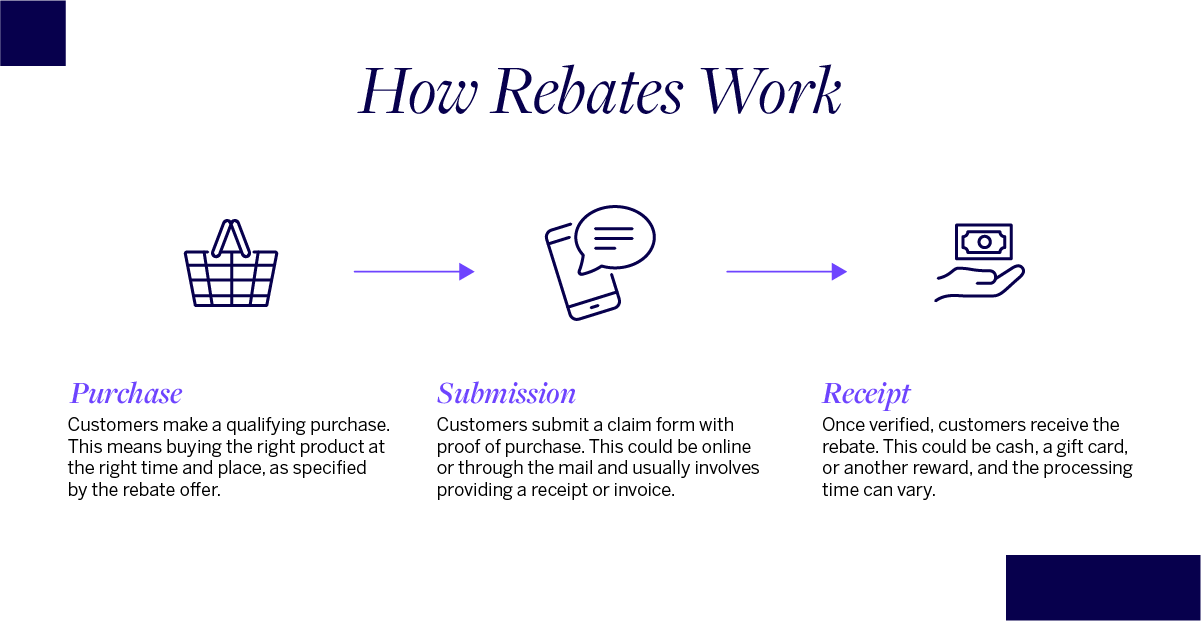
The typical rebate process involves three main steps:
- Purchase: Customers make a qualifying purchase. This means buying the right product at the right time and place, as specified by the rebate offer.
- Submission: Customers submit a claim form with proof of purchase. This could be online or through the mail and usually involves providing a receipt or invoice.
- Receipt: Once verified, customers receive the rebate. This could be cash, a gift card, or another reward, and the processing time can vary.
How Rebates Help Your Business
Rebates are not just an alternative to discounts. They are a strategic lever that allows businesses to influence customer behaviour, protect pricing, and unlock long-term value.
Because rebates are applied after purchase, they can be designed to reward specific actions, such as buying more, buying again, or buying at the right time, without eroding shelf price.
- Shape Customer Behavior: Unlike discounts that simply reduce the price, rebates can be designed to incentivise specific actions. Want customers to buy in bulk? Offer a volume rebate. Want to introduce a new product line? Offer a rebate for trying it. This targeted approach allows you to influence customer behaviour and drive specific outcomes.
- Build Stronger Customer Relationships: Rebates create a sense of reciprocity with your customers. They feel valued and appreciated, which fosters loyalty and encourages repeat business. This is especially true for loyalty rebates, which reward customers for their continued patronage.
- Gain a Competitive Advantage: In a crowded market, a well-structured rebate program can be a powerful differentiator. It allows you to offer value without simply lowering your prices, preserving your brand image and profit margins.
- Gather Valuable Customer Insights: The rebate claim process provides a unique opportunity to collect valuable customer data. You can learn about their preferences, purchase habits, and demographics. This data can then be used to personalise marketing efforts, improve product development, and refine your overall business strategy.
- Optimise Inventory Management: Rebates can be used to strategically manage inventory levels. Offer rebates on slow-moving products to clear out stock and make room for new inventory. This helps to reduce carrying costs and prevent losses from obsolete inventory.
- Enhance Brand Image: Rebates can contribute to a positive brand image. By offering rebates, you’re demonstrating a commitment to providing value to your customers. This can enhance brand perception and build trust.
Benefits of Using Rebates
Rebates deliver a combination of commercial, financial, and customer experience benefits when compared to upfront discounts:
- Increase sales and revenue
Rebates provide a compelling incentive to buy, particularly for higher-value or considered purchases. - Improve cash flow
Because rebates are paid after purchase, businesses retain full upfront revenue while managing payout timing. - Maintain price integrity
Rebates protect list prices and avoid the long-term erosion associated with frequent discounting. - Build customer loyalty
Rebates reward engagement and repeat behaviour, helping brands strengthen long-term customer relationships. - Enhance perceived value
Customers feel rewarded without seeing the product devalued at the point of sale. - Unlock first-party insights
Claim data can be used to inform future promotions, segmentation, and product strategy.
Pros and Cons of Rebates
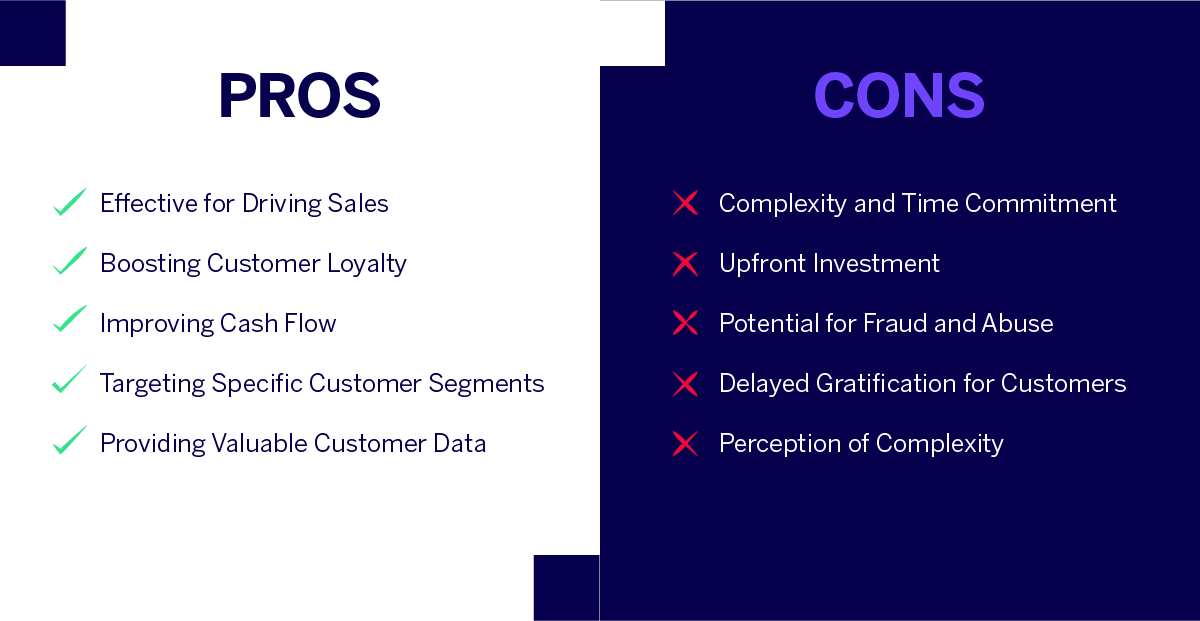
Pros:
- Effective for Driving Sales: Rebates are a proven method for incentivising purchases and increasing sales volume. They create a sense of urgency and encourage customers to take action.
- Boosting Customer Loyalty: By rewarding customers for their purchases, rebates foster loyalty and encourage repeat business. This can lead to long-term customer relationships and increased customer lifetime value.
- Improving Cash Flow: The delayed payout structure of rebates allows businesses to maintain healthy cash flow while still offering attractive incentives. This can be particularly beneficial for businesses with tight budgets.
- Targeting Specific Customer Segments: Rebates can be tailored to target specific customer segments, such as new customers, loyal customers, or high-value customers. This allows for more personalised and effective marketing campaigns.
- Providing Valuable Customer Data: The rebate claim process can provide valuable customer data and insights, which can be used to improve marketing efforts, product development, and customer service.
Cons:
- Complexity and Time Commitment: Setting up and managing a rebate program can be complex and time-consuming, requiring dedicated resources and systems.
- Upfront Investment: Marketing and promoting a rebate program requires an upfront investment, which may not be feasible for all businesses.
- Potential for Fraud and Abuse: Rebates can be susceptible to fraud and abuse, requiring robust verification and security measures.
- Delayed Gratification for Customers: Unlike discounts, rebates offer a delayed reward, which may not be as appealing to some customers who prefer immediate gratification.
- Perception of Complexity: If the rebate claim process is too complex or cumbersome, it can create a negative customer experience and deter participation.
Common Rebate Pitfalls (and How to Avoid Them)
- Overly complex claim processes that discourage participation
- Unclear eligibility rules or deadlines
- Slow validation and poor communication with customers
- Increased exposure to fraud and duplicate claims
- Lack of visibility into performance and redemption rates
Successful rebate programmes balance simplicity for customers with strong validation and control behind the scenes.
Types of Rebates
Rebates come in many forms depending on your commercial goals. Below are some of the most common types of rebates used in sales promotions.
Tax Rebates
Tax rebates are government incentives that reduce your tax liability. These are not typically offered by businesses, but it’s useful to understand them in the broader context of rebates. They often encourage specific behaviours like investing in renewable energy or making energy-efficient home improvements.
Cash Rebates
Cash rebates are a popular and versatile type of rebate where customers receive a cash refund after making a qualifying purchase. This is a great way to incentivise purchases and drive sales, especially for higher-priced items.
Opia can help you design and manage effective cash rebate programs, ensuring a seamless experience for both you and your customers.
Delivery Rebates
Delivery rebates help offset or reduce shipping costs, making products more attractive to customers, especially for online purchases. This can be a powerful incentive for price-sensitive customers or those who frequently shop online.
Instant Rebates
Instant rebates provide an immediate discount at the point of sale. They offer instant gratification and are great for driving impulse purchases or clearing out inventory.
Opia can help you integrate instant rebates into your promotional campaigns, creating a sense of urgency and maximising their impact.
Loyalty Rebates
Loyalty rebates are essential for rewarding repeat customers and building long-term relationships. They are a key component of customer loyalty programs and can significantly increase customer lifetime value.
Opia specialises in creating and managing customer loyalty programs that incorporate various types of rewards, including rebates, to keep your customers engaged and coming back for more.
Manufacturer Rebates
Manufacturer rebates are offered by manufacturers to incentivise retailers to sell their products. These are common in industries like consumer electronics and automotive.
Flat-Rate Rebates
Flat-rate rebates offer a fixed rebate amount, regardless of the purchase price. They are simple to understand and administer, making them suitable for various promotions.
Percent Rebates
Percent rebates are calculated as a percentage of the purchase price. The higher the purchase amount, the larger the rebate. This can encourage higher spending and promote premium products.
Sales Rebates
Sales rebates are offered retroactively for past purchases. They can be used to reward loyal customers, incentivise bulk purchases, or clear out inventory.
Volume Rebates
Volume rebates are tiered rebates based on the quantity of products purchased. They are common in B2B settings and encourage larger orders.
Coupon and Rebate Incentives
Combining coupons and rebates can create a powerful incentive by offering both immediate and delayed rewards. This maximises customer appeal and drives sales.
Opia can help you design integrated sales promotion strategies that combine coupons and rebates for maximum impact.
For a deeper breakdown, see our guide to rebates.
Rebates vs. Discounts
While both rebates and discounts are sales promotion techniques, they work in very different ways.
Choosing Between Rebates and Discounts
Use discounts when:
- You need to stimulate immediate demand and drive quick sales.
- You’re less concerned about maintaining a premium price perception.
- You want to offer a simple and easily understood incentive.
Use rebates when:
- You want to encourage repeat purchases and build customer loyalty.
- You need to manage cash flow and delay payouts.
- You want to gather valuable customer data through the claim process.
- You want to maintain price integrity and avoid price erosion.
When Rebates Work Best
- High-value or considered purchases
- Bundles or multi-product mechanics
- Volume or loyalty-driven campaigns
- When price protection is important
- When first-party data capture matters
Key Considerations When Offering a Rebate
Launching a rebate program involves more than just offering a refund. Consider these critical factors to maximise effectiveness and avoid potential pitfalls:
Rebate Management Process
Establishing a clear and efficient process for managing rebate claims is crucial for a successful program. This includes:
- Planning and Design: Define clear objectives for the rebate program, determine eligibility criteria, and design the claim process.
- Claim Submission: Provide user-friendly online forms or mail-in options for customers to submit their claims.
- Verification and Approval: Implement a robust verification process to ensure only valid claims are approved.
- Payment and Fulfillment: Choose a reliable method for delivering rebates to customers, such as direct deposit, gift cards, or checks.
- Tracking and Reporting: Monitor the performance of your rebate program with comprehensive tracking and reporting tools.
Automated claim validation and fulfilment are critical at scale, ensuring speed for customers and control for brands.
Purchase Price
Clearly communicate the qualifying purchase amount and any exclusions to avoid confusion and ensure transparency. This includes specifying whether the rebate applies to the pre-tax or post-tax amount, and whether any other discounts or promotions affect the qualifying purchase price.
Time of Purchase
Set clear deadlines and time frames for rebate eligibility. This includes specifying the start and end dates of the promotion, any time zone considerations, and the exact cut-off time for purchases to qualify.
Promotion and Communication
Effectively promote your rebate program through various channels, such as your website, social media, email marketing, and in-store displays. Communicate the rebate terms and conditions to ensure transparency and avoid customer frustration.
Fraud Prevention
Implement measures to prevent fraud and abuse, such as unique codes, claim limits, and address verification. For more insights on preventing coupon fraud, read our blog post on preventing coupon fraud.
Customer Support
Provide excellent customer support to address any questions or issues related to the rebate program. This can include a dedicated customer service team, FAQs, and online resources.
Technology and Automation
Leverage technology and automation to streamline the rebate management process, reduce manual errors, and improve efficiency.
Checklist for Evaluating Rebates
Deciding whether to implement a rebate program depends on various factors. Here’s a checklist to help you assess if rebates align with your business needs and goals:
- Target Audience: Do your customers respond well to delayed incentives?
- Budget: Do you have the resources to manage a rebate program effectively?
- Product/Service: Are your offerings suitable for rebates?
- Clarity: Can you clearly communicate the rebate terms and conditions?
- Tracking: Do you have a plan to track and measure the results?
If you can confidently answer “yes” to these questions, rebates might be a valuable addition to your marketing strategy.
Ready to optimise your coupon and rebate strategies?
Get in touch with our experts to discover how Opia can help you drive sales and boost customer loyalty.
Conclusion
Rebates can be a powerful tool for businesses to drive sales, boost customer loyalty, and achieve their marketing objectives. By understanding the different types of rebates, their benefits and drawbacks, and key considerations, businesses can develop and implement effective rebate programs that deliver measurable results.
Opia offers comprehensive sales promotion solutions to help businesses design, manage, and optimise their rebate programs, maximising their impact and ROI.
FAQs
What is a rebate?
A rebate is a sales promotion where you get money back after you buy something. It’s like a refund, but you get it just for making the purchase, not for returning anything.
What is an example of a rebate?
Imagine buying a camera for $200 with a $20 rebate offer. You pay $200 upfront, then submit a claim to get $20 back, making your final cost $180.
Does rebate mean money back?
Yes, a rebate is a refund you receive after you buy something.
Is a rebate a discount?
No. A discount lowers the price immediately; a rebate gives you money back later after you submit a claim.
What is the difference between a rebate and a refund?
A refund is given for returns or issues with a purchase. A rebate is a reward for making a purchase and is a type of sales promotion.
Is a rebate the same as a tax rebate?
No. In marketing, rebates are post-purchase incentives used by brands to drive sales. Tax rebates are government refunds and are not covered in this guide.
Gift with Purchase Promotions (GWP) Guide
Gift with Purchase (GWP) promotions are a simple idea with a big impact. When customers buy a qualifying product or spend above a certain amount, they receive an additional gift at no extra cost.
Instead of cutting prices, brands add value, making their offer more attractive, protecting price perception, and giving customers a compelling reason to choose them over competitors.
In this guide, we explain what GWP means in marketing and in business, how these promotions work in practice, when to use them, and how to design campaigns that drive profitable, repeatable sales uplift.
Table of Contents
- Key Takeaways
- Gift with Purchase (GWP) Meaning in Marketing
- GWP Meaning in Business
- Why Gift with Purchase Promotions Work
- How Do Gift with Purchase Promotions Work?
- GWP vs Discounts: A Quick Comparison
- Common Types of Gift with Purchase Promotions
- When Should You Use a Gift with Purchase Campaign?
- Benefits of Gift with Purchase Promotions
- How GWP Promotions Compare to Traditional Discounts
- Key Considerations for a Successful GWP Campaign
- Expert Tips for Successful GWP Promotions
- Common Mistakes to Avoid in GWP Promotions
- Examples of Successful GWP Promotions
- The Science of Sales Promotion
- How Opia Can Help Your Campaigns
- Get in Touch
- FAQs about Gift with Purchase Promotions
Key Takeaways
- GWP promotions drive immediate sales and market share by offering digital or physical rewards that attract customers without reducing shelf price
- Adding a gift increases perceived product value while maintaining price integrity and protecting brand positioning
- GWP campaigns attract new customers and build loyalty by providing a compelling incentive that encourages repeat purchases
- The claim and redemption process captures first-party customer data that informs future marketing strategy
- GWP campaigns can be customised to fit specific marketing goals, seasons, or events, from product launches to channel-specific incentives

Gift with Purchase (GWP) Meaning in Marketing
In marketing, GWP (Gift with Purchase) is a sales promotion strategy where customers receive an extra product, service, or credit for free when they make a qualifying purchase.
Instead of discounting the core product, the brand adds a reward on top. For example:
- “Buy this skincare set and receive a free cosmetic pouch.”
- “Spend £300 on selected TVs and get a £50 streaming credit.”
The goal is to:
- Influence buying decisions at the point of sale
- Increase average basket size or push customers into higher-value tiers
Differentiate your offer in crowded, price-sensitive categories
GWP Meaning in Business
From a commercial point of view, GWP is a way to:
- Protect long-term price perception
- Drive short-term sales uplift
- Introduce new products or services
- Reward loyalty without making always-on discounting the default
Done well, gift with purchase campaigns become part of a wider promotion strategy, used for product launches, seasonal peaks, or to support key channels and retailers.
Why Gift with Purchase Promotions Work
Gift with Purchase campaigns work because they tap into several proven behavioural triggers:
- Reciprocity: when customers receive something extra for free, they are more likely to feel positive toward the brand and complete the purchase
- Perceived value: a well-chosen gift can make the offer feel significantly more valuable, even when the cost to the brand is carefully controlled
- Urgency and scarcity: framing the gift as limited-time only or while stocks last encourages customers to act now rather than wait
- Risk reduction: a thoughtful gift such as accessories, extended warranty, or service credit can make a high-consideration purchase feel more justified
Combined with smart targeting and clear commercial modelling, these levers make GWP a powerful alternative to deep discounting.
How Do Gift with Purchase Promotions Work?
Opia recommends running GWP promotions through a straightforward claim and redemption process, ensuring the promotion is easy to enter with a fast fulfilment process. All of Opia’s promotions are built on our Rapid Rewards platform, allowing campaigns to be launched simply and efficiently across multiple markets.
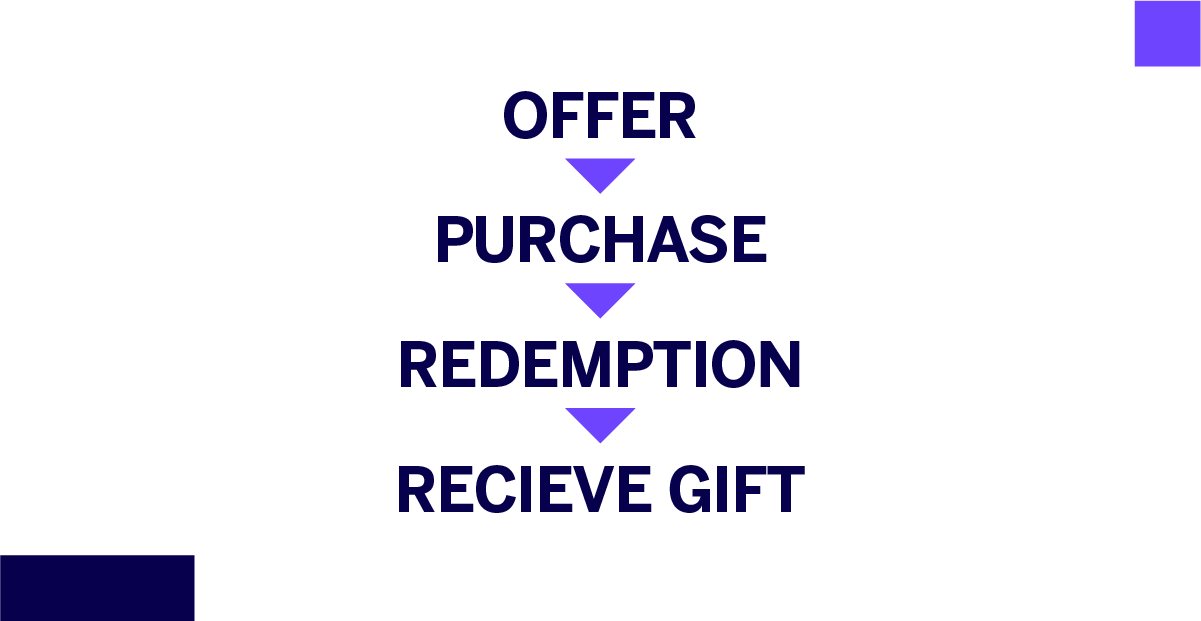
1. Offer
The business, brand, or retailer creates a promotion where an additional item is offered for free when customers purchase a qualifying product. This offer is communicated clearly through various marketing channels including in-store displays, online banners, social media, and email newsletters.
2. Purchase
Customers buy a product that qualifies for the gift with purchase offer. The qualifying criteria can be based on purchasing a specific product, reaching a certain spending threshold, or buying from a particular product category.
3. Redemption
We recommend running a post-purchase fulfilment model. The customer completes a claim on a redemption website we build, which we validate, and the reward is delivered to the customer shortly after purchase through an efficient fulfilment process.
4. Receive
Customers receive their free gift within a specified SLA period, which is detailed in the promotion terms and conditions. Efficient delivery and clear communication about gift status are essential to a positive customer experience. Our claim tracker and regular communications keep customers informed throughout.
GWP vs Discounts: A Quick Comparison
Here is how Gift with Purchase compares to a traditional discount across the metrics that matter commercially.
| Gift with Purchase | Discount | |
| Price impact | None. Full shelf price maintained | Direct reduction in price paid at register |
| Margin impact | Controlled. Cost is the gift, not margin on the core product | Direct margin reduction on every unit sold |
| Brand positioning | Protects premium positioning and price integrity | Risk of price erosion and devaluation if used frequently |
| Customer behaviour | Drives purchase through added value and reciprocity | Trains customers to wait for the next deal |
| Data capture | First-party data collected through claim and redemption process | No data capture at point of sale discount |
| Best for | Product launches, competitive categories, loyalty building | Inventory clearance, short-term volume, competitive response |
For a deeper look at how these tactics fit into your wider strategy, see our guide on Discounts vs Sales Promotions vs Offers.
Common Types of Gift with Purchase Promotions
GWP campaigns can be designed in many ways. Some of the most common formats include:
- Product accessories: a free smartwatch strap with a wearable, a case with a phone, or a mount with an action camera
- Digital rewards: streaming or gaming credit, subscription vouchers, cloud storage, or app credit linked to device usage
- Service-based gifts: installation, extended warranty, accidental damage cover, or performance guarantees
- Lifestyle rewards: fuel, grocery, or utility bill credits that support cost-of-living pressures while reinforcing brand empathy
- Branded merchandise or bundles: limited-edition merchandise, travel kits, or themed bundles that build affinity and create a collectable feel
The right GWP concept depends on your category, your margins, and the role you want the promotion to play: tactical sales uplift, long-term loyalty, or both.
When Should You Use a Gift with Purchase Campaign?
GWP promotions are especially effective when you want to:
- Launch or relaunch a product: give early adopters extra value without cutting the launch price
- Compete in a crowded category: stand out in a comparison table or retail aisle without entering a discount race
- Increase average order value (AOV): use minimum spend thresholds to nudge customers into higher-value baskets
- Clear end-of-line or slow-moving stock: repurpose older lines or accessories as perceived-high-value gifts
- Reward loyalty and repeat purchase: offer exclusive gifts for existing customers, VIP segments, or specific channels
With the right modelling and risk management, GWP can be used as a repeatable, scalable lever, not just a one-off promotional tactic.
Benefits of Gift with Purchase Promotions
1. Increased Sales and Customer Engagement
GWP promotions are a powerful tool for driving sales and engaging customers. By offering a free product or service, these promotions make the primary product more attractive, leading to higher sales volumes. Customers are more likely to purchase a product if they receive an additional gift, enhancing the overall value of the deal.
2. Enhanced Perceived Value
GWP promotions increase the perceived value of the primary product without reducing its price. This strategy helps maintain price integrity and avoids price erosion. The additional gift makes the purchase more appealing and can eliminate price as a barrier in the buying decision process.
3. Fostering Brand Loyalty
GWP promotions significantly enhance brand reputation and customer loyalty. Customers appreciate the added value of a free gift, improving their overall perception of the brand. The process of receiving a gift creates a positive interaction with the brand, fostering loyalty and encouraging repeat purchases.
4. Building Valuable Customer Insights
GWP promotions offer a unique opportunity to gather valuable customer data. By requiring customers to register or provide details to receive their gift, brands can collect information about purchasing habits, preferences, and demographic details. These insights inform future marketing strategies and promotional campaigns.
5. Strategic Flexibility and Creativity
GWP promotions allow brands to design unique and creative campaigns tailored to their specific needs and target market. Whether it is a seasonal promotion, a product launch, or a strategy to clear end-of-line stock, GWP offers can be customised to align with broader marketing objectives.
6. Efficient Delivery and Customer Experience
In addition to selecting the right gift, the timing of its receipt is critical. Ensure that customers’ free gifts are delivered quickly and efficiently, with clear delivery notifications to keep them informed. This enhances the customer experience and increases the perceived value of the promotion.
How GWP Promotions Compare to Traditional Discounts
While discounts reduce the upfront price, Gift with Purchase promotions take a different approach by adding value instead of removing it. This makes GWPs particularly effective for brands looking to retain price integrity, protect premium positioning, and avoid long-term price erosion.
Unlike discounts, which can train customers to wait for a deal, a well-chosen gift creates a positive brand interaction and increases perceived value without lowering margins.
If you want to explore how discounts fit into the wider promotions landscape, our guide on Discounts vs Sales Promotions vs Offers explains when each tactic works best.
Key Considerations for a Successful GWP Campaign
1. Set Clear Goals and KPIs
Establish clear goals and key performance indicators from the outset. These could include boosting sales on a specific product line, clearing end-of-line stock, attracting new customers, or increasing market share. Defining these objectives will help measure the campaign’s success and guide its implementation.
2. Plan Budgets and Manage Risks
Identifying the promotional cost can be challenging, as it depends on customer behaviour and redemption levels. To mitigate risk, consider working with providers who offer risk management solutions, such as fixed fees per unit sold, ensuring profitability regardless of redemption rates.
In addition to modelling the cost of the gift itself, consider:
- Minimum spend thresholds to protect margin and increase AOV
- Category or product-level targeting to focus on strategic ranges
- Stock and fulfilment constraints so the promotion can be delivered reliably in all markets
3. Align with Overall Marketing Strategy
When planning a GWP promotion, integrate it into your overall marketing strategy. Identify key periods where a GWP offer could drive sales, such as during holidays or specific events. Ensure that the promotion complements other marketing efforts and enhances the overall customer journey.
4. Use Creative Concepts and Appropriate Promotional Channels
For a GWP promotion to be successful, it needs to engage your audience with a compelling campaign. Get inventive with your marketing triggers and tie your promotion to relevant themes or events. Use appropriate channels to promote the campaign, including social media, email marketing, and in-store promotions, to maximise reach and impact.
Ensure all terms are simple and clearly communicated across every channel, including in-store staff training, on-pack messaging, and retailer communications, to avoid confusion at the point of purchase.
5. Leverage Technology for Campaign Setup
Ensure a high-quality customer experience by using specialist software to manage campaign redemption activities, customer support, and reward fulfilment. A seamless digital process will enhance customer satisfaction and streamline the administrative aspects of the promotion.
This also makes it easier to track redemptions, monitor inventory in real time, and quickly adjust communications if stock levels change.
Expert Tips for Successful GWP Promotions
Clear and Simple Redemption Process
Ensure the redemption process is straightforward for customers. Provide clear, step-by-step instructions and consider using visual aids like infographics or videos. A hassle-free process enhances customer satisfaction and encourages repeat purchases.
Importance of Tracking
Accurate tracking is essential. Use advanced technology to monitor gift redemptions and customer interactions in real time. This ensures efficient inventory management and distribution and provides valuable data on customer behaviour and redemption rates to inform future promotions.
Building Excitement and Engagement
Create excitement by actively engaging with customers through social media, email newsletters, and in-store displays. Highlight the value and exclusivity of the gift. Regular updates on gift availability and promotion status keep customers interested and engaged.
Select Relevant and Valuable Gifts
Choose gifts that are relevant to your target audience and complement your main product. Conduct market research to understand customer preferences and select gifts that align with their needs, increasing the perceived value of the promotion.
Create Limited-Time Offers
Create a sense of urgency by making your GWP promotion a limited-time offer. Limited availability encourages customers to act quickly, boosting sales and engagement. Highlight the scarcity and exclusivity of the gift to drive immediate purchases and increase the effectiveness of the promotion.
Common Mistakes to Avoid in GWP Promotions
Even strong brands can run into problems if a GWP campaign is not planned carefully. Common pitfalls include:
- Choosing an irrelevant or low-value gift: if the gift does not feel useful or exciting to your audience, it will not influence behaviour
- Overcomplicating the mechanics: complex rules, unclear thresholds, or hidden exclusions quickly create frustration and complaints
- Underestimating demand or stock: running out of qualifying products or gifts mid-campaign damages trust with customers and retailers
- Forgetting about packaging and presentation: poorly presented gifts reduce perceived value, even if the reward itself is strong
- Not measuring the right metrics: looking only at redemptions rather than sales uplift, AOV, or lifetime value can hide the true impact
Working with an experienced promotions partner helps you design a concept that is commercially sound, operationally realistic, and compelling for your customers.
Examples of Successful GWP Promotions
Here are some examples of how we have helped leading brands achieve their sales and marketing goals through expertly crafted GWP promotions.
$100 Streaming Service Credit with LG TV Purchases
In the US, LG Electronics sought to replicate the success of their previous promotion, which included a Disney+ subscription as a gift with LG TV purchases. With Disney+ unavailable, LG needed an alternative that would deliver similar or better results and keep retailers motivated to promote their products.
Opia designed a new promotion offering a £100 credit toward streaming or gaming services with Prime Video, Hulu, Showtime, Sling, or Xbox for each LG TV purchase. This approach increased sales and created a unique selling point for LG TVs in a competitive market. The promotion generated excitement among consumers and retailers, boosting foot traffic and sales performance.

Free Samsung Galaxy Watch Active with S Series Phones
In the United Kingdom, Samsung aimed to maintain its market presence and drive sales of its flagship S Series phones during the post-Christmas period by offering a free Galaxy Watch Active with each purchase. This approach increased sales, showcased the benefits of the Samsung Watch Active and the Samsung Health app, and avoided costly discounts while enhancing perceived value.
Opia managed the entire promotion, from creating the campaign concept to handling claim management and customer support. The campaign exceeded expectations, driving high engagement and reinforcing Samsung’s market position.

The Science of Sales Promotion
Promotions have evolved from unpredictable ventures to scientifically driven strategies. Opia leverages years of data insights to advise on the best promotional tactics based on your category and objectives. This scientific approach allows for predictable and confident planning of your product cycles, ensuring maximum ROI.
How Opia Can Help Your Campaigns
At Opia, we understand that every brand has unique commercial goals. Our bespoke approach ensures that each promotional idea is tailored to your specific needs, driving action from your target market. By working closely with our clients, we design innovative promotional solutions that offer the best value for you and your customers.
Discover more about how we can increase your sales revenue with our different types of disruptive promotion campaigns. Visit our gift with purchase page for more information.
Get in Touch
Ready to delight your customers and reduce your promotional costs? Get in touch today to discuss how we can start building your customised campaign. At Opia, we take pride in offering end-to-end sales promotion solutions, ensuring a seamless and hassle-free experience for our clients.
FAQs about Gift with Purchase Promotions
What does gift with purchase mean?
A gift with purchase is a sales promotion strategy where customers receive an additional product or service for free when they make a purchase.
What does GWP mean in marketing?
In marketing, GWP stands for Gift with Purchase. It refers to a promotion where customers receive a free gift when they buy a qualifying product or spend above a set amount.
What does GWP mean in business?
In a business context, GWP is a sales promotion strategy used to drive short-term sales uplift, increase average order value, and build loyalty without relying solely on price discounts.
Is Gift with Purchase the same as a discount?
No. A discount directly reduces the price paid. A Gift with Purchase maintains the core price but adds value with an additional product or service, which helps protect price perception and brand positioning.
What is the gift with purchase trend?
The gift with purchase trend involves offering free products or services with a purchase to increase the perceived value and attractiveness of the primary product, particularly in consumer electronics, beauty, and home appliances.
How can gift with purchase promotions benefit brands?
GWP promotions drive sales, enhance perceived product value, foster customer loyalty, provide valuable customer insights, and offer strategic flexibility.
How can brands ensure a successful gift with purchase campaign?
Brands should set clear goals, plan budgets carefully with fixed-fee risk management, align the promotion with their marketing strategy, use creative concepts, and leverage technology for management and fulfilment.
Are gift with purchase promotions better than traditional discounts?
GWP promotions increase the perceived value of the primary product without reducing its price, maintaining price integrity and avoiding price erosion. For brands that need to protect shelf price and channel relationships, GWP is typically the stronger long-term strategy.
What are some common pitfalls to avoid in gift with purchase promotions?
Common pitfalls include choosing an irrelevant gift, overcomplicating the mechanics, underestimating demand, poor packaging presentation, and measuring only redemptions rather than sales uplift and ROI.
Sales Promotion Plan: Step-by-Step Guide
Most promotional campaigns that underdeliver have one thing in common: they were built around a tactic rather than a plan. A discount chosen because it worked last quarter, a mechanic copied from a competitor, a budget set before anyone defined what success looks like.
A well-structured sales promotion plan changes that. It turns promotions from one-off tactics into repeatable commercial tools, aligned around clear goals, the right audience, and mechanics that actually move the needle.
In this guide, we cover the ten steps to building an effective sales promotion plan, from setting goals to evaluating results, along with the promotion types best suited to each objective.
Key Takeaways
- A sales promotion plan turns one-off campaigns into repeatable commercial tools by aligning goals, mechanics, budget, and measurement before launch
- Setting SMART goals upfront is the difference between a campaign you can evaluate and one you can only guess at
- The right promotion mechanic depends on your objective: cashback and trade-in protect shelf price, referral programmes drive lower-cost acquisition, gift with purchase increases perceived value without discounting
- Risk assessment and budget modelling should happen before creative, not after: know your maximum liability before you commit to a mechanic
- Post-campaign evaluation is where the real value compounds: the insights from one campaign become the planning inputs for the next
What Is a Sales Promotion Plan?
A sales promotion plan is a structured roadmap for how you will use promotions to drive growth. It defines why you are running a promotion, who you are targeting, which mechanics you will use such as cashback, trade-in, referral, or gift-with-purchase, and how you will budget, launch, and measure success.
Instead of one-off discounts, a clear plan turns promotions into repeatable growth levers. It aligns marketing, sales, finance, and operations around shared objectives, timelines, and KPIs, so every campaign is designed to deliver measurable commercial impact rather than just a short-term spike.
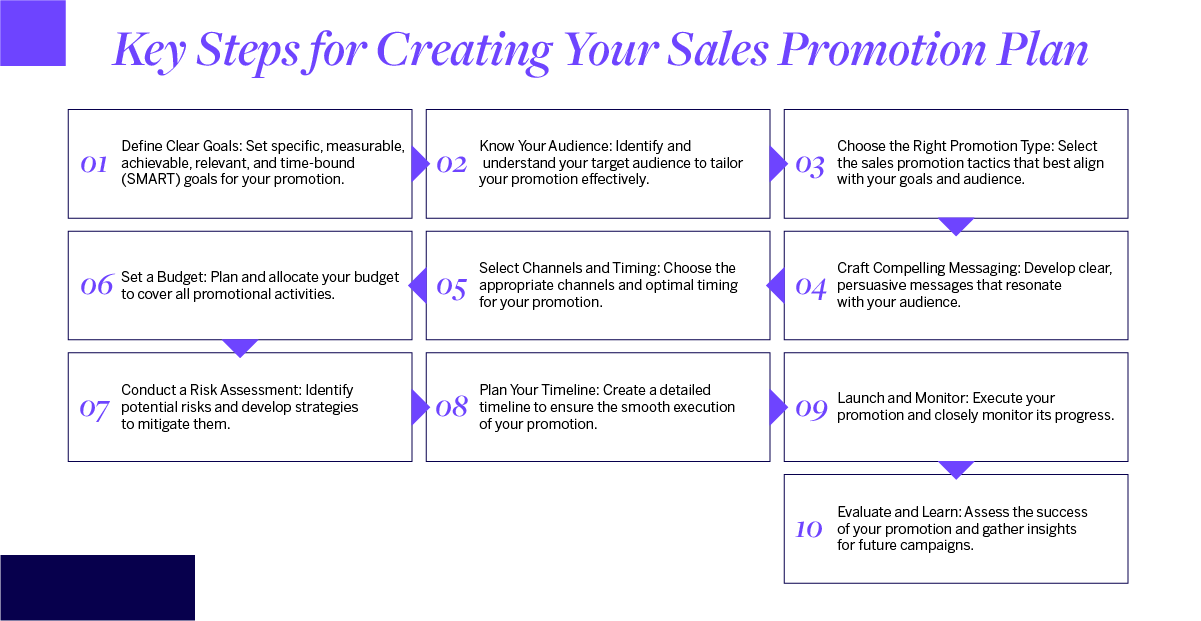
Key Steps for Creating Your Sales Promotion Plan
- Define Clear Goals
- Know Your Audience
- Choose the Right Promotion Type
- Craft Compelling Messaging
- Select Channels and Timing
- Set a Budget
- Conduct a Risk Assessment
- Plan Your Timeline
- Launch and Monitor
- Evaluate and Learn
Download the Sales Promotion Planning Guide
If you would like to turn this article into a working document, you can download our Sales Promotion Planning Guide.
Inside, you will find:
- A step-by-step framework from goal-setting to post-campaign review
- Fillable templates for budgets, timelines, and KPIs
- Practical tables to compare promotion types and mechanics
- Real-world examples of cashback, trade-in, referral, and more
This resource is designed to help you move from ideas to an actionable plan you can share with your wider team.
Sales Promotion Planning: Step-by-Step Guide
1. Define Your Goals
The first step in any successful sales promotion plan is to define your goals. Ensure they are SMART: Specific, Measurable, Achievable, Relevant, and Time-bound. Clear objectives will guide your strategy and help you measure success.
Example goals:
- Increase sales by 15% in the next quarter
- Acquire 500 new customers within two months
- Clear 30% of excess inventory by year-end


2. Know Your Audience
Understanding your target audience is critical. Gather data through surveys, social media insights, and customer feedback to identify demographics, preferences, and buying behaviours. Consider building buyer personas to tailor your promotion to the people most likely to respond to it.
3. Choose the Right Promotion Type
Selecting the right sales promotion type depends on what you are trying to achieve and who you are trying to reach. Are you looking to drive immediate sales, clear inventory, or build long-term loyalty? Different mechanics serve different purposes.
Discounts and coupons can quickly boost volume. Referral programmes leverage existing customers to bring in new ones. Buy and try mechanics reduce hesitation on premium or new products. Cashback and trade-in promotions drive conversion while protecting shelf price.
Aligning your promotion type with your goals and customer preferences is what separates campaigns that deliver lasting impact from those that produce a short-term spike and little else.


4. Craft Compelling Messaging
Develop clear, persuasive messaging that communicates the benefit of your promotion simply and directly. Use attention-grabbing headlines, strong calls to action, and compelling visuals. Make sure your messaging aligns with your brand values and speaks to your target audience in language they recognise.
5. Select Channels and Timing
Choose the marketing channels that best reach your target audience, whether that is social media, email marketing, paid advertising, or influencer partnerships. Keep messaging consistent across all channels and time your promotion to launch when your audience is most likely to act.


6. Set a Budget
Establish a budget that covers all promotional activities. Consider both fixed costs such as creative development and market research, and variable costs such as media spend and sales commissions. Use data from past campaigns to set realistic cost assumptions and build in contingency for overperformance.
7. Conduct a Risk Assessment
Identify potential risks that could affect your promotion, from market changes to logistical challenges. Develop strategies to mitigate them and ensure compliance with legal and regulatory requirements.
Beyond operational risks, connect your promotion plan to profitability:
- Margin impact: Model how different reward levels and participation scenarios affect your gross margin
- Uplift assumptions: Define the minimum sales uplift required for the campaign to break even or outperform business as usual
- Liability exposure: Understand your maximum potential payout if the promotion overperforms, and agree in advance how this will be funded
At Opia, we use promotional risk modelling and fixed-fee structures to give brands a clear liability cap before launch. This allows marketing teams to run more ambitious campaigns while giving finance and leadership the certainty they need to approve them.


8. Plan Your Timeline
Create a detailed timeline with key milestones and deadlines. Assign clear ownership to each task and use project management tools to track progress. Build in buffer time to account for unexpected delays, particularly around creative approvals, legal review, and retailer briefings.
9. Launch and Monitor
Execute your promotion and monitor its performance closely from day one. Track key metrics including sales volume, website traffic, claim rates, and customer engagement. Be ready to adjust spend, messaging, or channel mix based on real-time performance data.


10. Evaluate and Learn
After the promotion ends, evaluate its success against your initial goals. Analyse sales data, customer feedback, and engagement metrics to understand what worked and what did not.
When reviewing performance, look beyond headline sales and focus on a core set of KPIs:
- Sales uplift: Incremental units and revenue compared with a realistic baseline period
- Redemption and participation rates: Are customers engaging with the mechanic as expected?
- Average order value and product mix: Did the promotion encourage trade-up, bundling, or higher basket value?
- Cost per claim and ROI: Total cost of rewards, media, and operations versus incremental profit
- New vs existing customers: Are you mainly rewarding loyal customers or also driving new acquisition?
Document these insights and feed them back into your next sales promotion plan. Over time, this creates a learning loop that makes each campaign more effective, more efficient, and more aligned with your wider commercial strategy.
Choosing the Right Sales Promotion Mechanic
Different promotion types serve different objectives. The right mechanic depends on what you are trying to achieve, whether that is driving volume, protecting price perception, encouraging upgrades, or increasing loyalty.
Below are the most effective sales promotion types used by brands today, and when to use each one.
1. Cashback and Value-Back Promotions
Customers receive money back after purchase when they meet defined criteria such as product, retailer, spend level, or date range.
Use when you want to:
- Drive short-term volume without permanently lowering shelf price
- Reward specific products, channels, or baskets
- Create a clear, tangible value message such as “up to £200 back”
2. Trade-In Promotions
Customers trade in an old product in return for a reward or discount on a new one.
Use when you want to:
- Encourage upgrades to newer, higher-margin products
- Support sustainability goals by taking older products out of circulation
- Differentiate your offer beyond simple price cuts
3. Buy and Try (Satisfaction Guarantees)
Customers buy with the option to claim a full or partial refund if they are not satisfied within a defined period.
Use when you want to:
- Reduce perceived risk for premium or new-to-market products
- Encourage trial among hesitant customers
- Build trust by standing behind product quality
4. Gift with Purchase (GWP)
Customers receive a free product, service, or experience when they buy a qualifying product.
Use when you want to:
- Increase perceived value without discounting the core product
- Drive higher basket value or attach rates
- Introduce customers to complementary products or services
5. Event-Driven Promotions
Rewards are linked to specific events or milestones such as sports results, seasonal peaks, or product launch windows.
Use when you want to:
- Leverage cultural or seasonal moments to drive urgency
- Create highly engaging, time-bound campaigns
- Stand out from generic discounts with a more creative concept
6. Referral and Rewards Programmes
Existing customers are rewarded for referring friends, family, or colleagues.
Use when you want to:
- Acquire new customers at a lower cost than paid media alone
- Reward and retain your most loyal advocates
- Build a stronger first-party data asset
7. Bundles and Buy More Save More Offers
Customers receive added value when they buy in bundles or reach a defined spend threshold.
Use when you want to:
- Increase average order value
- Promote complementary products and attach rates
- Clear specific lines without discounting everything
8. Instant Win and Prize Draw Promotions
Customers have the chance to win prizes when they participate, often alongside another promotion mechanic.
Use when you want to:
- Create excitement and ongoing engagement across the campaign period
- Add a layer of gamification to a launch or peak period
- Support brand awareness alongside short-term sales
The most effective sales promotion plans often combine more than one mechanic. A cashback offer with an instant win overlay, or a trade-in paired with a gift with purchase for early adopters. The key is ensuring each mechanic is aligned with your objectives, budget, and operational capabilities.
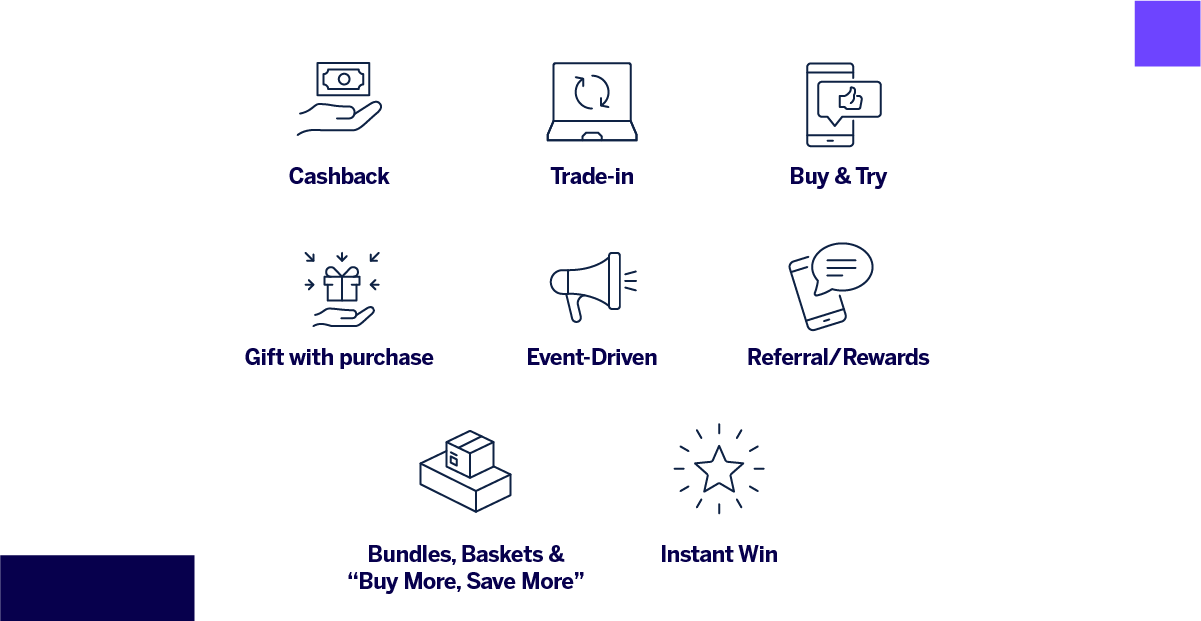
Conclusion
A strong sales promotion plan is what separates campaigns that deliver lasting commercial impact from those that produce a temporary spike and little else. When every step, from goal-setting to post-campaign evaluation, is connected by a clear strategic thread, promotions become repeatable growth tools rather than one-off bets.
If you are ready to move from planning to action, download our Sales Promotion Planning Guide. It brings these ten steps together into a practical toolkit with templates, examples, and planning tables you can use with your team.
Get in Touch
Ready to take your sales promotions to the next level? Contact Opia today to discuss how we can help you design and execute results-driven sales promotions tailored to your business goals.
FAQs
What is a sales promotion plan?
A sales promotion plan is a structured roadmap that defines why you are running a promotion, who you are targeting, which mechanics you will use, and how you will budget, launch, and measure success. It turns promotions from one-off tactics into repeatable commercial tools aligned around clear goals and measurable KPIs.
What are the steps in a sales promotion plan?
Key steps include defining your goals, knowing your audience, choosing the right promotion type, crafting compelling messaging, selecting channels and timing, setting a budget, conducting a risk assessment, planning your timeline, launching and monitoring, and evaluating your promotion.
What is the promotion planning process in marketing?
The promotion planning process involves setting objectives, identifying the target audience, selecting promotion types, creating a budget, developing a timeline, executing the promotion, and evaluating its effectiveness against defined KPIs.
Why are sales promotions important?
Sales promotions drive immediate sales, attract new customers, boost brand awareness, enhance customer loyalty, and generate data that informs future marketing strategy.
How do I choose the best sales promotion tactic?
Choose the tactic that best aligns with your goals, target audience, and overall marketing strategy. Cashback and trade-in promotions work well for driving conversion while protecting shelf price. Referral programmes are effective for lower-cost acquisition. Gift with purchase increases perceived value without discounting. The right choice depends on what you are trying to achieve and who you are trying to reach.
What metrics should I track to evaluate my sales promotion?
Track sales uplift against a baseline, redemption and participation rates, average order value, cost per claim, ROI, and the ratio of new to existing customers. These metrics give you a clearer picture of commercial impact than top-line sales alone.

Navigating Sports Promotion Compliance for Global Sales Success
Event-driven promotions link customer rewards to live sporting moments — like earning cash for every goal scored or win achieved. They’re powerful, emotional, and proven to drive measurable sales uplift.
But tapping into that excitement comes with one big challenge: compliance. To stay on the right side of trademark ownership and sponsorship agreements, brands — especially non-sponsors — must understand what they can and can’t say.
This guide explains how to design compliant, event-driven promotions that maximise engagement, protect your brand, and deliver high impact during major global tournaments.

Key Takeaways
- Official sponsors are permitted to use trademarks like “FIFA,” “World Cup,” and official venue names to run compliant and impactful promotions.
- Non-Sponsors must use generic, descriptive language such as “global sporting events” or “large-scale international tournaments” to avoid infringing on the rights of trademark owners.
- Event-Driven Mechanics like ‘Cash for Goals’ (or ‘Cash for Points/Medals’) tie rewards to live event outcomes, creating a powerful emotional experience.
Disclaimer: References to the above events are for descriptive purposes only. Opia is not affiliated with or endorsed by any of these events or their organisers.
Compliance Rules for Sponsors Vs Non-Sponsors
The key difference in your promotional strategy hinges on your relationship with the event organisers. Ignoring these rules can lead to expensive legal action and reputational damage.
If your brand is an Official Sponsor, you’ve acquired the legal right to associate directly with the event. This grants you the ability to use the official trademarks, logos, and protected names in your marketing and sales promotions.
This freedom allows sponsors to run highly specific and targeted campaigns that maximise the value of their investment, such as a ‘Cash for Goals’ offer tied explicitly to a major tournament.
For the vast majority of brands that are non-sponsors, ambush marketing – the attempt to associate your brand with an event without paying the rights fee – is strictly prohibited. You must avoid any suggestion of an official affiliation.
To remain compliant, non-sponsors must use generic, descriptive terms like: “global sporting events,” “large-scale international tournaments,” “major sporting championship,” or “the season’s biggest football event.”
By framing your promotion around the general excitement of “global sporting events,” you can still tap into consumer enthusiasm while protecting yourself from litigation.
Related reading: What Is Sales Promotion? Learn how different promotion types work.

How Event-Driven Promotions Work
At Opia, we specialise in disruptive event-driven sales promotions that deliver higher sales volume at lower cost. By combining the global pull of major sporting events with data-powered design, we help brands create campaigns that compel action while protecting margins from a legally safe position.
Here are two proven, data-powered promotion examples you can deploy:
Cash for Goals (Points, Strokes, etc.)
This mechanic transforms a simple product purchase into an engaging, real-time game by linking the customer reward directly to the live performance of a chosen team or athlete. It creates a powerful shared sense of success and gives the customer a personal, vested interest in the event’s outcome.
How it works:
- Buy a qualifying product
- Register and select a team/athlete
- Earn a reward for every goal/point scored
- Receive the total reward at the end
Example: Buy a TV and get £10 for every point/goal scored by your chosen team or athlete.
Cash for Events (Wins, Tournament Stages, etc.)
Cash for Events rewards major milestones, such as a team winning the tournament or reaching the final. It builds anticipation and a strong reason to choose your brand.
How it works:
- Buy a qualifying product
- Register and choose a team/athlete
- Earn a fixed cash reward if they hit the milestone
Example: Buy a TV and get £10 for every point/goal scored by your chosen team or athlete.
Explore more promotion types: Gift-With-Purchase Promotions Guide
The Benefits of Compliant Sports Promotions
For Brands & Retailers (Pros)
- Drive Urgency and Sales: Promotions tied to an imminent sporting event create a powerful, non-discount-based reason to buy now.
- Enhance Engagement: Real-time rewards keep customers connected to your brand throughout the entire tournament, deepening the relationship.
- Competitive Edge: Interactive mechanics elevate your offer beyond generic competitor discounts.
- Protect Profitability: By linking a reward to an external event (a goal, a win), you avoid a permanent, margin-eroding discount on your products.
Potential Drawbacks to Consider (Cons)
- Complexity: These promotions require expert-level risk modelling, legal checks, and real-time fulfilment logistics.
- IP Risk: Any misstep in language or association can be costly, requiring expert legal review from the outset.
Why Choose Opia for Event-Driven Promotions
At Opia, we design data-driven campaigns for global brands — from cashback and trade-in promotions to complex, event-linked activations which will not expose your brand to legal risk. Our in-house legal and risk teams ensure every campaign complies with local regulations and avoids falling foul of legal or trademark issues, all the while delivering measurable commercial impact.

Conclusion
Aligning your sales promotions with the massive audience and emotion of global sporting events is a proven strategy for driving sales and building long-term loyalty.
Navigating the path to success requires avoiding legal pitfalls. By understanding the clear distinction between the privileges of an Official Sponsor and the necessary caution of a non-sponsor, you can design a high-impact, campaign without the risk of a cease-and-desist notice, injunction or damages claim.
With Opia’s Fixed Fee risk solution, you can then execute these innovative promotions with guaranteed budget protection.
Ready to transform global excitement into measurable sales uplift?
Book a free discovery session with Opia to design your next compliant, event-driven promotion.
FAQs
Our in-house legal experts meticulously review all creative and terms and conditions to ensure only generic, non-infringing language (e.g., “global sporting events”) is used, protecting your brand from ambush marketing claims.
They protect margins and brand equity. Event-driven promotions are up to 40% more cost-efficient and deliver measurable sales uplift without devaluing products.
Yes. The mechanics are designed to link any product purchase (e.g., electronics, automotive, groceries) to the excitement of a major global event, boosting engagement across sectors.
They turn fan excitement into measurable results. Customers get a compelling reason to buy now, while brands see stronger engagement and loyalty without having to rely on heavy discounting.
We have delivered promotions in more than 40 countries and 24 languages. Our compliance team ensures every campaign meets local laws and advertising standards.
Unlike point-of-sale discounts where customer data is lost to the retailer, our event-driven promotions require customers to register their purchase and claim their incentive on a secure, white-label digital platform. This process allows your brand to own the customer relationship and capture valuable first-party data for future marketing efforts.
It provides a Guaranteed Liability Cap. You pay a single, all-inclusive fee, and we take on 100% of the financial risk associated with a higher-than-expected number of points/goals or wins, ensuring your campaign is profitable from the start.
No, these mechanics are highly scalable and can be tailored to businesses of all sizes, across various industries and promotional budgets.
Sales Promotion: Definition, Benefits and Examples
Table of Contents
- What is a sales promotion?
- How does a sales promotion work?
- Types of sales promotion (with examples)
- 10 Practical Promotion Ideas
- What are the benefits of sales promotions?
- Discounts vs Sales Promotions
- Sales Promotion Risks (and How to Mitigate Them)
- Promotion Strategies: Pull, Push & Hybrid
- Successful examples of sales promotion
- Tips for building successful sales promotions
- Where to Run Your Promotion
- A bespoke approach to your brand’s requirements
- FAQs
What is a sales promotion?
A sales promotion is a time-bound incentive that motivates purchase or participation. Unlike blanket discounts, modern promotions use targeted mechanics such as cashback, trade-in, gift-with-purchase, or buy & try to drive volume while protecting margin, brand equity, and price position.
How does a sales promotion work?
Sales promotions are tools used in marketing strategies to showcase a product deal, motivating the consumer to buy. By using attractive incentives, good sales promotions, which can be tactical sales promotions or strategic sales promotions, drive demand, leading to an increase in sales, basket size and increase average order values.
Opia works with its clients as strategic promotional partners, understanding their business and seeking insight from their markets and customers’ behaviour to create innovative promotional ideas. By managing the campaign end-to-end, including taking care of any financial exposure when delivering our sales promotion services, Opia ensures mutual value is offered to clients and customers.
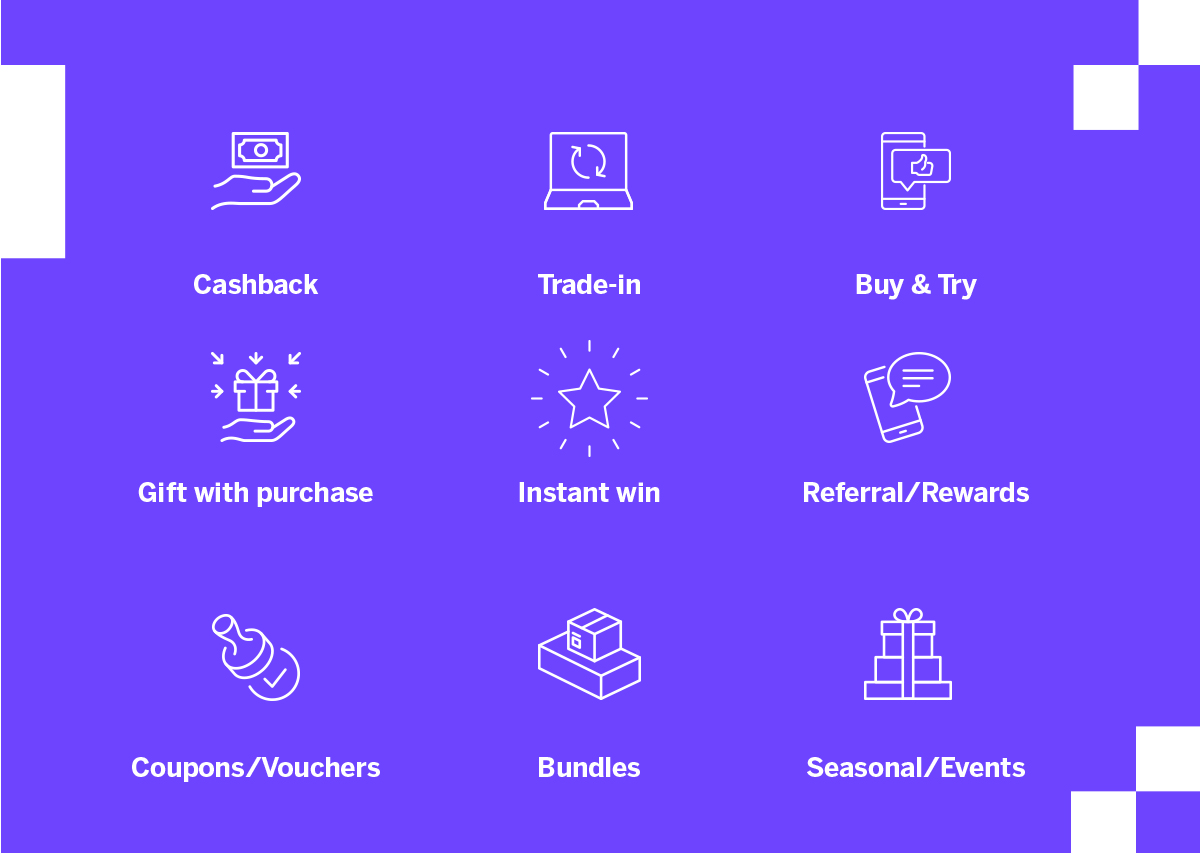
Types of sales promotion (with examples)
1. Coupons and Vouchers
Coupons and vouchers offer customers a partial refund or discount on their purchase, increasing the purchase incentive while giving greater control over price positioning. This approach is more cost-effective than traditional discounting. By using cashback promotions, brands can drive purchases while maintaining their price integrity.
Example: A consumer electronics store offers a £50 cashback voucher on all smartphone purchases. Customers receive the cashback after submitting proof of purchase, encouraging them to buy without immediately reducing the product’s price.
2. Trade-In Programs
Trade-in programs encourage customers to exchange their old products for new ones, often with additional benefits like trade-in cashback, trade-in rewards, such as digital gift cards, or physical gifts. This approach generates urgency and helps clear out older inventory. Trade-in promotions also align with sustainability goals by promoting recycling and responsible disposal of old products.
Example: A laptop retailer allows customers to trade-in their old laptops for a £100 discount on a new model, plus an additional £50 gift card. This strategy encourages customers to upgrade their devices sooner and increases sales of new models.
3. Buy & Try Promotions
Buy & Try sales promotions, also known as money back guarantees boost confidence in new product lines and remove barriers to purchase by offering a risk-free, no-obligation trial period. Customers can return their product and quickly obtain a refund during this time, significantly reducing hesitation and encouraging purchases.
This strategy is ideal for increasing the adoption of innovative products or incentivising the purchase of higher-value items.
Example: A tech company offers a 30-day risk-free trial for their new smart home devices. Customers can return the products within the trial period for a full refund if not satisfied. This promotion encourages hesitant customers to try the new technology, leading to higher adoption rates. Buy and Try works best during the consideration phase of purchase and can help to drive brand preference over similar competitor purchases by removing the risk of purchase. As a result, we often see an increase in average unit prices, as customers are encouraged to spend a large percentage of their budgets.
4. Referral and Reward Programs
Referral and reward programs increase brand awareness and customer loyalty by rewarding customers for referring new customers or making repeat purchases. These programs leverage the power of word-of-mouth marketing and can significantly amplify your customer base with minimal cost. Referrals and recommendations from Friends and Family are the most trusted type of recommendation – imagine motivating your loyal install base of customers with incentives to encourage them to recommend your products. Our research shows that it is important that both the person referring and the person buying the product both receive the same reward value.
Example: A subscription service offers a free month of service for every friend referred who signs up. This motivates existing users to promote the service and brings in new customers at a low acquisition cost.
5. Gift with Purchase
Gift with purchase promotions provide an additional product or service for free when customers make a purchase, increasing the perceived value and encouraging higher sales. These gifts can be tailored to customer preferences, enhancing the overall shopping experience and driving loyalty. Ensure that the reward the customer is receiving is one that is useful and desirable to your target customer. This could be a complimentary product, software, services or digital gift cards.
Example: A beauty brand offers a free make-up bag with any purchase over £50. This not only makes the offer more attractive but also encourages customers to spend more to qualify for the gift.
6. Instant Win Promotions
Instant win promotions create excitement and drive immediate purchases by offering customers the chance to win prizes instantly upon purchase. These promotions can significantly boost engagement and repeat purchases, as customers are enticed by the possibility of instant rewards. Since not all customers receive the reward we are able to concentrate the budget into even bigger prizes, which can gain further interest from customers. 1 in 10 or 1 in 20 customers win for free are a popular way to use the concentrated budget to reward some customers and be able to use the powerful free message.
Example: A snack food company runs a campaign where customers enter codes found inside packaging for a chance to win instant prizes like gift cards or exclusive merchandise. This generates buzz and encourages repeat purchases as customers try their luck multiple times.
Other types of sales promotions
- Free Trials and Demos: Free trials and demos provide customers with a no-obligation trial period for new products, removing barriers to purchase and boosting confidence in new product lines. These promotions can significantly reduce customer hesitation, making it easier for them to experience the benefits of a new product firsthand.
- Competitions and Giveaways: Competitions and giveaways engage customers by encouraging them to participate in challenges or social media activities for a chance to win prizes, creating buzz and rewarding loyal customers.
- Flash Sales: Flash sales offer significant discounts for a very limited period, creating a sense of urgency and encouraging quick purchase decisions.
- Product Bundles: Product bundles involve selling a set of products together at a discounted rate, offering greater value than purchasing items individually, and often boosting overall sales.
- Buy One, Get One Free (BOGOF): BOGOF promotions offer an additional product for free or at a discount when one is purchased, encouraging customers to buy more and share with others.
- Early-Bird Specials: Early-bird specials provide discounts or special offers to customers who make a purchase early, incentivising prompt buying and increasing initial sales.
- Donations and Charitable Promotions: Donations and charitable promotions dedicate a portion of purchase proceeds to a charitable cause, enhancing brand image and building customer loyalty by supporting important causes.

10 Practical Promotion Ideas
Once you understand the main types of sales promotions, the next step is bringing them to life. Here are ten proven ideas that help brands boost engagement, lift sales, and stand out in competitive markets:
- Mystery cashback tiers for selected SKUs.
- Spend-and-save brackets to lift AOV.
- Bundle + bonus accessory credit.
- Refer-a-friend reward for both sides.
- Event-triggered cashback (e.g., seasonal tie-ins).
- Trade-in uplift with sustainability messaging.
- Buy & Try for premium launches.
- Instant-win overlay on cashback.
- Category-switch credit for competitor trade-ins.
- Seasonal booster to clear slow-moving stock.
These examples show that there’s no single formula for success. The right promotion depends on your audience, timing, and goals.
What are the benefits of sales promotions?
Sales promotions don’t just lift short-term sales; they can strengthen pricing power, loyalty, and brand value when strategically designed. Here’s how sales promotions can benefit your business and drive growth:
1) To increase sales
Increasing sales is a goal that almost every business seeks to achieve, and sales promotions are a highly effective method of accomplishing it. Sales promotions can drive immediate sales and generate revenue for your company.
By offering cashbacks, discounts, time-limited offers, or other incentives, you can attract more customers and encourage them to make purchases. Examples of sales promotion tools, such as ‘buy and try’ or ‘satisfaction guarantee,’ give the customer reassurance to make the purchase.

2) To protect margins
Untargeted price discounts are an extremely costly way to drive volume, not all customers need the discount to purchase, some are happy to pay the full price. Thus by focusing your investment on the most engaged and responsive customers, another benefit of sales promotions is achieving similar results at a fraction of the cost.
Sales promotions like ‘cashback,’ ‘instant win,’ or ‘gift with purchase’ strategies heighten the perceived value of the product and make the deal more attractive, creating urgency for short-term results.
3) To introduce products to new markets
Sales promotions can be used to introduce products to new markets where there is product unfamiliarity. By either building confidence in the product or presenting the customer with a compelling incentive, sales promotions remove barriers to the buying decision.
Special deals or introductory offers can entice prospective customers to try a product or service and encourage them to switch to your brand, increasing your customer base.
4) To increase brand awareness
Sales promotions can create buzz and generate attention for your brand. With exciting offers and engaging campaigns, they get people talking, increasing brand visibility and audience reach. Creative sales promotions, such as referral and rewards programs, motivate customers to share the product and the brand with peers to obtain a reward.
Meanwhile, strategies like instant win sales campaigns generate excitement in the market and make your brand part of the conversation.
5) To get ahead of competitors
In today’s competitive climate, gaining the edge over your competitors will help your business grow and succeed. Implementing different types of sales promotion techniques can drive action from your customers by making the deal on your product more appealing than the alternatives on the market.
Sales promotions can differentiate your brand from others in your sector by offering better deals, added value, or attractive incentives, enticing customers away from competitors and increasing your market share.
6) To obtain customer loyalty
Sales promotions are used to retain existing customers and attract new ones. Offering exclusive deals or rewards to your current customers can strengthen their loyalty and encourage repeat purchases. By registering details to obtain promotional rewards, customers connect with your brand and open up future communication opportunities to encourage brand loyalty. Being able to build a list of engaged opt in customer data base brands can maximise long term customer value. This is particularly helpful for brands that do not sell direct, and are at an arm’s length to their customer, as the customer is buying via a retailer.
7) To partner with dealers or retailers
Running a sales promotion campaign that benefits your dealers or retailers, as well as your customers gives your brand an advantage over competitors. For example, a ‘basket boost’ campaign requires customers to purchase accessories from the retailer alongside your product to qualify for cashback rewards.
This approach ensures dealers favour your product, promoting it ahead of other alternatives.
8) To target slow-moving stock
Sales promotions can be designed to target specific product lines or services that are slow-moving, end-of-season, or excess stock that you wish to clear out. By offering discounts or bundle deals, you can quickly sell off surplus stock, freeing up space and capital for new inventory, and encouraging the selling of your latest and greatest products.
9) To upsell and cross-sell
Sales promotions can be an effective strategy to encourage your customers to upgrade their purchases (upselling) or buy complementary products (cross-selling). For example, you can offer bundle deals or incentives for purchasing higher-value items. These promotions will increase the average transaction value and your business’s overall revenue.
10) To build valuable data and customer insights
Sales promotions provide an excellent opportunity to gather customer data and insights. Often, they require participating customers to provide their details or engage in specific actions, such as signing up for newsletters or filling out surveys. This requirement enables your business to collect valuable data on your customers, their preferences, and buying behaviour, which can inform future marketing efforts and personalised targeting.
Discounts vs Sales Promotions
While sales promotions are designed to boost performance, not all approaches create equal value. Traditional discounts can erode margins and brand perception, while strategic promotions deliver impact without compromise.
Here’s how sales promotions differentiate from discounts:
| Dimension | Discounts | Sales Promotions |
| Cost control | Broad, margin-eroding | Targeted spend, fixed-fee cap |
| Brand equity | Devalues shelf price | Adds value without price cut |
| Data capture | Lost at POS | Captured via claim journey |
| Control | Low | High – rules, caps, insurance |
In short, sales promotions reward behaviour rather than undercut price, creating urgency and perceived value while protecting profitability.
Sales Promotion Risks (and How to Mitigate Them)
Every campaign carries some level of risk: operational, financial, or reputational.
The key is not to avoid it, but to anticipate and design around it.
| Risk | Impact | How Leading Brands Mitigate It |
| Brand devaluation | Customers wait for discounts | Use value-add mechanics (cashback, GWP, trade-in) and fixed-fee caps |
| Price anchoring | Harder to sustain full price | Limit duration, target by SKU, plan clear exit |
| Fraud or ineligible claims | Inflated costs, poor data | Combine AI validation + human QA, audit trails |
| Cross-market complexity | Taxes, fulfilment, languages | Centralised orchestration with local partners |
At Opia, compliance and risk control are built into every campaign, from secure claim validation to insured, fixed-fee pricing.
Promotion Strategies: Pull, Push & Hybrid
Once the fundamentals are clear, the next step is deciding how to activate your promotion. Different strategic approaches suit different goals and audiences.
- Pull promotions: Consumer-facing campaigns such as cashback, gift-with-purchase, or instant-win mechanics that create demand at retail.
- Push promotions: Dealer or trade incentives that encourage sell-in and in-store visibility.
- Hybrid: Combining both, for example, a consumer cashback that also rewards the retailer for participation.
At Opia, most campaigns are pull-led, designed to drive sell-through by engaging consumers directly while giving retailers confidence through fixed-fee protection.


Successful examples of sales promotion
Theory only matters when it delivers in practice. .Below are real-world examples of how leading brands have used different promotion types — from cashback to trade-in — to increase sales and strengthen customer loyalty.
Increasing Sales
Dell’s Small Business Cashback Promotion
Dell aimed to boost sales on Dell.com during key times of the year. Opia created a cashback promotion for a range of Dell products, offering customers $100 to $200 cashback. Customers could claim their cashback online upon product dispatch, receiving a Dell-branded digital VISA prepaid card.
This promotion not only increased sales during critical periods but also strengthened brand loyalty, demonstrating the power of Cashback Promotions.
Lenovo’s Environmental Trade-In Campaign
To highlight its commitment to sustainability, Lenovo partnered with Opia for an Earth Day trade-in campaign. Small and medium businesses received 20% cashback on selected Think laptops and PCs when trading in old devices. For each trade-in, Lenovo planted a tree in the UK, offset at least one tonne of CO2 emissions in the Amazon rainforest, and ensured the devices were refurbished, reused, or recycled with zero going to landfill.
This campaign promoted sustainability while boosting sales, illustrating the benefits of Trade-In Promotions.


Dell’s Premium Range Promotion
During the back-to-school and Black Friday periods in France, Dell sought to increase market share in the premium PC segment. Opia created a multi-tiered cashback promotion on Dell’s XPS, Alienware, and Inspiron product families. The promotion offered up to €200 cashback, driving a 25% increase in sales in the XPS and Alienware ranges.
This successful approach also protected Dell’s price position, demonstrating the effectiveness of Cashback Promotions.
Conn’s HomePlus “Get Your Tax Back” Campaign
Conn’s HomePlus aimed to attract customers with a unique promotion. Opia designed a “Get Your Tax Back” campaign, allowing customers to claim the value of state sales tax on purchases over a certain amount. The promotion worked both in stores and online, and its success led to variations like “Ca$hBacktober” and “Memorial Day Mattress Tax Back.”
This initiative showcased the versatility and appeal of Instant Wins.


Building Confidence
Samsung’s Buy & Try Promotion
Samsung aimed to drive the adoption of its premium Galaxy Z Series foldable phones. Opia developed a Buy & Try campaign offering a 60-day trial period. Customers could return the phones if unsatisfied, reducing buyer hesitation.
The promotion ran in ten countries and supported the launch of new models, effectively driving sales and customer acquisition through Buy & Try Promotions.
Enhancing Customer Loyalty
Samsung Wallet Rewards Customer Loyalty with Cinema Vouchers
Samsung sought to reward its loyal customers and promote the relaunch of its mobile payment app, Samsung Wallet. They collaborated with Opia to design a rewards promotion where users could win cinema vouchers. Participants registered in their Samsung Wallet App and entered daily draws by making payments with Samsung Pay.
This month-long promotion, which offered over 9,500 cinema vouchers, successfully engaged customers and reinforced Samsung Wallet’s new capabilities, showcasing the effectiveness of Instant Win Promotions.


LG’s Streaming Service Promotion
LG sought to motivate retail partners and boost sales for its Home Entertainment products. Opia created a promotion offering a $100 credit for streaming or gaming services with the purchase of an LG TV.
This gift with purchase generated excitement and increased store traffic, highlighting the impact of Gift with Purchase promotions.
Driving Engagement
Samsung Watch Promotion
Between the Christmas and New Year period, Samsung wanted to maintain their brand presence and drive sales of their flagship S Series phones. Opia created a promotion offering a free Galaxy Watch Active with the purchase of an S Series phone. This campaign used health and sports technology to promote the phones, driving high levels of engagement and showcasing the integration between Samsung’s smartphones and wearables.
This demonstrates the effectiveness of Gift with Purchase promotions.


Howard’s Tax Back Promotional Event
Howard’s, a leading appliance retailer, sought to engage customers during the busy July 4th period. Opia created a ‘Tax Back’ promotion, allowing customers to claim the value of state sales tax on purchases over $300. This promotion was available in-store and online, with rewards offered via PayPal or physically.
This redemption promotion saved Howard’s over 46% compared to traditional discounting methods, illustrating the impact of Instant Wins.
Tips for building successful sales promotions
Set clear goals and KPIs
Establish specific, measurable objectives for your promotion, such as boosting sales of a particular product line, clearing out end-of-season stock, or attracting new customers. Clear KPIs will help you measure the success and guide the implementation of your campaign.
Understand your target audience
Tailor your promotions to meet the needs and preferences of your target market. Use customer data and insights to design offers that resonate with your audience, whether it’s through discounts, cashback, or free trials.
Leverage technology for seamless execution
Utilise digital platforms to manage your promotions efficiently. Ensure that the claims process is straightforward, tracking is accurate, and customer interactions are seamless. Platforms like Opia’s CLOUD can facilitate a smooth process from purchase to reward.
Create a sense of urgency
Incorporate time-limited offers to encourage quick decision-making and purchasing. Urgency can drive immediate action, increasing the effectiveness of your promotion and boosting short-term sales.
Offer value without eroding prices
Use promotions that maintain your product’s price integrity, such as cashback offers or buy & try campaigns. These strategies provide value to customers while preserving your brand’s perceived value and avoiding price wars.
Where to Run Your Promotion
Choosing the right channel is just as important as designing the right offer. Depending on your audience and goals, sales promotions can be deployed across digital and physical touchpoints to maximise visibility and engagement.
- Email marketing: Reach existing customers directly with personalised offers and time-limited deals.
- Social media: Build buzz through engaging visuals, instant-win formats, or referral campaigns.
- E-commerce websites: Highlight offers on product pages or banners to drive conversion.
- Retail and in-store activations: Combine POS materials with cashback or trade-in incentives.
- SMS and mobile notifications: Perfect for flash sales or urgent reminders.
- Events and partnerships: Amplify exposure by tying promotions to seasonal moments or partner campaigns.
Tip: Choose 1-2 primary channels per campaign and ensure your messaging and tracking stay consistent across all touchpoints.
A bespoke approach to your brand’s requirements
Whatever commercial goals your business has, Opia will tailor a promotional idea to be unique to your needs and innovative to drive action from your target market. By working closely with our clients, we design bespoke promotional solutions that offer the best value for you and your customers.
Discover more about how we can increase your sales revenue with our different types of disruptive sales promotion solutions or get in touch with us to see how we can help you.
FAQs
A time-bound incentive to increase purchase or engagement without cutting base price.
Cashback, trade-in, buy & try, gift with purchase, and instant-win campaigns tend to deliver the strongest results across industries.
They protect brand value and control cost through targeted mechanics and fixed fees.
Opia’s actuarial model and insurance cap total exposure before launch.
Typically 4–8 weeks, aligned to buying cycles or retailer windows.
Incremental units, AOV, claim rate, approval rate, ROI vs discounting.
Partnering with an experienced provider like Opia ensures promotions meet all legal, financial, and data protection requirements while maintaining full cost control.
Discover How Tech With A Human Touch Can Transform Your Customer Experience
Transforming how businesses interact with their customers isn’t just about keeping up; it’s about leading the way. In a world where customer expectations are constantly rising, organisations face a critical choice: embrace innovation to personalise interactions and automate processes, or risk becoming irrelevant. This challenge isn’t confined to one industry; it’s a universal call for change across financial services, insurance, utilities, telecoms, retail, travel, and even the public sector.
Key Takeaways
- Evolving Customer Demands: Modern consumers expect seamless, personalised, and automated interactions.
- “Tech with a Human Touch”: Opia’s unique approach blends technology and human expertise to create bespoke CX solutions.
- Significant ROI: Clients achieve an average of 40% savings in service costs, mitigate over £1 million in annual fraud, and automate more than 80% of customer journeys.
- Empowering All Stakeholders: Solutions benefit finance, operations, marketing, and customer acquisition by boosting savings, efficiency, loyalty, and conversion rates.
- Strategic AI Integration: AI is deployed purposefully to enhance processes and guide customers, ensuring tangible value without over-reliance.
The Shifting Landscape of Customer Experience
For years, many organisations, particularly in the public sector, prioritised internal processes over the end-user experience. This approach is no longer sustainable. Today, every interaction, whether with a retail customer or a citizen accessing government services, must be treated as a valuable consumer touchpoint. This shift demands a radical rethink of customer experience (CX).
At Opia, we’ve channeled two decades of specialised CX experience into a new solution: “tech with the human touch.” This modular approach allows us to tailor bespoke solutions that precisely address our clients’ unique needs and pain points, ensuring optimal efficiency and effectiveness. This represents a fresh perspective on Business Process Outsourcing (BPO), a market already projected to grow from $16 billion in 2023 to $32 billion by 2030 thanks to digitalisation.
How Opia Transforms CX
Opia empowers companies and organisations to revolutionise customer journeys and automate back-office operations through a suite of integrated solutions:
- Accessible Web-Based Platforms: Intuitive, frictionless web platforms for seamless user experiences.
- Automated Workflows: Simplified processes with intelligent, automated decision-making.
- AI-Powered Verification: Advanced AI for robust screening, validation, and verification.
- Comprehensive Fulfilment: Integrated solutions covering payments, rewards, and delivery.
- Multichannel Customer Service: Flexible support via multi-language voice, digital channels, or self-serve options.
Opia’s Proven Impact
Our unique platforms and solutions are trusted by leading organisations worldwide, including Google, the UK’s Ministry of Justice, Costco, and Lenovo. By seamlessly integrating people, processes, and technology into a unified operating model, Opia delivers measurable results:
- Cost Savings: Achieve an average of 40% savings in the cost to serve compared to traditional operations, with a potential 30%+ uplift in sales (vs forecast).
- Fraud Mitigation: Over £1 million in fraud mitigated for clients in the past year, maintaining a fraud rate under 1% across our own operations. More than 70% of claims are automated.
- Digital Transformation: Automate or digitise over 80% of customer journeys and back-office processes in real-time, helping clients modernise and shed legacy tech.
- Global Customer Care: Non-automated customer service journeys are expertly supported by our in-house team, spanning 40 countries, with over 90% being multilingual across 15 languages.
- High Customer Satisfaction: Achieve a 95% ‘satisfied’ or ‘highly satisfied’ rating from our clients’ customers regarding their brand experience.
Empowering All Stakeholders
Investing in enhanced CX is a strategic decision that requires alignment across various departments. Opia’s solutions are designed to satisfy every key stakeholder:
- Finance: Focuses on cost savings, fraud prevention, and ROI. For example, one client achieved a 54% cost saving through a digital-first cashback program with a 66% influence rate.
- Operations: Prioritises digital transformation, automation, and efficiency gains. A client saw service delivery times slashed from three weeks to three days, resulting in over 90% cost savings.
- Marketing/Customer Engagement: Concerned with brand satisfaction and loyalty. Opia helped a client deliver a carbon-offset digital-first reverse logistics program with an 86% influence rate to support net-zero targets.
- New Customer Acquisition: Aims to identify and convert target audiences. We achieved a 98% influence rate across customer acquisition initiatives, with 50% of customers citing the campaign as their sole driver for purchase.
Our innovative approach to BPO ensures all these stakeholders are as satisfied as their customers, leading to streamlined operations, enhanced fraud prevention, increased efficiency, and stronger brand loyalty. Overall, we see 86% of end customers citing their experience as having a direct influence on their behaviour.
The Strategic Role of AI in CX
At Opia, we view Artificial Intelligence (AI) not as a standalone product, but as a powerful tool to be strategically integrated for specific business outcomes. We don’t sell our own AI. Instead, our innovation team rigorously tests and leverages the right AI solutions to empower our clients.
AI is never a default; it’s deployed only when and where it will deliver significant benefit. This might involve automating 70-80% of a process while guiding a customer through the remaining 20-30% with a human interaction. We also recognise that some customers prefer speaking to a human, and our solutions always offer both routes, preventing frustrating interactions with ineffective AI.
While our front-end interfaces might appear simple, they are powered by a complex network of workflows enabling everything from integration and automation to fraud prevention and fulfilment. Our primary goal is to use research and evidence to identify sources of customer dissatisfaction and dropout, then provide solutions that proactively prevent these pain points.
Moving Beyond Legacy Systems
Many organisations are hampered by fragmented departments and outdated legacy systems that stifle efficiency. Opia’s expertise helps break down these silos, fostering a cohesive approach to delivering exceptional customer experiences. We combine our deep understanding of customer journeys with our clients’ industry-specific knowledge, ensuring practical and effective solutions.
We understand that clients may prefer a measured pace of change. Our collaborative, two-way dialogue builds trust and fosters long-lasting partnerships, consistently delivering results. Especially for regulatory compliance, getting it right often means taking the necessary time to implement robust solutions, even if they aren’t the quickest to deploy.
Ultimately, whether the goal is to increase sales, reduce costs, or remove friction for a smoother customer experience, Opia’s solutions transcend sector boundaries. We work with clients to analyse their most problematic processes and re-engineer them into seamless solutions that integrate effortlessly with their existing back-end systems.
Conclusion
The market clearly demands a blend of human empathy and cutting-edge technology to truly transform customer experience. By partnering with a specialist like Opia, businesses can revolutionise their CX, boost satisfaction and loyalty, and achieve substantial operational savings. It’s about moving beyond outdated practices to embrace a future where efficiency, security, and exceptional customer interactions are the norm.
Ready to elevate your customer experience?
Book a free discovery session with Opia to see how we can help transform your business and empower all stakeholders.
FAQs
What is “tech with a human touch“?
Opia’s blend of advanced technology and human insight for effective customer experiences.
How much can businesses save?
Clients average 40% savings in service costs, with potential sales uplifts.
What types of businesses can benefit?
Opia works with financial services, insurance, utilities, telecoms, retail, travel, and public sectors.
Does Opia sell its own AI products?
No, Opia integrates suitable AI tools into bespoke solutions for specific client outcomes.
The Future of Digital Wallet is Here: A Complete Guide
The world of payments is constantly evolving, and keeping pace with consumer demand means embracing innovation. Digital wallets are at the forefront of this shift, changing how we store and use our payment cards, loyalty programs, and even identification, contributing to a truly revolutionary customer experience. A digital wallet, sometimes called an e-wallet, is a secure electronic service that lets you make payments and store payment information on a mobile device or computer. It’s like a virtual version of your physical wallet, making transactions quicker and more convenient.
Key Takeaways
- Rapid Growth & Adoption: Digital wallet usage is exploding, with projections showing nearly 70% of the global population will use them by 2030.
- Effortless Card Addition: Web Push Provisioning (WPP) allows users to add payment cards to digital wallets like Google Pay or Samsung Pay directly from a web browser.
- Superior Customer Experience: A fast, secure, and hassle-free card-addition process significantly boosts user satisfaction and loyalty.
- Enhanced Security: Digital wallets utilise tokenised credentials to protect sensitive information, reducing the risk of fraud.
- Competitive Edge: Adopting cutting-edge solutions like WPP-enabled digital cards can differentiate your business and attract digitally-savvy consumers.
How Digital Wallets Work
Digital wallets simplify payments by storing your card details securely. When you’re ready to pay, you can use your smartphone, smartwatch, or other compatible device to complete the transaction.
With Push Provisioning, the process of adding a card is even more streamlined, offering a remarkably smooth experience that Opia is proud to champion:
- Receive Your Card: The user receives their digital wallet card information via email or SMS.
- Access and Add: They then access a secure card portal from their web browser and simply tap “add to wallet” for services like Google Pay or Samsung Pay.
- Ready to Use! After following a few quick steps provided by Google or Samsung, the card is instantly added to their digital wallet and ready for immediate use, whether online or in-store.
This seamless integration is a testament to the forward-thinking solutions Opia continues to bring to market, ensuring our partners are always aligned with the latest end-consumer trends, often powered by our Opia Cloud platform.
Why Embrace Digital Wallets Now?
The consumer payment landscape is rapidly shifting towards digital solutions. Integrating a digital wallet with Push Provisioning isn’t just an option; it’s essential for several compelling reasons, and Opia is here to help you lead the way:
- Capitalise on Digital Wallet Growth: In 2025, over 55% of the global population (4.5 billion users) used digital wallets. This figure is projected to reach nearly 70% (an estimated 6 billion users) by 2030. As digital wallet transactions continue their rapid ascent, offering seamless, browser-based integration is crucial to meet and exceed consumer expectations.
- Enhance Customer Experience: Enhance Customer Experience: A fast, secure, and hassle-free card-addition process is a fundamental driver of user satisfaction and customer loyalty. By simplifying this critical step, you significantly improve the overall customer journey.
- Gain a Competitive Advantage: In a crowded market, early adoption of cutting-edge solutions like Push Provisioning-enabled digital cards can set your business apart. Be a leader, not a follower, and differentiate your brand in the eyes of digitally-savvy consumers.
Benefits of Digital Wallets
The advantages of an enhanced digital wallet experience are clear and compelling:
- Convenience: Users can add cards to digital wallets without needing to download additional apps, removing a significant barrier to adoption.
- Efficiency: The digital wallet drastically reduces the steps involved in manual card registration, leading to a remarkably rapid process.
- Speed: New instant card provisioning means immediate usability for both online and in-store purchases, eliminating frustrating wait times.
- High Conversion Rates: Data shows that over 70% of users add cards to wallets when using a mobile browser, highlighting the effectiveness of this streamlined approach.
- Security: Digital wallets utilise tokenised credentials, a robust security feature that helps reduce fraud and eliminates the need for manual card entry, safeguarding sensitive information.
Aligned with User Behaviour: The Mobile-First Generation
The shift to digital wallets is deeply rooted in current user behaviour, particularly among younger demographics and Opia’s solutions are designed to meet them where they are:
- 95% of Gen Z and 90% of Millennials use mobile banking daily. This generation is inherently comfortable and reliant on their mobile devices for financial interactions.
- 60% of Millennials primarily use mobile banking apps, further cementing the importance of mobile-centric financial solutions.
- 80% of Gen Z prefer contactless payments, and more than half regularly use mobile wallets like Google Pay. Their preference for digital and contactless transactions makes the digital wallet an indispensable offering.
Conclusion
The digital payment landscape is evolving at an unprecedented pace. By adopting a secure, fast, and easy-to-use digital wallet, enabled by Push Provisioning – a key component of Opia’s innovative offerings – you’re not just offering a payment solution. You’re offering unparalleled convenience, robust security, and a superior customer experience. This innovation allows you to capitalize on the immense growth of digital wallets, enhance customer satisfaction, and gain a significant competitive edge in the market. Opia continues to innovate and be on track with the latest end-consumer trends, ensuring your business stays ahead.
Ready to provide your users with a smarter, more seamless payment experience?
Talk to the team at Opia today and discover how to integrate this smarter way to manage digital payments, boost user engagement, and enhance security for your customers.
FAQs
How does Push Provisioning through a web browser make adding cards easier?
It lets users add cards directly from a web browser with a few taps, no app download needed.
Is adding cards via Push Provisioning secure?
Yes, it uses tokenised credentials, a highly secure method that reduces fraud and avoids manual card entry.
What are the main benefits for businesses offering this enhanced Digital Wallet? Businesses can capitalise on digital wallet growth, boost customer satisfaction with a faster process, and gain a competitive edge.
Which digital wallets are supported by Push Provisioning?
Currently, it supports popular digital wallets like Google Pay and Samsung Pay.