



Most promotional campaigns that underdeliver have one thing in common: they were built around a tactic rather than a plan. A discount chosen because it worked last quarter, a mechanic copied from a competitor, a budget set before anyone defined what success looks like.
A well-structured sales promotion plan changes that. It turns promotions from one-off tactics into repeatable commercial tools, aligned around clear goals, the right audience, and mechanics that actually move the needle.
In this guide, we cover the ten steps to building an effective sales promotion plan, from setting goals to evaluating results, along with the promotion types best suited to each objective.
Key Takeaways
- A sales promotion plan turns one-off campaigns into repeatable commercial tools by aligning goals, mechanics, budget, and measurement before launch
- Setting SMART goals upfront is the difference between a campaign you can evaluate and one you can only guess at
- The right promotion mechanic depends on your objective: cashback and trade-in protect shelf price, referral programs drive lower-cost acquisition, gift with purchase increases perceived value without discounting
- Risk assessment and budget modelling should happen before creative, not after: know your maximum liability before you commit to a mechanic
- Post-campaign evaluation is where the real value compounds: the insights from one campaign become the planning inputs for the next
What Is a Sales Promotion Plan?
A sales promotion plan is a structured roadmap for how you will use promotions to drive growth. It defines why you are running a promotion, who you are targeting, which mechanics you will use such as cashback, trade-in, referral, or gift-with-purchase, and how you will budget, launch, and measure success.
Instead of one-off discounts, a clear plan turns promotions into repeatable growth levers. It aligns marketing, sales, finance, and operations around shared objectives, timelines, and KPIs, so every campaign is designed to deliver measurable commercial impact rather than just a short-term spike.
Key Steps for Creating Your Sales Promotion Plan
- Define Clear Goals
- Know Your Audience
- Choose the Right Promotion Type
- Craft Compelling Messaging
- Select Channels and Timing
- Set a Budget
- Conduct a Risk Assessment
- Plan Your Timeline
- Launch and Monitor
- Evaluate and Learn
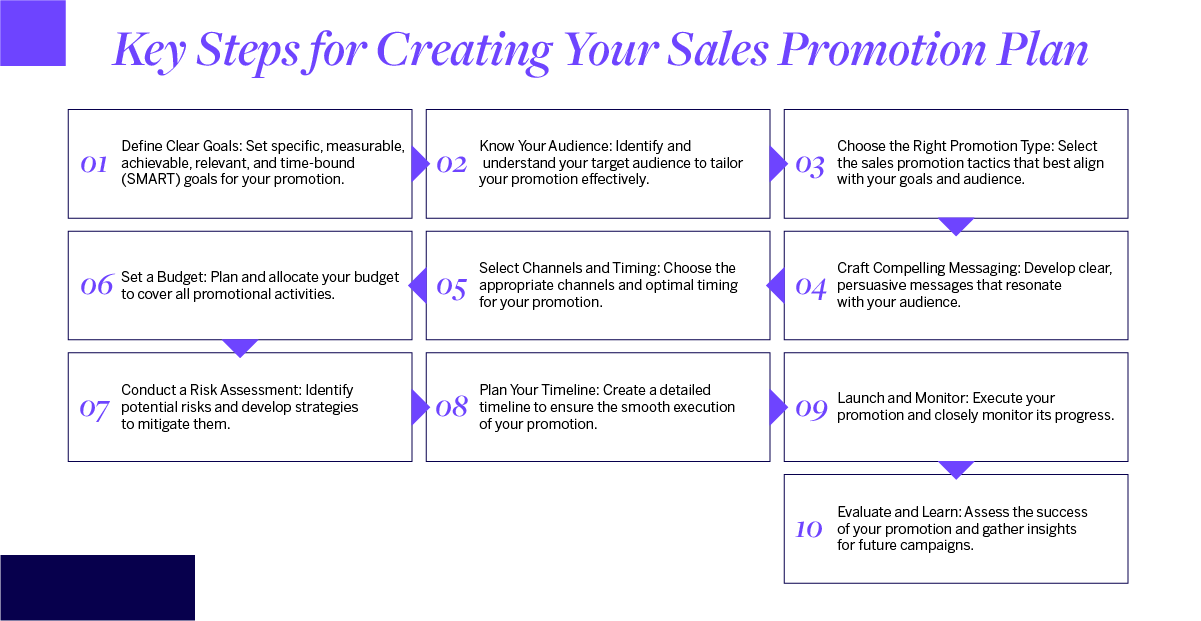
Sales Promotion Planning: Step-by-Step Guide
1. Define Your Goals
The first step in any successful sales promotion plan is to define your goals. Ensure they are SMART: Specific, Measurable, Achievable, Relevant, and Time-bound. Clear objectives will guide your strategy and help you measure success.
Example goals:
- Increase sales by 15% in the next quarter
- Acquire 500 new customers within two months
- Clear 30% of excess inventory by year-end


2. Know Your Audience
Understanding your target audience is critical. Gather data through surveys, social media insights, and customer feedback to identify demographics, preferences, and buying behaviors. Consider building buyer personas to tailor your promotion to the people most likely to respond to it.
3. Choose the Right Promotion Type
Selecting the right sales promotion type depends on what you are trying to achieve and who you are trying to reach. Are you looking to drive immediate sales, clear inventory, or build long-term loyalty? Different mechanics serve different purposes.
Discounts and coupons can quickly boost volume. Referral programs leverage existing customers to bring in new ones. Buy and try mechanics reduce hesitation on premium or new products. Cashback and trade-in promotions drive conversion while protecting shelf price.
Aligning your promotion type with your goals and customer preferences is what separates campaigns that deliver lasting impact from those that produce a short-term spike and little else.


4. Craft Compelling Messaging
Develop clear, persuasive messaging that communicates the benefit of your promotion simply and directly. Use attention-grabbing headlines, strong calls to action, and compelling visuals. Make sure your messaging aligns with your brand values and speaks to your target audience in language they recognize.
5. Select Channels and Timing
Choose the marketing channels that best reach your target audience, whether that is social media, email marketing, paid advertising, or influencer partnerships. Keep messaging consistent across all channels and time your promotion to launch when your audience is most likely to act.


6. Set a Budget
Establish a budget that covers all promotional activities. Consider both fixed costs such as creative development and market research, and variable costs such as media spend and sales commissions. Use data from past campaigns to set realistic cost assumptions and build in contingency for overperformance.
7. Conduct a Risk Assessment
Identify potential risks that could affect your promotion, from market changes to logistical challenges. Develop strategies to mitigate them and ensure compliance with legal and regulatory requirements.
Beyond operational risks, connect your promotion plan to profitability:
- Margin impact: Model how different reward levels and participation scenarios affect your gross margin
- Uplift assumptions: Define the minimum sales uplift required for the campaign to break even or outperform business as usual
- Liability exposure: Understand your maximum potential payout if the promotion overperforms, and agree in advance how this will be funded
At Opia, we use promotional risk modeling and fixed-fee structures to give brands a clear liability cap before launch. This allows marketing teams to run more ambitious campaigns while giving finance and leadership the certainty they need to approve them.


8. Plan Your Timeline
Create a detailed timeline with key milestones and deadlines. Assign clear ownership to each task and use project management tools to track progress. Build in buffer time to account for unexpected delays, particularly around creative approvals, legal review, and retailer briefings.
9. Launch and Monitor
Execute your promotion and monitor its performance closely from day one. Track key metrics including sales volume, website traffic, claim rates, and customer engagement. Be ready to adjust spend, messaging, or channel mix based on real-time performance data.


10. Evaluate and Learn
After the promotion ends, evaluate its success against your initial goals. Analyze sales data, customer feedback, and engagement metrics to understand what worked and what did not.
When reviewing performance, look beyond headline sales and focus on a core set of KPIs:
- Sales uplift: Incremental units and revenue compared with a realistic baseline period
- Redemption and participation rates: Are customers engaging with the mechanic as expected?
- Average order value and product mix: Did the promotion encourage trade-up, bundling, or higher basket value?
- Cost per claim and ROI: Total cost of rewards, media, and operations versus incremental profit
- New vs existing customers: Are you mainly rewarding loyal customers or also driving new acquisition?
Document these insights and feed them back into your next sales promotion plan. Over time, this creates a learning loop that makes each campaign more effective, more efficient, and more aligned with your wider commercial strategy.
Choosing the Right Sales Promotion Mechanic
Different promotion types serve different objectives. The right mechanic depends on what you are trying to achieve, whether that is driving volume, protecting price perception, encouraging upgrades, or increasing loyalty.
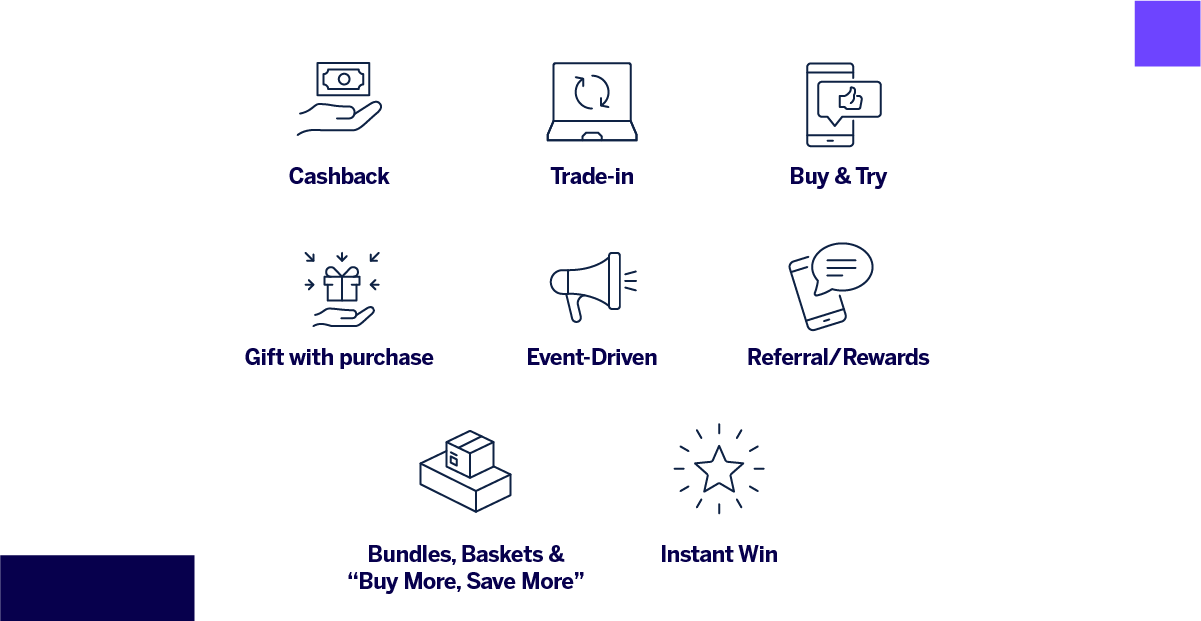
Below are the most effective sales promotion types used by brands today, and when to use each one.
1. Cashback and Value-Back Promotions
Customers receive money back after purchase when they meet defined criteria such as product, retailer, spend level, or date range.
Use when you want to:
- Drive short-term volume without permanently lowering shelf price
- Reward specific products, channels, or baskets
- Create a clear, tangible value message such as “up to $200 back”
2. Trade-In Promotions
Customers trade in an old product in return for a reward or discount on a new one.
Use when you want to:
- Encourage upgrades to newer, higher-margin products
- Support sustainability goals by taking older products out of circulation
- Differentiate your offer beyond simple price cuts
3. Buy and Try (Satisfaction Guarantees)
Customers buy with the option to claim a full or partial refund if they are not satisfied within a defined period.
Use when you want to:
- Reduce perceived risk for premium or new-to-market products
- Encourage trial among hesitant customers
- Build trust by standing behind product quality
4. Gift with Purchase (GWP)
Customers receive a free product, service, or experience when they buy a qualifying product.
Use when you want to:
- Increase perceived value without discounting the core product
- Drive higher basket value or attach rates
- Introduce customers to complementary products or services
5. Event-Driven Promotions
Rewards are linked to specific events or milestones such as sports results, seasonal peaks, or product launch windows.
Use when you want to:
- Leverage cultural or seasonal moments to drive urgency
- Create highly engaging, time-bound campaigns
- Stand out from generic discounts with a more creative concept
6. Referral and Rewards Programs
Existing customers are rewarded for referring friends, family, or colleagues.
Use when you want to:
- Acquire new customers at a lower cost than paid media alone
- Reward and retain your most loyal advocates
- Build a stronger first-party data asset
7. Bundles and Buy More Save More Offers
Customers receive added value when they buy in bundles or reach a defined spend threshold.
Use when you want to:
- Increase average order value
- Promote complementary products and attach rates
- Clear specific lines without discounting everything
8. Instant Win and Prize Draw Promotions
Customers have the chance to win prizes when they participate, often alongside another promotion mechanic.
Use when you want to:
- Create excitement and ongoing engagement across the campaign period
- Add a layer of gamification to a launch or peak period
- Support brand awareness alongside short-term sales
The most effective sales promotion plans often combine more than one mechanic. A cashback offer with an instant win overlay, or a trade-in paired with a gift with purchase for early adopters. The key is ensuring each mechanic is aligned with your objectives, budget, and operational capabilities.
Conclusion
A strong sales promotion plan is what separates campaigns that deliver lasting commercial impact from those that produce a temporary spike and little else. When every step, from goal-setting to post-campaign evaluation, is connected by a clear strategic thread, promotions become repeatable growth tools rather than one-off bets.
Get in Touch
Ready to take your sales promotions to the next level? Contact Opia today to discuss how we can help you design and execute results-driven sales promotions tailored to your business goals.
FAQs
What is a sales promotion plan?
A sales promotion plan is a structured roadmap that defines why you are running a promotion, who you are targeting, which mechanics you will use, and how you will budget, launch, and measure success. It turns promotions from one-off tactics into repeatable commercial tools aligned around clear goals and measurable KPIs.
What are the steps in a sales promotion plan?
Key steps include defining your goals, knowing your audience, choosing the right promotion type, crafting compelling messaging, selecting channels and timing, setting a budget, conducting a risk assessment, planning your timeline, launching and monitoring, and evaluating your promotion.
What is the promotion planning process in marketing?
The promotion planning process involves setting objectives, identifying the target audience, selecting promotion types, creating a budget, developing a timeline, executing the promotion, and evaluating its effectiveness against defined KPIs.
Why are sales promotions important?
Sales promotions drive immediate sales, attract new customers, boost brand awareness, enhance customer loyalty, and generate data that informs future marketing strategy.
How do I choose the best sales promotion tactic?
Choose the tactic that best aligns with your goals, target audience, and overall marketing strategy. Cashback and trade-in promotions work well for driving conversion while protecting shelf price. Referral programs are effective for lower-cost acquisition. Gift with purchase increases perceived value without discounting. The right choice depends on what you are trying to achieve and who you are trying to reach.
What metrics should I track to evaluate my sales promotion?
Track sales uplift against a baseline, redemption and participation rates, average order value, cost per claim, ROI, and the ratio of new to existing customers. These metrics give you a clearer picture of commercial impact than top-line sales alone.