



Sales promotions are one of the most effective tools for driving short-term sales without permanently discounting your product, when they’re designed well. This guide covers what a sales promotion actually is, the mechanics that work best for different goals, real examples from global brands including Dell, Lenovo, and Samsung, and how to measure whether a campaign actually delivered. Whether you’re evaluating your first promotion or refining an established program, use the sections below as a working reference.
Table of Contents
- Key takeaways
- What is a sales promotion?
- How does a sales promotion work?
- Which Sales Promotion Fits Your Goal?
- What are the benefits of sales promotions?
- Types of sales promotion (with examples)
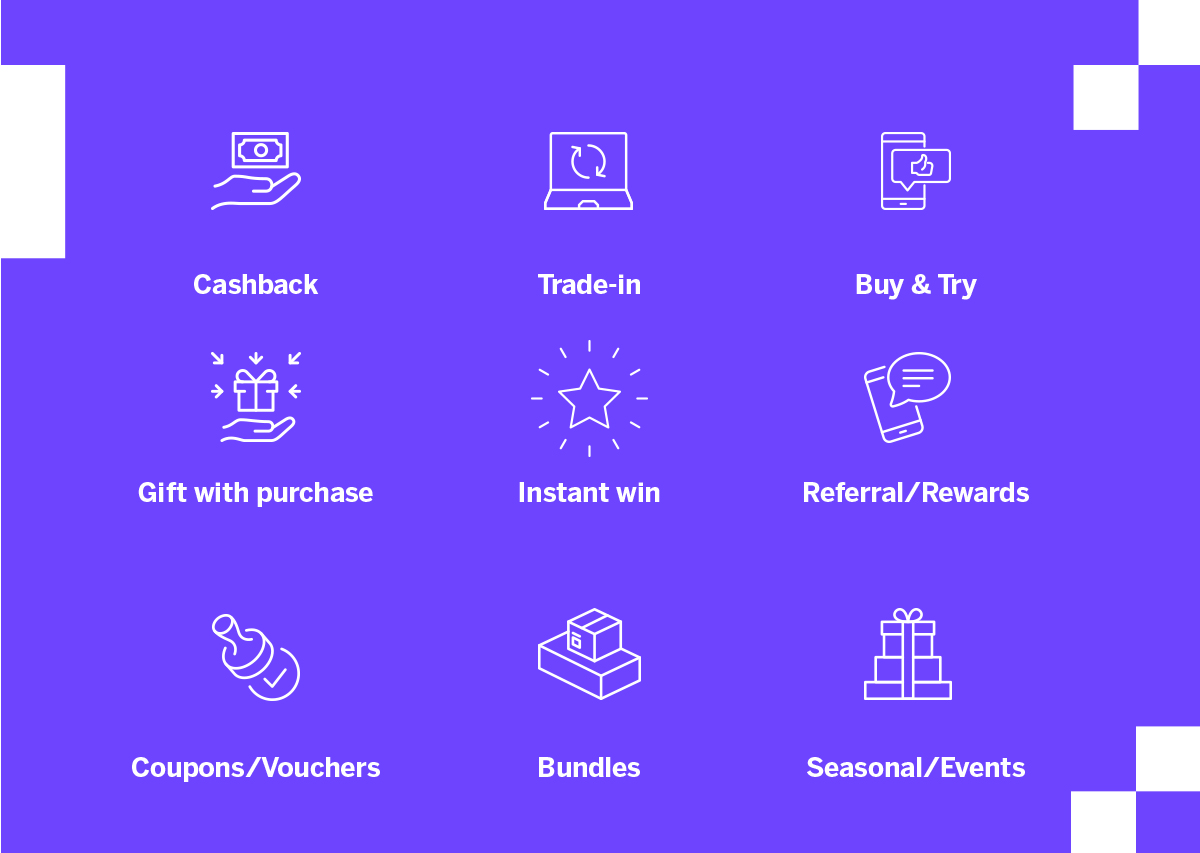
- 9 Practical Promotion Ideas
- Discounts vs Sales Promotions
- Sales Promotion Risks (and How to Mitigate Them)
- Why Run Your Sales Promotion Through a Managed Partner?
- Promotion Strategies: Pull, Push & Hybrid
- Successful examples of sales promotion
- Measuring Sales Promotion Success
- Tips for building successful sales promotions
- Where to Run Your Promotion
- A bespoke approach to your brand's requirements
- FAQs
- Related posts
Key takeaways
- A sales promotion is a time-bound incentive that rewards customer action, a claim, a referral, a trade-in, rather than cutting price outright, protecting margin and brand value in a way a blanket discount can’t.
- The right mechanic depends on the goal: cashback protects shelf price, trade-in clears old inventory and drives upgrades, buy & try removes purchase hesitation, referral programs cut acquisition cost, gift with purchase lifts basket size, and instant win drives engagement.
- Measuring success means tracking four things together, redemption rate, revenue uplift, AOV change, and true cost per claim, not claims volume alone.
- The real risk in a promotion isn’t the offer, it’s execution: fraud, cross-market compliance, and fulfillment at scale are where in-house teams most often lose control of cost.
- Real brands run these mechanics at scale through a managed partner, Dell, Lenovo, Samsung, Conn’s, LG, and Howard’s each used a different mechanic for a different goal, from margin protection to customer loyalty to market share.
What is a sales promotion?
A sales promotion is a time-bound incentive that motivates purchase or participation, offering measurable value to customers without simply cutting price. Unlike blanket discounts, modern sales promotions use targeted mechanics, cashback, trade-in, gift-with-purchase, referral rewards, or buy & try, to drive volume while protecting margin, brand equity, and price position.
The key difference between a sales promotion and a discount is simple: a discount reduces the price for every customer automatically, whether they need the incentive to convert or not. A sales promotion instead asks the customer to take a small additional step, submitting a claim, referring a friend, trading in an old device, in exchange for a reward. That single design difference is what allows a promotion to drive real sales lift without eroding price perception the way a blanket discount does.
Brands typically run a sales promotion to:
- Drive an immediate increase in sales volume
- Protect margin and shelf price while still incentivizing purchase
- Clear slow-moving or end-of-season stock
- Acquire new customers at a lower cost than paid media alone
- Build brand awareness through a mechanic worth talking about
- Compliantly capture first-party customer data through the claim journey
In highly competitive US markets, promotions need to do more than drive short-term sales, they need to protect margin and brand value at scale, which is why more brands are moving toward mechanic-led promotions instead of straight discounting.
How does a sales promotion work?
Sales promotions are tools used in marketing strategies to highlight an offer, motivating the consumer to buy. By using well-designed incentives, effective sales promotions, whether tactical or strategic, drive demand, leading to an increase in sales, basket size and average order value (AOV).
In practice, a sales promotion runs through a consistent journey regardless of mechanics. A customer makes a qualifying purchase, then takes a defined action, submitting proof of purchase for cashback, trading in an old device, referring a friend, or entering a code for an instant win. That action is validated against the promotion’s rules, checked for eligibility and fraud, before the reward is issued, whether that’s a cash payment, a gift card, a discount code, or a physical item.
The strength of a promotion lies as much in how smoothly that validation and fulfillment journey runs as it does in the offer itself, a generous reward with a clunky claims process will underperform a modest reward that pays out fast and reliably. This is particularly important in multi-market campaigns, where mechanics must scale consistently across regions, currencies, and customer expectations.
OPIA works with its clients as strategic promotional partners, understanding their business and using market and customer insights to create innovative promotional ideas. By managing the campaign end-to-end, including managing financial risk when delivering our sales promotion services, OPIA ensures value for both clients and customers.
Which Sales Promotion Fits Your Goal?
Different mechanics are built for different outcomes. Use this as a quick-reference starting point before choosing which type of sales promotion to run.
| Your Goal | Best-Fit Mechanic | Why It Works |
|---|---|---|
| Drive volume without cutting shelf price | Cashback | Reward is claimed after purchase, so the listed price and margin stay intact |
| Clear old inventory or drive upgrades | Trade-In | Removes the barrier of an unused old product sitting with the customer |
| Overcome hesitation on a new or premium product | Buy & Try | Removes purchase risk entirely by extending the statutory and retail refund windows |
| Acquire new customers at low cost | Referral & Reward | Leverages existing customers’ trust rather than paid acquisition spend |
| Increase basket size or perceived value | Gift with Purchase | Adds value to the transaction without discounting the core product |
| Drive engagement and repeat purchase | Instant Win | Concentrates budget into fewer, bigger rewards to maximize excitement (US offers need a free, no-purchase-necessary entry route) |
| Strengthen retailer or dealer relationships | Sales Staff Incentive / Push Promotion | Rewards the channel directly for prioritizing your product |
What are the benefits of sales promotions?
Sales promotions don’t just lift short-term sales, they can strengthen pricing power, loyalty, and brand value when strategically designed. Here’s how sales promotions can benefit your business and drive growth:
1. To increase sales
Increasing sales is a goal that almost every business seeks to achieve, and sales promotions are a highly effective method of accomplishing it. Sales promotions can drive immediate sales and generate revenue for your company.
By offering cashbacks, discounts, time-limited offers, or other incentives, you can attract more customers and encourage them to make purchases. Examples of sales promotion tools, such as ‘buy and try’ or ‘satisfaction guarantee,’ give the customer reassurance to make the purchase.
2. To protect margins
Untargeted price discounts are an extremely costly way to drive volume, not all customers need a discount to convert, some are happy to pay the full price. Thus by focusing your investment on the most engaged and responsive customers, another benefit of sales promotions is achieving similar results at a fraction of the cost.
Bold promotional strategies heighten the perceived value of the product and make the deal more attractive, creating urgency for short-term results.
3. To introduce products to new markets
Sales promotions can be used to introduce products to new markets where there is product unfamiliarity. By either building confidence in the product or presenting the customer with a compelling incentive, sales promotions remove barriers to the buying decision.
Special deals or introductory offers can entice prospective customers to try a product or service and encourage them to switch to your brand, increasing your customer base.
4. To increase brand awareness
Sales promotions can create buzz and generate attention for your brand. With exciting offers and engaging campaigns, they get people talking, increasing brand visibility and audience reach. Creative sales promotions, such as referral and rewards programs, motivate customers to share the product and the brand with peers to obtain a reward.
Meanwhile, strategies like instant win sales campaigns generate excitement in the market and make your brand part of the conversation.
5. To get ahead of competitors
In today’s competitive climate, gaining the edge over your competitors will help your business grow and succeed. Implementing different types of sales promotion techniques can drive action from your customers by making the deal on your product more appealing than the alternatives on the market.
Sales promotions can differentiate your brand from others in your sector by offering better deals, added value, or attractive incentives, enticing customers away from competitors and increasing your market share.
6. To obtain customer loyalty
Sales promotions are used to retain existing customers and attract new ones. Offering exclusive deals or rewards to your current customers can strengthen their loyalty and encourage repeat purchases. By registering details to obtain promotional rewards, customers connect with your brand and open up future communication opportunities to encourage brand loyalty. Building an engaged, opt-in customer database helps brands maximize long-term customer value. This benefits brands with an indirect customer relationship, selling through retailers rather than directly.
7. To partner with dealers or retailers
Running a sales promotion campaign that benefits your dealers or retailers, as well as your customers gives your brand an advantage over competitors. For example, a ‘basket boost’ campaign requires customers to purchase accessories from the retailer alongside your product to qualify for cashback rewards.
This approach ensures dealers favor your product, promoting it ahead of other alternatives.
8. To target slow-moving stock
Sales promotions can be designed to target specific product lines or services that are slow-moving, end-of-season, or excess stock that you wish to clear out. By offering discounts or bundle deals, you can quickly sell off surplus stock, freeing up space and capital for new inventory, and encouraging the selling of your latest and greatest products.
9. To upsell and cross-sell
Sales promotions can be an effective strategy to encourage your customers to upgrade their purchases (upselling) or buy complementary products (cross-selling). For example, you can offer bundle deals or incentives for purchasing higher-value items. These promotions will increase the average transaction value and your business’s overall revenue.
10. To build valuable data and customer insights
Sales promotions provide an excellent opportunity to gather customer data and insights. Often, they require participating customers to provide their details or engage in specific actions, such as signing up for newsletters or filling out surveys. This requirement enables your business to collect valuable data on your customers, their preferences, and buying behavior, which can inform future marketing efforts and personalized targeting.
Want to see how these benefits play out in practice?
Types of sales promotion (with examples)
1. Coupons and Rebates
Coupons and rebates offer customers a partial refund or discount on their purchase, increasing the purchase incentive while giving greater control over price positioning. This approach is more cost-effective than traditional discounting. By using cashback promotions, brands can drive purchases while maintaining their price integrity.
Example: A consumer electronics store offers a $50 cashback offer on all smartphone purchases. Customers receive the cashback after submitting proof of purchase, encouraging them to buy without immediately reducing the product’s price.
For a full breakdown of how rebates work and where they differ from other coupon types, see our guide to what is a rebate and our overview of the different types of rebates.
2. Trade-In Programs
Trade-in programs encourage customers to exchange their old products for new ones, often with additional benefits like trade-in cashback, trade-in rewards, such as digital gift cards, or physical gifts. This approach generates urgency and helps clear out older inventory. Trade-in promotions also align with sustainability goals by promoting recycling and responsible disposal of old products. Our full trade-in promotions guide covers how to structure a trade-in mechanic from end to end.
Example: A laptop retailer allows customers to trade-in their old laptops for a $100 discount on a new model, plus an additional $50 gift card. This strategy encourages customers to upgrade their devices sooner and increases sales of new models.
3. Buy & Try Promotions
Buy & Try sales promotions, also known as money back guarantees boost confidence in new product lines and remove barriers to purchase by offering a risk-free trial period. Customers can return their product and quickly obtain a refund during this time, significantly reducing hesitation and encouraging purchases.
This strategy is ideal for increasing the adoption of innovative products or incentivizing the purchase of higher-value items.
Example: A tech company offers a 30-day risk-free trial for their new smart home devices. Customers can return the products within the trial period for a full refund if not satisfied. This promotion encourages hesitant customers to try the new technology, leading to higher adoption rates. Buy and Try works best during the consideration phase of purchase and can help to drive brand preference over similar competitor purchases by removing the risk of purchase. As a result, we often see an increase in average unit prices, as customers are encouraged to spend a larger percentage of their budgets.
4. Referral and Reward Programs
Referral and reward programs increase brand awareness and customer loyalty by rewarding customers for referring new customers or making repeat purchases. These programs leverage the power of word-of-mouth marketing and can significantly amplify your customer base with minimal cost. Referrals and recommendations from friends and family are the most trusted type of recommendation, imagine motivating your loyal install base of customers with incentives to encourage them to recommend your products.
Our research shows that it is important that both the person referring and the person buying the product both receive the same reward value. See our full breakdown of referral and reward program strategy for more detail.
Example: A subscription service offers a free month of service for every friend referred who signs up. This motivates existing users to promote the service and brings in new customers at a low acquisition cost.
5. Gift with Purchase
Gift with purchase promotions provide an additional product or service for free when customers make a purchase, increasing the perceived value and encouraging higher sales. These gifts can be tailored to customer preferences, enhancing the overall shopping experience and driving loyalty. Ensure that the reward the customer is receiving is one that is useful and desirable to your target customer. This could be a complimentary product, software, services or digital gift cards.
Our gift with purchase guide covers how to choose the right gift for your audience.
Example: A beauty brand offers a free makeup bag with any purchase over $50. This not only makes the offer more attractive but also encourages customers to spend more to qualify for the gift.
6. Instant Win Promotions
Instant win promotions create excitement and drive immediate purchases by offering customers the chance to win prizes instantly. These promotions can significantly boost engagement, as customers are enticed by the possibility of instant rewards. Since not all customers receive the reward we are able to concentrate the budget into even bigger prizes, which can gain further interest. ‘1 in 10’ or ‘1 in 20’ win rates are commonly used as a popular way to use the concentrated budget to reward some customers and be able to use the powerful free message.
Other types of sales promotions
- Free Trials and Demos: provide customers with a no-obligation trial period for new products, removing barriers to purchase and boosting confidence in new product lines.
- Competitions and Giveaways: drive engagement by encouraging participation in challenges or social media activities for a chance to win prizes.
- Flash Sales: offer significant discounts for a very limited period, creating a sense of urgency.
- Product Bundles: sell a set of products together at a discounted rate, offering greater value than purchasing items individually.
- BOGO (Buy One, Get One): offer an additional product for free or at a discount when one is purchased.
- Early-Bird Specials: provide discounts to customers who make a purchase early, incentivizing prompt buying.
- Donations and Charitable Promotions: dedicate a portion of purchase proceeds to a charitable cause, enhancing brand image.

9 Practical Promotion Ideas
Once you understand the main types of sales promotions, the next step is bringing them to life. Here are nine proven ideas that help brands boost engagement, lift sales, and stand out in competitive markets:
- Mystery cashback tiers for selected SKUs.
- Spend-and-save brackets to lift AOV.
- Bundle + bonus accessory credit.
- Refer-a-friend reward for both sides.
- Event-triggered cashback (e.g., seasonal tie-ins).
- Trade-in uplift with sustainability messaging.
- Buy & Try for premium launches.
- Category-switch credit for competitor trade-ins.
- Seasonal booster to clear slow-moving stock.
These examples show that there’s no single formula for success. The right promotion depends on your audience, timing, and goals.
Discounts vs Sales Promotions
While sales promotions are designed to boost performance, not all approaches create equal value. Traditional discounts can erode margins and brand perception, while strategic promotions deliver impact without compromise.
Here’s how sales promotions differentiate from discounts:
| Dimension | Discounts | Sales Promotions |
| Cost control | Broad, margin-eroding | Targeted spend, fixed-fee cap |
| Brand equity | Devalues shelf price | Adds value without price cut |
| Data capture | Lost at POS | Captured via claim journey |
| Control | Low | High, rules, caps, insurance |
In short, sales promotions reward behavior rather than undercut price, creating urgency and perceived value while protecting profitability.
Go deeper on this comparison:
Sales Promotion Risks (and How to Mitigate Them)
Every campaign carries some level of risk: operational, financial, or reputational. The key is not to avoid it, but to anticipate and design around it.
| Risk | Impact | How Leading Brands Mitigate It |
| Brand devaluation | Customers wait for discounts | Use value-add mechanics (cashback, GWP, trade-in) and fixed-fee caps |
| Price anchoring | Harder to sustain full price | Limit duration, target by SKU, plan clear exit |
| Fraud or ineligible claims | Inflated costs, poor data | Combine AI validation + human QA, audit trails |
| Cross-market complexity | Taxes, fulfillment, languages | Centralized orchestration with local partners |
At OPIA, compliance and risk control are built into every campaign, from secure claim validation to fixed-fee pricing. See our full approach to promotional risk management.
Why Run Your Sales Promotion Through a Managed Partner?
Most guides to sales promotions stop at the idea, pick a mechanic, write the offer, launch it. In practice, the difference between a promotion that protects margin and one that quietly erodes it comes down to execution, and that’s where most in-house teams hit friction.
- Fixed-fee pricing: the cost of the campaign is agreed before launch, so redemption volume can’t turn into runaway spend
- Fraud and eligibility validation: every claim is checked against the promotion’s rules before a reward is paid, protecting both budget and data quality, and curbing abuse
- Multi-market compliance: promotional law, tax treatment, and disclosure requirements vary by country, and getting this wrong is far costlier than budgeting for it upfront
- Fulfillment at scale: digital and physical rewards delivered reliably across multiple markets and currencies, without building that infrastructure in-house
This is the part of a sales promotion that determines whether the same offer feels effortless to a customer or generates a support queue, and it’s the part a generic idea-list can’t help with.
This is exactly the model OPIA is built on. Every campaign runs on fixed-fee pricing agreed before launch, claim validation combining AI screening with human oversight, and a single operational platform for delivering rewards across markets and currencies. The examples below, Dell, Lenovo, Samsung, and others, show what that looks like once it’s already been run at scale.
Ready to run a promotion without carrying the operational risk yourself? Get in touch to talk through your next campaign, or use our free Sales Promotion Planning Guide to start mapping it out.
Promotion Strategies: Pull, Push & Hybrid
Once the fundamentals are clear, the next step is deciding how to activate your promotion. Different strategic approaches suit different goals and audiences.
- Pull promotions: Consumer-facing campaigns such as cashback, gift-with-purchase, or instant-win mechanics that create demand at retail.
- Push promotions: Dealer or trade incentives that encourage sell-in and in-store visibility.
- Hybrid: Combining both, for example, a consumer cashback that also rewards the retailer for participation.
At OPIA, most campaigns are pull-led, designed to drive sell-through by engaging consumers directly while giving retailers confidence through fixed-fee protection.


Successful examples of sales promotion
Theory only matters when it is delivered in practice. Below are real-world examples of how leading brands have used different promotion types to increase sales and strengthen customer loyalty.
The following examples come from a range of global campaigns across different markets and currencies, demonstrating how these mechanics perform in practice.
Increasing Sales
Dell’s Small Business Cashback Promotion
Dell aimed to boost sales on Dell.com during key times of the year. OPIA created a cashback promotion for a range of Dell products, offering customers $100 to $200 cashback. Customers could claim their cashback online upon product dispatch, receiving a Dell-branded digital VISA prepaid card.
This promotion not only increased sales during critical periods but also strengthened brand loyalty.
Lenovo’s Environmental Trade-In Campaign
To highlight its commitment to sustainability, Lenovo partnered with OPIA for an Earth Day trade-in campaign. Small and medium businesses received 20% cashback on selected Think laptops and PCs when trading in old devices. For each trade-in, Lenovo planted a tree in the UK, offset at least one tonne of CO2 emissions in the Amazon rainforest, and ensured the devices were refurbished, reused, or recycled with zero going to landfill.
This campaign promoted sustainability while boosting sales.


Dell’s Premium Range Promotion
During the back-to-school and Black Friday periods in France, Dell sought to increase market share in the premium PC segment. OPIA created a multi-tiered cashback promotion on Dell’s XPS, Alienware, and Inspiron product families. The promotion offered up to €200 cashback, driving a 25% increase in sales in the XPS and Alienware ranges.
This successful approach also protected Dell’s price position, demonstrating the effectiveness of cashback promotions.
Conn’s HomePlus “Get Your Tax Back” Campaign
Conn’s HomePlus aimed to attract customers with a unique promotion. OPIA designed a “Get Your Tax Back” campaign, allowing customers to claim the value of state sales tax on purchases over a certain amount. The promotion worked both in-store and online, and its success led to variations like “Ca$hBacktober” and “Memorial Day Mattress Tax Back.”


Building Confidence
Samsung’s Buy & Try Promotion
Samsung aimed to drive the adoption of its premium Galaxy Z Series foldable phones. OPIA developed a Buy & Try campaign offering a 60-day trial period. Customers could return the phones if unsatisfied, reducing buyer hesitation.
The promotion ran in ten countries and supported the launch of new models, effectively driving sales and customer acquisition through buy & try promotions.
Enhancing Customer Loyalty
Samsung Wallet Rewards Customer Loyalty with Cinema Vouchers
Samsung sought to reward its loyal customers and promote the relaunch of its mobile payment app, Samsung Wallet. They collaborated with OPIA to design a rewards promotion where users could win cinema vouchers. Participants registered in their Samsung Wallet App and entered daily draws by making payments with Samsung Pay.
This month-long promotion, which offered over 9,500 cinema vouchers, successfully engaged customers and reinforced Samsung Wallet’s new capabilities, showcasing the effectiveness of instant win promotions.


LG’s Streaming Service Promotion
LG sought to motivate retail partners and boost sales for its Home Entertainment products. OPIA created a promotion offering a $100 credit for streaming or gaming services with the purchase of an LG TV.
This gift with purchase generated excitement and increased store traffic.
Driving Engagement
Samsung Watch Promotion
Between the Christmas and New Year period, Samsung wanted to maintain their brand presence and drive sales of their flagship S Series phones. OPIA created a promotion offering a free Galaxy Watch Active with the purchase of an S Series phone. This campaign used health and sports technology to promote the phones, driving high levels of engagement and showcasing the integration between Samsung’s smartphones and wearables.


Howard’s Tax Back Promotional Event
Howard’s, a leading appliance retailer, sought to engage customers during the busy July 4th period. OPIA created a ‘Tax Back’ promotion, allowing customers to claim the value of state sales tax on purchases over $300. This promotion was available in-store and online, with rewards offered via PayPal or via physical rewards where needed.
This redemption promotion saved Howard’s over 46% compared to traditional discounting methods.
Measuring Sales Promotion Success
A promotion is only as good as the data proving it worked. Four metrics matter most:
- Redemption rate: the percentage of eligible customers who actually claim the reward, tells you whether the mechanic and messaging are working together
- Revenue and sales uplift: the actual increase in sales attributable to the promotion, versus what would have happened anyway
- Average order value (AOV) change: whether the promotion is encouraging customers to spend more per transaction, not just more often
- Cost per claim: the true all-in cost of each successful redemption, including validation and fulfillment, not just the reward value
For a full framework on tracking these across a live campaign, see our practical guide to measuring sales promotion ROI.
Want results like these?
See how we measure sales promotion ROI or get in touch to talk through your next campaign.
Tips for building successful sales promotions
Getting the mechanic right is only half the job, execution is where most of these five principles either get followed or quietly skipped under deadline pressure.
- Set clear goals and KPIs: Establish specific, measurable objectives for your promotion, such as boosting sales of a particular product line, clearing out end-of-season stock, or attracting new customers.
- Understand your target audience: Tailor your promotions to meet the needs and preferences of your target market.
- Leverage technology for seamless execution: Use digital platforms to manage your promotions efficiently. Platforms like OPIA’s CLOUD can facilitate a smooth process from purchase to reward.
- Create a sense of urgency: Incorporate time-limited offers to encourage quick decision-making and purchasing.
- Offer value without eroding prices: Use promotions that maintain your product’s price integrity.
For a complete, step-by-step framework covering goal-setting, budgeting, timelines, and risk assessment, see our sales promotion planning guide.
Where to Run Your Promotion
Choosing the right channel is just as important as designing the right offer. Depending on your audience and goals, sales promotions can be deployed across digital and physical touchpoints to maximize visibility and engagement.
- Email marketing: Reach existing customers directly with personalized offers and time-limited deals.
- Social media: Build buzz through engaging visuals, instant-win formats, or referral campaigns.
- E-commerce websites: Highlight offers on product pages or banners to drive conversion.
- Retail and in-store activations: Combine POS materials with cashback or trade-in incentives.
- SMS and mobile notifications: Perfect for flash sales or urgent reminders.
- Events and partnerships: Amplify exposure by tying promotions to seasonal moments or partner campaigns.
Tip: Choose 1-2 primary channels per campaign and ensure your messaging and tracking stay consistent across all touchpoints.
A bespoke approach to your brand’s requirements
Whatever commercial goals your business has, OPIA will tailor a promotional idea to be unique to your needs and innovative to drive action from your target market. By working closely with our clients, we design bespoke promotional solutions that offer the best value for you and your customers.
Discover more about how we can increase your sales revenue with our different types of disruptive sales promotion solutions or get in touch to see how we can help you.
FAQs
A sales promotion is a time-bound incentive that motivates purchase or participation, using targeted mechanics such as cashback, trade-in, gift-with-purchase, referral rewards, or buy & try. Unlike a blanket discount, it rewards a specific customer action rather than reducing price for everyone automatically.
There’s no single most effective type, it depends on your goal. Cashback protects price while driving conversion, trade-in suits upgrade-led categories, Buy & Try reduces hesitation on premium products, and referral programs deliver the lowest-cost acquisition.
For most brands, yes, targeted promotions generally outperform blanket discounts on cost control, brand equity, and data capture. Discounts apply automatically to every customer regardless of need, eroding margin and shelf price perception. Promotions reward a specific action instead, which keeps spend targeted and price positioning intact.
The most effective approach is a fixed-fee pricing model, where the maximum cost is agreed before launch rather than scaling unpredictably with redemption volume. Combining this with AI-assisted claim validation and human QA further protects against fraud and inflated costs.
It depends on the mechanic. Urgency-led promotions like flash sales or instant win campaigns typically run days to a couple of weeks, while ongoing mechanics like referral programs can run for months. Our planning guide covers how to set the right window for your campaign.
Redemption rate, revenue uplift, average order value (AOV) change, and cost per claim are the core metrics most brands track. For a full breakdown of how to measure sales promotion performance properly, see our practical guide to measuring sales promotion ROI.
Clear terms and conditions, fraud and eligibility validation on every claim, and centralized oversight for any campaign running across multiple markets or regulatory environments. Building these in from the planning stage, rather than adding them after launch, is what keeps a promotion both compliant and financially predictable.