



If you sit in a trade marketing or category management seat at a consumer electronics or appliance brand, you know this tension well. A retail buyer sets a sell-through target. Your brand team defends a price position built over years. The easiest way to hit the number is a price cut, and it is also the most expensive thing you can do to the number next quarter.
Most advice on protecting shelf price gets the balance wrong, treating it as a matter of discounting more carefully rather than questioning whether the price needs to move at all. This guide takes a different position.
The most reliable way to protect your shelf price is to run promotions that never touch it, delivering value to the customer after purchase instead of at the register. It covers why shelf price matters more than most brands realize, where the standard advice falls short, which mechanics protect price while still driving sell-through, and the guardrails worth having either way.

Key Takeaways
- Shelf price is a brand asset. Every visible price cut resets the reference price customers use to judge what your product is worth
- Temporary price reductions and discount guardrails limit the damage of discounting. They do not eliminate it
- Post-purchase mechanics such as cashback, gift with purchase, and trade-in deliver promotional value while the shelf price stays intact
- Because the reward is delivered brand-direct after purchase, these mechanics avoid the channel conflict that visible price cuts create across retail partners
- Price pressure tends to cluster around predictable moments: new model launches, end-of-line clearance, and competitor launch windows. Each calls for a different mechanic
- Fixed-fee promotional models cap the cost of value-added campaigns before launch, giving category teams the budget certainty finance expects from a discount
Why Shelf Price Is Worth Protecting
Shelf price does more than determine your margin on each sale. It anchors how the market values your product, and in consumer electronics that value story is most of what the brand is selling.
Reference price and the anchoring effect
Customers do not evaluate prices in isolation. They compare against a reference price built from what they have seen before. Every time your product appears at a reduced price, that reference point moves down.
Once a customer has seen a laptop at $899, the $999 shelf price stops looking like the price and starts looking like a markup. This effect compounds with every promotion and is extremely difficult to reverse, particularly on a product line that will still be selling in eighteen months.
The premium positioning problem
For brands competing on quality, innovation, or experience rather than price, frequent visible discounting sends a contradictory signal. A flagship device cannot claim premium positioning while regularly appearing at 25% off. Customers resolve that contradiction by concluding the discount price is the real price, and the premium claim quietly dies.
This is the argument the brand team is usually making internally, and it is the one that gets overridden the moment a quarter looks soft.
Price pressure follows the product lifecycle
For most consumer electronics and appliance ranges, pressure on shelf price does not arrive randomly. It clusters around three predictable moments. A new model launch puts pressure on the outgoing range as retailers push to clear stock ahead of the replacement. An end-of-line transition creates a genuine need to move remaining inventory before it becomes obsolete. And a competitor launch, particularly a strong one, invites an immediate discounting response to defend market share.
Each of these moments has a mechanic that fits it better than a price cut.
Trade-in is built for exactly the launch-cycle upgrade moment, converting owners of the outgoing model into buyers of the new one without discounting either.
Cashback and Gift with Purchase absorb competitor pressure without resetting the reference price on a product that still has a long shelf life ahead of it.
Recognizing which moment you are in changes which tool you reach for.
Retailer and channel relationships
Shelf price is also a commercial agreement with your retail partners. When one channel discounts, every other channel notices. Partners either demand matching terms or lose sales to the discounting channel, and your next pricing conversation gets harder across the board. For brands selling through multiple retailers and marketplaces, a visible price cut agreed with one partner becomes a problem with all of them.
The pull-forward trap
Predictable discounting trains customers to wait. Brands that promote on a regular cycle consistently see purchase activity fall between promotional periods and spike during them. Total annual volume often barely moves.
What changes is when customers buy, and at what margin, which makes forecasting and stock planning harder for exactly the teams who have to hit a number every quarter regardless.
For a deeper look at how this affects campaign economics, see our guide to measuring sales promotion ROI.

The Problem With the Standard Advice
Search for advice on protecting shelf price and you will find three recurring recommendations: use temporary price reductions instead of permanent cuts, set discount guardrails, and negotiate trade funding carefully.
All three are sensible. None of them solves the underlying problem.
A temporary price reduction is still a visible price reduction. The shopper standing at the shelf, or scrolling the retailer’s site, does not distinguish between a permanent cut and a four-week TPR. They see a lower price, and their reference price adjusts accordingly. The temporary framing protects your internal price list. It does not protect the customer’s perception, and it is the customer’s perception that determines what they expect to pay next time.
Discount guardrails, such as capping depth at 25% or limiting frequency to twice a quarter, are damage limitation. They are worth having, and we cover them below. But a rule that says you will only erode your reference price twice a quarter is still a plan to erode it, just more slowly.
The honest conclusion is that any promotion built on visible price reduction involves a trade between short-term sell-through and long-term price integrity. The way out of that trade is not better discounting discipline. It is a different kind of promotion entirely.
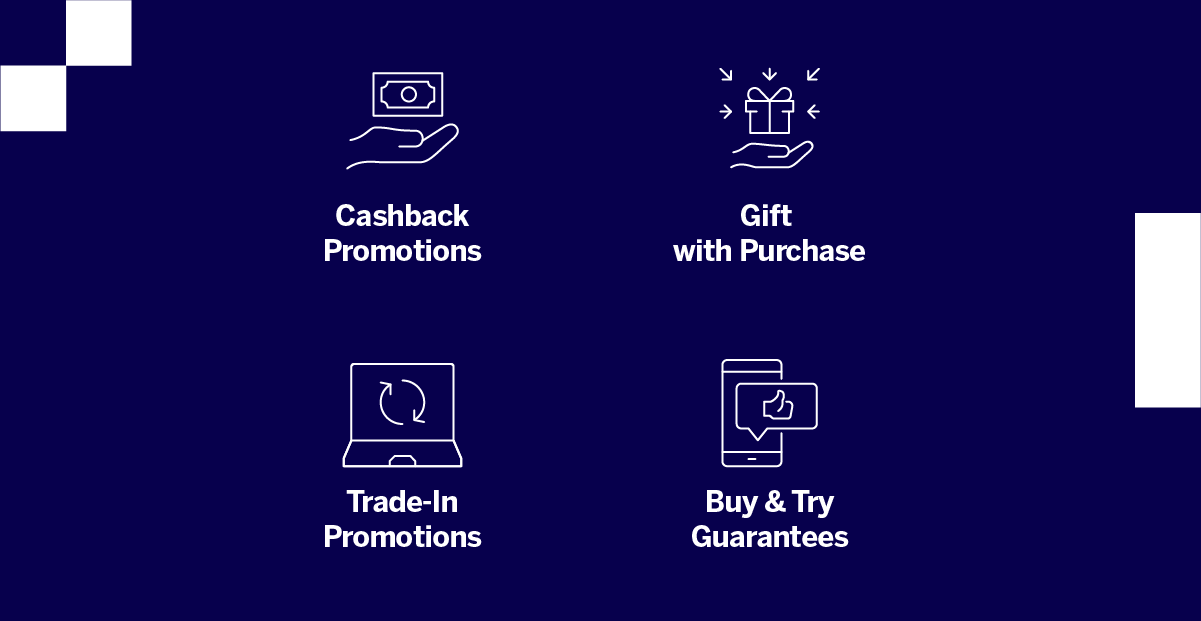
The Mechanics That Protect Shelf Price
The mechanics below share one defining feature: the customer pays the full shelf price at the register, and the promotional value is delivered separately. The price on the shelf, in the ad, and in the customer’s memory never changes.
Cashback promotions
The customer buys at full price and claims a cash reward after purchase. The advertised price is untouched, the value message is clear, and because the reward is claimed rather than automatic, your effective cost per unit is lower than the equivalent discount. Cashback promotions are the most direct substitute for a price cut and work well against a competitor launch, where the goal is to hold sell-through without resetting the price on a product with a long life ahead of it.
Gift with purchase
Instead of lowering the price, you add value on top of it. A streaming credit with a TV, professional installation with an appliance, a complimentary accessory with a device. The customer’s perception of the deal improves while the price point is reinforced rather than undermined.
This works particularly well at launch, when the goal is to build a compelling first impression around a new range rather than discount it before it has established itself.
See our full gift with purchase guide for how to choose the right gift.
Trade-in promotions
The customer pays full price for the new product and receives value for their old one through a separate process. This is the mechanic built specifically for the launch-cycle moment: it converts owners of the outgoing model into buyers of the new one, moves them off the product you need to clear, and does it without discounting either the old range or the new. Trade-in promotions also create a switching barrier competitors find hard to match once a customer has committed.
Buy and try guarantees
Purchase hesitation on premium products is often about risk, not price. A satisfaction guarantee removes the risk without touching the price, unlocking customers who would otherwise wait for reviews, try a competitor’s product, or defer the purchase. The shelf price holds, and the guarantee itself reinforces premium positioning: a brand confident enough to offer one is signalling quality, not desperation.

Promotional Guardrails Worth Setting
Whatever mix of mechanics you use, promotional discipline needs structure that survives beyond one campaign owner. These guardrails keep activity consistent across teams, product lines, and markets.
| Guardrail | What It Controls | Example Rule |
| Mechanic-first policy | Whether price reductions are ever the default response to a soft sell-through number | All promotional briefs must consider a value-added mechanic before a price reduction is approved |
| Depth limit | How far any approved price activity can go | Core range never promoted below a defined threshold of MSRP |
| Frequency limit | How often the same SKU can be promoted | No SKU promoted more than twice per quarter, never in consecutive months |
| Channel consistency | Whether promotional value differs across retail partners | Post-purchase rewards delivered brand-direct so every retailer sells at the same shelf price |
| Reward ceiling | The maximum value delivered per unit through any mechanic | Reward value capped at a set percentage of product margin, agreed with finance before launch |
The most important guardrail is the first one. Making value-added mechanics the default consideration, rather than the exception a category manager has to fight for, changes the promotional culture of the organisation over time and gives the next person in the seat something to point to when a discount request lands on their desk.
For a structured approach to planning campaigns within these rules, see our sales promotion planning guide.
Protecting Price Across Multiple Retail Channels
Shelf price protection gets harder as distribution gets wider, and for brands selling through big-box retail, pure-play e-commerce, and direct-to-consumer simultaneously, a single promotional mechanic rarely fits every channel cleanly.
Post-purchase mechanics resolve most of this structurally. Because the reward is delivered directly from the brand to the customer after purchase, every retail partner sells at the same shelf price. No partner is undercut, no price matching is triggered, and the promotional value flows through a channel the brand fully controls. This also means the brand, not the retailer, captures the first-party customer data the claim process generates, which matters when the retailer relationship itself is one you are trying to protect.
For brands operating in US club retail, where pricing compliance and sell-through velocity define success, we have covered this in detail in our guide to driving club channel success without discounting.
How Opia Can Help
Opia designs and manages shelf-price-safe promotions for some of the world’s leading consumer electronics and appliance brands, including Samsung, LG, Dell, and Lenovo. From cashback and trade-in programs to gift with purchase and satisfaction guarantees, we handle the full campaign end-to-end: strategy, redemption website, claim validation, fraud prevention, fulfillment, and reporting.
Our fixed-fee pricing model caps your promotional liability before the campaign launches, which means a value-added promotion can be budgeted with the same certainty finance expects from a discount, without any of the price erosion. Whether you are managing a launch, an end-of-line transition, or a competitor response, we can help you match the mechanic to the moment.
If you are planning promotional activity and want to protect your shelf price while still hitting your sell-through targets, get in touch with our team.
FAQs
What does it mean to protect shelf price?
Keeping your product’s advertised price stable while still running promotions, delivering value through other means instead of a price cut.
Why is protecting shelf price important?
It anchors how customers value your product. Every visible price cut lowers that reference point and trains customers to wait for the next one.
Do temporary price reductions protect shelf price?
Only partially. Shoppers still see the lower price and adjust their expectations, whether the cut is temporary or permanent.
What is the best promotion that does not affect shelf price?
Cashback is the most direct option. Gift with purchase, trade-in, and buy and try guarantees also protect shelf price fully.
Which mechanic should I use for a launch versus a clearance?
Use gift with purchase or trade-in for a launch. A controlled price cut is sometimes right for true end-of-line clearance.
How do post-purchase promotions avoid channel conflict?
The reward goes directly from brand to customer, so every retailer sells at the same shelf price.
How do I budget without knowing the redemption rate?
A fixed-fee model caps your cost per unit before launch, regardless of how many customers claim.